
Bach – Nun Komm der Heiden Heiland

Home » Organ Sheet Music » Bach – Nun Komm der Heiden Heiland

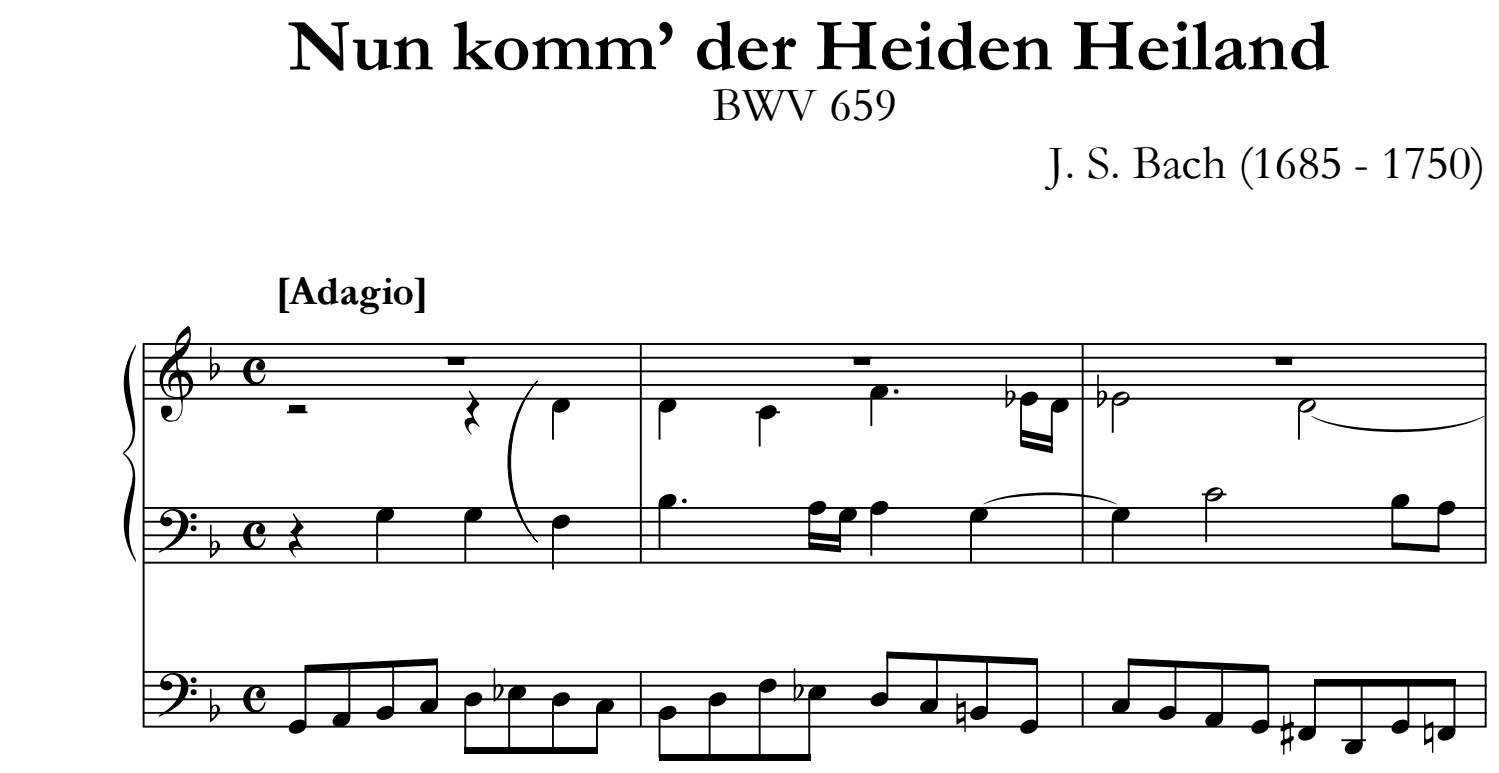
“Nun komm, der Heiden Heiland, BWV 659” is a chorale prelude composed by Johann Sebastian Bach. It is part of his larger collection of organ works, particularly those that involve chorale settings. The title translates to “Now come, Savior of the Gentiles” in English.

This chorale prelude is based on the hymn “Nun komm, der Heiden Heiland,” which is attributed to Martin Luther. The piece consists of a rich and elaborate setting of the chorale melody, showcasing Bach’s contrapuntal skills and harmonic inventiveness. The melody of the hymn is presented in a majestic and ornate manner, surrounded by intricate counterpoint and ornamentation.
PREVIEW

Christmas Sheet Music

“Gaudete” is a sacred Christmas carol that has its origins in Latin liturgical music. The word “Gaudete” means “Rejoice” in Latin, and the carol is often associated with the Advent season, which is the period of preparation and anticipation leading up to Christmas. While “Gaudete” may seem intimidating at first glance, it is accessible to pianists with a moderate to …

“Shepherds, Shake Off Your Drowsy Sleep” is a traditional Christmas carol. The song’s lyrics encourage shepherds to wake up and go to Bethlehem to witness the birth of Jesus. The carol reflects the Biblical account of the shepherds who were visited by angels and instructed to go and see the newborn Christ. Due to the technical demands and the need …

The lyrics for this carol were written by the English hymn writer Isaac Watts. Watts was known for his prolific hymn writing, and “Joy to the World” is one of his most famous compositions. This sheet music is arranged for the flute.

The “Coventry Carol” is a Christmas carol that dates back to the 16th century. It is part of a larger work known as the “Coventry Mystery Plays,” which were a series of dramatic presentations or pageants performed in Coventry, England, during the late Middle Ages. The carol is specifically associated with the “Pageant of the Shearmen and Tailors,” one of …

Composed as part of Handel’s renowned oratorio “Messiah,” this chorus erupts with triumphant joy, announcing the birth of Jesus Christ. The soaring soprano lines and rich choral harmonies paint a vivid picture of heavenly hosts proclaiming the good news. Handel’s “For unto us a child is born” is a timeless masterpiece, a cornerstone of the Christmas season and a powerful …

Also known as “See Amid the Winter’s Snow” is often sung in church services, caroling events, and Christmas concerts. Its gentle melody and lyrics capture the reverence and wonder of the Christmas story, making it a cherished carol during the holiday season.

“We Wish You a Merry Christmas” is a traditional English Christmas carol that dates back to the 16th century. Its cheerful melody and festive lyrics make it a popular choice during the holiday season. The song is in a lively 3/4 time signature, giving it a waltz-like feel, and is commonly arranged in the key of G major for beginners. …

Gounod’s “L’Angelus” captures the solemnity and reverence of the Angelus prayer through its expressive melodies and harmonies. The title is French for “The Angelus,” and the music aims to convey the spirit of this prayerful moment. “L’Angelus” is a vocal work that draws inspiration from the traditional Catholic devotion known as the Angelus, commemorating the Annunciation. The piece is typically …

“I Heard the Bells on Christmas Day” is a Christmas carol with lyrics written by the American poet Henry Wadsworth Longfellow. The poem was initially composed on December 25, 1863, during the American Civil War. Longfellow had experienced personal tragedy, with his son Charles severely wounded in the war, and he was deeply affected by the state of the nation. …

Johannes Brahms’s Eleven Chorale Preludes, Op. 122, stand as one of the final contributions to the composer’s extensive body of work. Composed in the last years of his life (1896), these chorale preludes exhibit a deep introspection and spiritual depth, reflecting Brahms’s mature style. Here is a list of the eleven chorale preludes included in Op. 122: Each of these …

“Ave Maria” in A major is part of his larger work, the “Six Duets for Two Voices and Organ,” Op. 10. This collection includes settings of various sacred texts, and the “Ave Maria” in A major is one of the pieces within this set. These duets were composed in 1858 and showcase Saint-Saëns’s mastery of choral writing and his ability …

Peter J. Wilhousky wrote the lyrics and music for “Carol of the Russian Children” in 1936. He is the same composer who adapted the Ukrainian folk chant “Shchedryk” (sometimes spelled “Shchedrik”) to create the English version of “Carol of the Bells.” The lyrics of “Carol of the Russian Children” celebrate the beauty of the Russian landscape, particularly the valleys and …

“O Holy Night” (French: “Cantique de Noël”) is a Christmas carol that was written in French by poet Placide Cappeau and set to music by composer Adolphe Adam. Cappeau wrote the lyrics in 1843, and Adam composed the music later the same year. The carol was first performed in Roquemaure, France, during a midnight Mass on Christmas Eve in 1847.. …

Pyotr Ilyich Tchaikovsky’s timeless ballet, “The Nutcracker,” is a masterpiece that has captivated audiences for generations. Among its enchanting compositions is the charming “Dance of the Mirlitons,” a delightful piece that translates beautifully onto the piano. The Dance of the Mirlitons, also known as the Reed Flutes, is a whimsical and lively dance that occurs in Act II of The …

“The Sussex Mummers’ Christmas Carol” lyrics often vary, as is common with many traditional folk carols, but the general narrative involves Mary asking Joseph to pick cherries from a tree to satisfy her cravings. Joseph reacts with surprise, expressing doubt about the child’s parentage. In the carol, the angel Gabriel appears to Joseph, explaining the divine nature of Mary’s pregnancy. …