
Twinkle Twinkle Little Star

Home » Violin Sheet Music » Easy Violin Sheet Music » Twinkle Twinkle Little Star

The melody for “Twinkle, Twinkle, Little Star” is also the same as that of the French nursery rhyme “Ah! vous dirai-je, maman” and Wolfgang Amadeus Mozart famously used this melody for his variations for piano, K. 265/300e. The simple and repetitive nature of the rhyme makes it a favorite for young children and is often one of the first songs they learn to sing. This one is the arrangement for easy violin beginner sheet music.
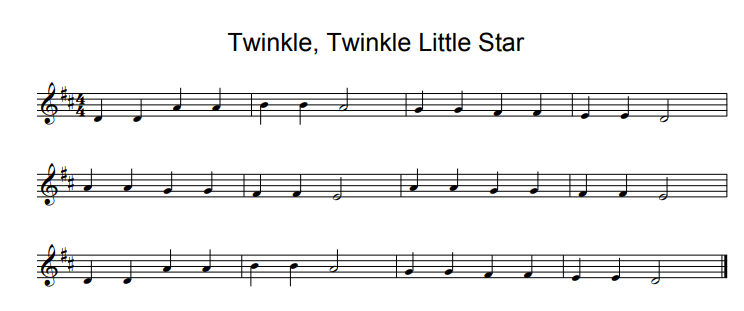
PREVIEW

Free Violin Sheet Music

Mozart’s Symphony No. 39 in E-flat major, K. 543, is a vibrant tapestry of sunshine and shadows, composed in a burst of inspiration during the summer of 1788. It stands out amongst Mozart’s symphonies for its warmth and optimism, even as it flirts with moments of drama and introspection. Unlike many symphonies of the era, it opens with a slow, …

Tchaikovsky‘s String Quartet No. 1 in D major, Op. 11, is a cornerstone of chamber music repertoire, and for violinists, wielding the melody within its movements is a privilege like no other. Composed in 1871, the quartet bursts with Tchaikovsky’s signature passion, lyricism, and emotional depth, offering a violinist a canvas to paint a tapestry of sound. Tchaikovsky’s gift for …

Rossini‘s effervescent overture to La gazza ladra (The Thieving Magpie) is a cornerstone of the violin repertoire, a whirlwind of virtuosity and charm that has captivated audiences for over two centuries. Grabbing your violin and diving into this iconic piece is an exhilarating experience, demanding both technical precision and a playful spirit. For violinists, La gazza ladra presents a delightful …

Clara Schumann composed her Piano Concerto in A minor, Op. 7, in 1835 when she was just 15 years old. This concerto is one of her early compositions and demonstrates her prodigious talent as both a pianist and a composer. Intermediate and early advanced violinists may find certain sections of the concerto approachable, but capturing the full essence of Clara …

Composed in the 19th century, this piece showcases Wieniawski’s brilliance as a violinist and composer. Wieniawski’s Fantaisie Brillante is based on themes from Charles Gounod’s opera “Faust.” It was a common practice in the Romantic era for composers to create virtuosic works based on popular operatic themes. The piece weaves together various themes from “Faust,” allowing the violinist to explore …

Composed around 1764-1765, Symphony No. 22 is part of Haydn’s earlier works. It belongs to a set of symphonies written during his employment under Prince Nikolaus Esterházy. While the origin of the nickname “The Philosopher” is uncertain, it could be attributed to the work’s intellectual depth and the reflective nature of its movements. This symphony, with its intellectual depth and …

The Prelude serves as an introduction to “Tristan und Isolde,” setting the stage for the opera’s dramatic love story. It leads directly into the first act, where the story unfolds. Due to its beauty and significance, the Prelude is often performed in concert settings as a standalone piece. It has become one of the most iconic and frequently performed orchestral …

“Tristan and Isolde” opera is known for its seamless and continuous music, with few traditional arias or recitatives. Wagner’s approach creates a sense of timelessness and intensity. The score features lush orchestration and Wagner’s skillful use of leitmotifs (recurring musical themes associated with characters, emotions, or ideas). Certain parts of “Tristan und Isolde,” including the Prelude and the Liebestod, are …

Schumann’s Symphony No. 4, Op. 120, is a splendid example of Schumann’s romantic symphonic style. Its history of revisions and its rich, emotional content make it an intriguing piece for both performers and listeners. The first movement opens with a rich and expressive melody, demonstrating Schumann’s melodic prowess. The Romanza is lyrical and introspective, providing a stark contrast to the …

Grieg’s music is celebrated for its ability to capture the essence of Norwegian folk culture while maintaining a universal appeal. His contributions to classical music have left an indelible mark, making him a source of national pride in Norway. Edvard Grieg’s “Peer Gynt Suite No. 1, Op. 46” suite is a renowned and iconic piece in the classical music repertoire. …

The name “Air on the G String” is a later addition, and it refers to the fact that the melody is played on the G string of the violin, giving it a soft and gentle quality. The piece is known for its serene and elegant melody, making it a popular choice for weddings and other special occasions. It is actually …

The “Song of India,” also known as the “Song of the Hindu,” is an excerpt from the opera “Sadko” composed by Nikolai Rimsky-Korsakov. “Sadko” is a Russian opera that premiered in 1898 and is based on a Russian epic fairy tale. The “Song of India” is one of the most famous and recognizable pieces from this opera. The “Song of …

Henryk Wieniawski’s Violin Concerto No. 2 in D minor, Op. 22, is one of the most celebrated and frequently performed violin concertos in the Romantic repertoire. The concerto is dedicated to the famous Spanish violinist Pablo de Sarasate, who was a close friend of Wieniawski. As with many of Wieniawski’s compositions, the Second Violin Concerto is noted for its virtuosic …

Schubert’s Symphony No. 5 in B-flat major, D.485, is a symphony bathed in youthful exuberance and Mozartian influence. Composed in 1816 at the tender age of 20, it’s a testament to Schubert’s innate musicality and a delightful gem for violinists to explore. Whether you’re a seasoned concertmaster or a passionate amateur, delving into the violin part of this symphony is …

Composed in 1829 as part of Rossini’s opera “William Tell,” the overture is divided into four distinct sections: the pastoral introduction featuring the famous solo for English horn, the stormy Allegro section, the calm and lyrical Andante, and the finale, which is marked by its galloping pace and heroic themes. Adapting this symphonic work for the violin requires not only …