
Strauss – Also Sprach Zarathustra

Home » Flute Sheet Music » Strauss – Also Sprach Zarathustra

Strauss’s orchestration in “Also sprach Zarathustra” is rich and colorful. He uses a large orchestra, including brass, strings, woodwinds, and percussion, to create a grand and powerful sound that matches the philosophical themes.

The piece has become a symbol of Strauss’s late-Romantic style and is a classic example of programmatic music, where the music tells a story or conveys non-musical ideas. The opening fanfare, in particular, is often used to signify important and grandiose moments in popular culture.

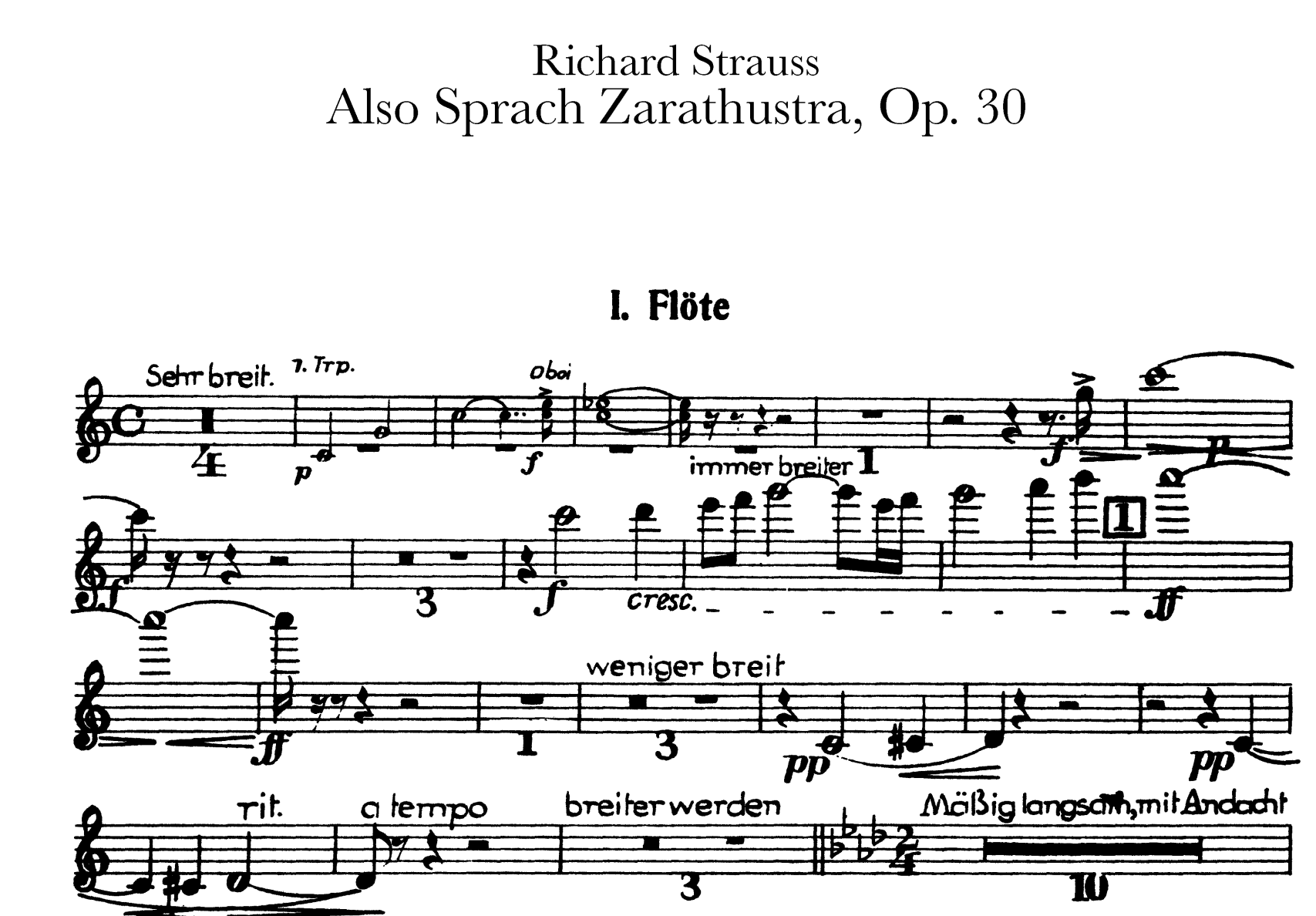
  • Range: The piece demands a wide range from the flute, venturing into the instrument’s upper register, which can be notoriously challenging to control.
  • Dynamics: The music requires a vast dynamic range, from delicate whispers to soaring pronouncements, which the flute can achieve but requires careful breath control and articulation.
  • Orchestral Texture: Translating the orchestral textures of the piece to a single instrument is a creative endeavor. The flutist must find ways to suggest the richness and complexity of the original through dynamics, articulation, and even multiphonics (playing multiple notes simultaneously).
PREVIEW

Free Flute Sheet Music

Nikolai Rimsky-Korsakov’s “The Flight of the Bumblebee” for flute is a popular and iconic piece in the classical music repertoire. This composition, originally from his opera “The Tale of Tsar Saltan,” has become widely recognized for its virtuosic and rapid flute passages. It’s a thrilling and challenging work that many flutists aspire to master. Playing the “Flight of the Bumblebee” …

“Boléro” is arguably Maurice Ravel’s most famous and distinctive composition, showcasing his unique approach to orchestration and rhythm. “Boléro” is renowned for its relentless and hypnotic rhythm. The entire piece is built on a single, repeated melody that grows in intensity and orchestration as it unfolds. Ravel’s masterful orchestration is a highlight. The piece begins with a snare drum solo, …

Sarasate’s Navarra, Op. 33 – a vibrant tapestry of Spanish passion, originally woven for the fiery voice of the violin. But what happens when this epic saga is entrusted to the gentle whispers of the flute? Playing Navarra on the flute is more than just a technical feat; it’s a daring act of reinvention, a chance to paint Spanish landscapes …

Mozart’s iconic Magic Flute Queen of the Night aria, “Der Hölle Rache kocht in meinem Herzen” (Hell’s vengeance boils in my heart), is a volcanic eruption of operatic drama, typically reserved for the soaring power of sopranos. But what if this fiery aria soared not from the stage, but from the delicate whispers of the flute? Imagine, instead of a …

The Flute Concerto in D Minor, H. 484.1, Wq 22, is one of C.P.E. Bach’s contributions to the concerto genre. It’s recognized as a significant piece in his catalogue. C.P.E. Bach’s concerto is characterized by its expressiveness, emotional depth, and the use of the sensitive style (Empfindsamkeit) that he championed. It features lyrical and virtuosic passages for the flute, as …

Pachelbel’s Canon in D, usually reserved for the dignified tones of the organ or the soaring richness of strings, can whisper its magic through the delicate breath of the flute. Simplified arrangements strip away the complexity, revealing the melody’s pure essence, inviting even beginner flautists to join its timeless dance. Imagine the first notes emerging like a gentle breeze through …

The Magic Flute, K.620, by Wolfgang Amadeus Mozart, is a two-act Singspiel (a German opera with spoken dialogue) filled with fantastical elements, Masonic symbolism, and captivating music. The story interweaves themes of love, forgiveness, enlightenment, and the battle between good and evil. The orchestration is masterful, featuring woodwinds, strings, horns, and timpani to create dramatic tension and emotional depth. Flute sheet music.

Dvorak’s Symphony No. 9 in E minor, commonly known as the “New World Symphony,” is a beloved work in the classical music repertoire. He composed his Symphony No. 9 in 1893 during his time as the director of the National Conservatory of Music in America. This symphony is often seen as a fusion of European classical tradition and American folk …

Chopin’s Nocturne Op.9 No.2 is a moonlit masterpiece, its delicate melodies and introspective moods woven for the piano’s expressive embrace. But what if this nocturnal serenade found a new voice, a whisper instead of a sigh, a dance of moonlight on silver instead of ivory keys? What if Chopin’s nocturne took flight on the flute? Playing the Nocturne on flute …

“Rain, Rain, Go Away” is a traditional nursery rhyme and children’s song that is often sung when it’s raining and children wish for the rain to stop so they can play outside. This nursery rhyme is simple and cheerful, and it is often used to pass the time on rainy days or to encourage the sun to come out so …

The “Peer Gynt” incidental music, which includes the Suite No. 1 and Suite No. 2, is arguably Grieg’s most famous work. Peer Gynt Suite No. 1, Op. 46″ is a prime example of Grieg’s ability to create vivid and evocative musical images. It’s also a testament to his skill in using folk melodies and rhythms to create compositions with a …

The melody for “Twinkle, Twinkle, Little Star” is also the same as that of the French nursery rhyme “Ah! vous dirai-je, maman” and Wolfgang Amadeus Mozart famously used this melody for his variations for piano, K. 265/300e. The simple and repetitive nature of the rhyme makes it a favorite for young children and is often one of the first songs …

“Peter and the Wolf” was composed in 1936 and has since become a classic introduction to orchestral music for young audiences. The piece tells the story of a young boy named Peter and his adventures in the meadow, where he encounters various animals, each represented by a specific instrument or group of instruments. The narrative is typically accompanied by an …

Flute Concerto in D minor, RV 439, Op. 10, No. 2, “La Notte” (The Night), it is part of a set of six concertos known as “Il cimento dell’armonia e dell’inventione” (The Contest Between Harmony and Invention), which were published in 1725. “La Notte” is scored for solo flute (or recorder), strings, and continuo. It is notable for its colorful …

“Peer Gynt Suite No. 2” consists of four movements, each of which captures a distinct aspect of the narrative: