
Angels We Have Heard on High

Home » Cello Sheet Music » Angels We Have Heard on High

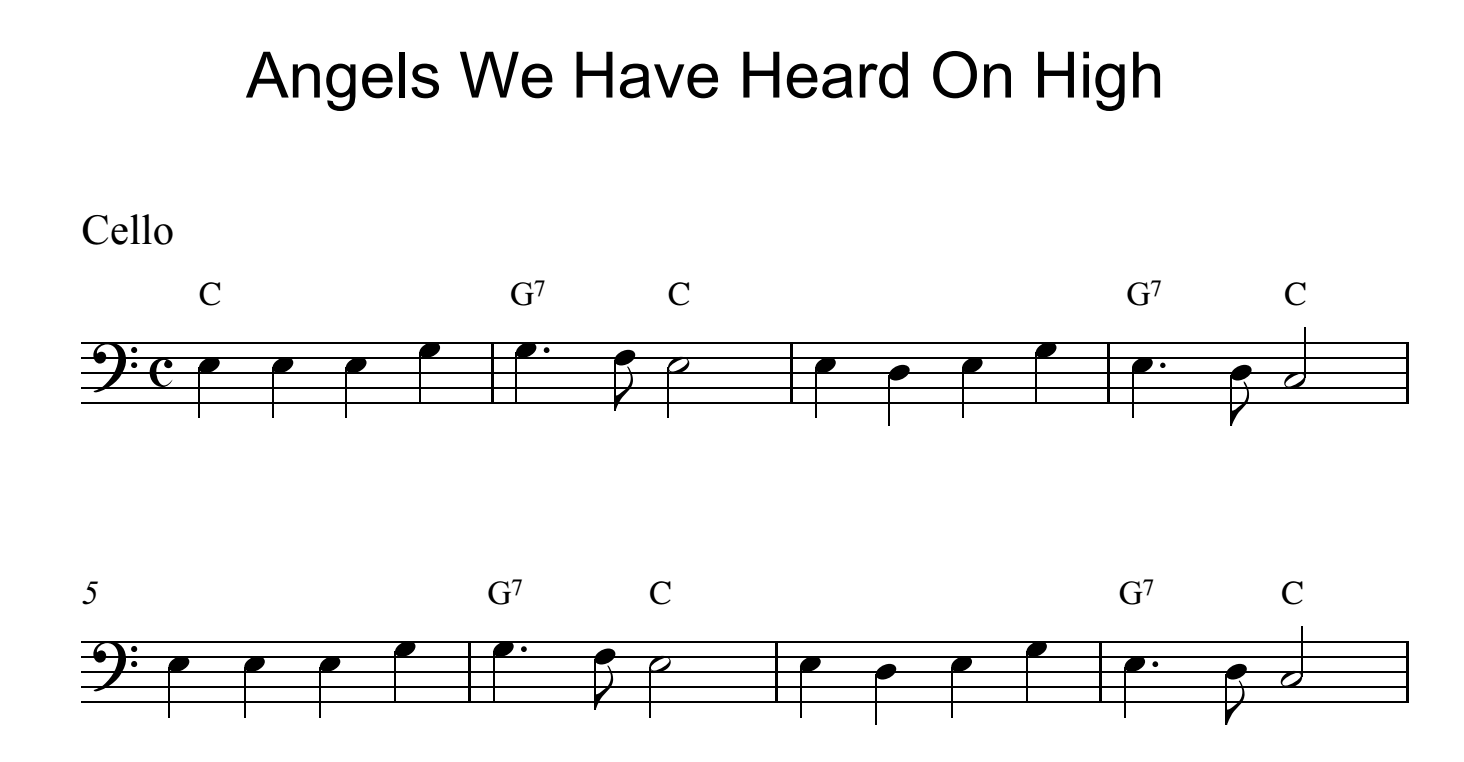
“Angels We Have Heard on High” is a traditional Christmas carol, originating from France. The song is best known for its “Gloria in excelsis Deo” refrain, which reflects the biblical story of angels proclaiming the birth of Jesus to shepherds. The melody, known as “Gloria”, is believed to have been written in the 18th century, while the English lyrics were translated by James Chadwick in 1862.

The melody features flowing legato lines, particularly in the refrain (“Gloria”). To capture the smoothness and sustained notes, focus on steady bow control, using long and smooth bow strokes. Practice with slow, controlled movements to ensure clean transitions between notes. Keep the tempo lively but controlled. While the carol has an upbeat feel, make sure you don’t rush through sections, especially if you are playing with other instruments or an accompaniment. A moderate tempo will allow for a more graceful performance.
PREVIEW

Christmas Sheet Music

“Jingle Bells” is one of the most well-known and beloved Christmas songs worldwide. It was written by James Lord Pierpont and published under the title “One Horse Open Sleigh” in 1857.

Hector Berlioz’s “L’Enfance du Christ” (The Childhood of Christ) is an oratorio composed between 1853 and 1854. The work is divided into three parts and tells the story of the Holy Family’s journey to Egypt to escape the massacre of infants ordered by King Herod. The oratorio consists of the following parts: The skill level required to play Berlioz’s “L’Enfance …

“Cathedral Windows” Op. 106, composed in 1914, showcases Karg-Elert’s innovative approach to harmonies, textures, and registrations. “Cathedral Windows” is a set of six pieces, each named after a specific stained glass window in a cathedral. Karg-Elert employs rich harmonies, intricate counterpoint, and expressive melodic lines to evoke the majestic and contemplative atmosphere of these imagined windows. The movements are titled: …

The Christmas Oratorio (Weihnachtsoratorium), BWV 248, is a magnificent choral work composed by Johann Sebastian Bach. Completed in 1734, it is a set of six cantatas intended for performance during the Christmas season. Each cantata corresponds to a specific feast day within the Christmas period. Here’s an overview of the structure and themes of Bach’s Christmas Oratorio.

“O Little Town of Bethlehem” is a well-known Christmas carol with lyrics written by Phillips Brooks and music composed by Lewis Redner. The song was first performed in 1868 and has become a classic in the Christmas music repertoire. It paints a peaceful and reverent picture of the town of Bethlehem on the night of Jesus’ birth. The original version …

“Angels We Have Heard on High” is a traditional Christmas carol with French origins. The English lyrics were written by James Chadwick, an English Roman Catholic bishop, in the mid-19th century. The music for “Angels We Have Heard on High” is based on the traditional French melody of “Gloria in excelsis Deo,” which means “Glory to God in the Highest.” …

“O Come, O Come, Emmanuel” is a well-known Christmas carol with its origins in medieval Latin hymns. It is a hymn of anticipation, longing for the coming of the Messiah. The lyrics are based on a set of seven Advent antiphons, each addressing a different name or attribute of Christ and used in the seven days leading up to Christmas. …

“The First Nowell,” also spelled as “The First Noel,” is a traditional English Christmas carol. The word “Noel” is an old English word derived from the French “Noël,” which means Christmas. The carol dates back to the 18th century or earlier, and it tells the story of the nativity of Jesus Christ.

This masterpiece, also known as “Concerto Grosso in G minor, Op. 6, No. 8,” holds a special place in the repertoire of Baroque music. Composed by Arcangelo Corelli around 1690, this concerto is part of his renowned set of twelve concerti grossi. Corelli’s Christmas Concerto has remained a popular choice for holiday performances, admired for its exuberance and the timeless …

Johannes Brahms’s Eleven Chorale Preludes, Op. 122, stand as one of the final contributions to the composer’s extensive body of work. Composed in the last years of his life (1896), these chorale preludes exhibit a deep introspection and spiritual depth, reflecting Brahms’s mature style. Here is a list of the eleven chorale preludes included in Op. 122: Each of these …

The Coventry Carol is a traditional English Christmas carol dating back to the 16th century. It was originally part of a mystery play called The Pageant of the Shearmen and Tailors, which depicted the biblical story of the Massacre of the Innocents, where King Herod ordered the killing of male infants. The carol is a haunting lullaby sung by mothers …

The melody of “O Come, All Ye Faithful” is lyrical and flowing, which suits the cello’s natural singing tone. Focus on making each phrase sound vocal, as though you are singing through the instrument. Start gently and build towards the climactic phrase “O come, let us adore Him.” Use controlled crescendos to bring warmth and richness to the tune, especially …

“It Came Upon the Midnight Clear” is a popular Christmas carol with lyrics written by Edmund Sears and music composed by Richard Storrs Willis. The carol was first published in 1850. The tune composed by Richard Storrs Willis is a beautiful and peaceful melody, often sung during the Christmas season to celebrate the birth of Jesus Christ and to convey …

Bach’s Christmas Oratorio is a monumental work composed for the Christmas season, celebrating the birth of Christ through vibrant choruses, arias, and recitatives. It is written for a full choir, soloists, and orchestra, with text from the Gospels of Luke and Matthew, and draws on both sacred and secular themes. The six parts of the oratorio each have their own …

“Christmas Is Coming” is a traditional Christmas song that is often associated with the holiday season. It is not a well-known or widely recognized Christmas song with a distinct origin. It may be a lesser-known or regional carol, and there isn’t significant historical or cultural information available about it. However it is commonly sung as part of the Christmas carol …