
Bach – Wachet auf ruft uns die Stimme

Home » Organ Sheet Music » Bach – Wachet auf ruft uns die Stimme

“Wachet auf, ruft uns die Stimme” BWV 645 is part of Bach’s Orgelbüchlein (Little Organ Book), which is a collection of chorale preludes for the organ. This particular chorale prelude is based on the hymn of the same name by Philipp Nicolai. The hymn itself is associated with the Advent season and is often used in church services.

The piece is known for its expressive and contemplative character, and it has been appreciated for its intricate counterpoint and harmonic richness. It’s a beautiful example of Bach’s skill in adapting and expanding upon existing hymn melodies in his compositions for the organ.
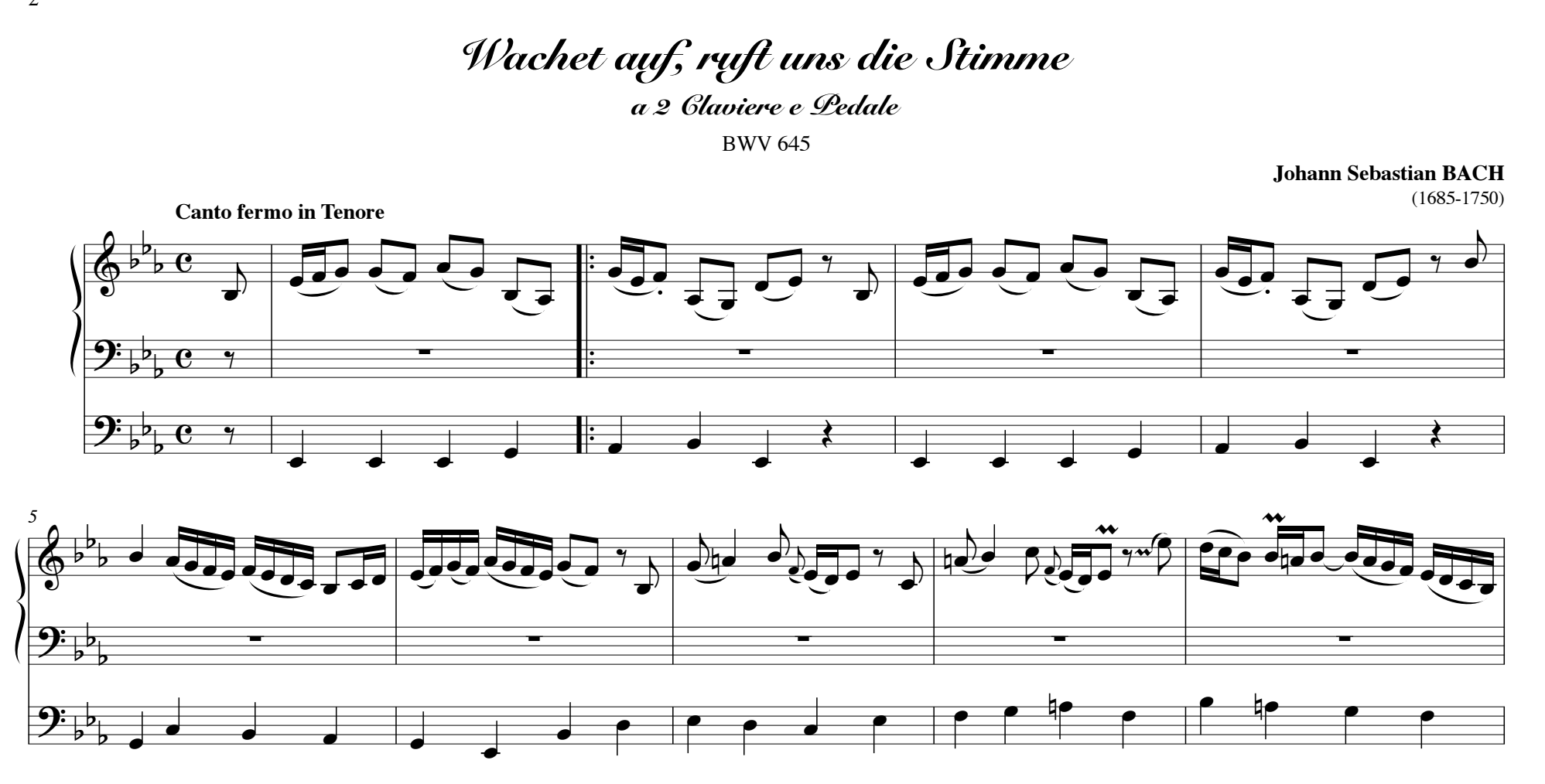
PREVIEW

Christmas Sheet Music

The lyrics for this carol were written by the English hymn writer Isaac Watts. Watts was known for his prolific hymn writing, and “Joy to the World” is one of his most famous compositions. This sheet music is arranged for the flute.

As the holiday season approaches, nothing captures the spirit of Christmas quite like music. Whether you’re a seasoned pianist or just starting to tickle the ivories, there’s something magical about playing beloved Christmas tunes. If you’re on the hunt for the perfect piano sheet music to add to your repertoire, look no further than “Have Yourself a Merry Little Christmas.” …

The Ave Maria is a traditional Catholic prayer that is a tribute to the Virgin Mary. It’s based on the Annunciation, where the angel Gabriel announced to Mary that she would conceive and give birth to Jesus. There have been various musical compositions set to the words of the Ave Maria, with one of the most famous being composed by …

Pyotr Ilyich Tchaikovsky’s “Waltz of the Snowflakes” is a mesmerizing piece of classical music that captures the enchantment and beauty of winter. Originally composed for the ballet “The Nutcracker,” this waltz has become a timeless favorite, evoking images of swirling snowflakes dancing in a winter wonderland. The “Waltz of the Snowflakes” is part of the second act of “The Nutcracker” …

“The Sussex Mummers’ Christmas Carol” lyrics often vary, as is common with many traditional folk carols, but the general narrative involves Mary asking Joseph to pick cherries from a tree to satisfy her cravings. Joseph reacts with surprise, expressing doubt about the child’s parentage. In the carol, the angel Gabriel appears to Joseph, explaining the divine nature of Mary’s pregnancy. …

“Hark! The Herald Angels Sing” is a popular Christmas carol with lyrics written by Charles Wesley in 1739. The music for the carol was composed by Felix Mendelssohn in 1840. The carol is traditionally sung to celebrate the birth of Jesus Christ and is a staple in Christmas celebrations and church services. The carol goes on to tell the story …

“All My Heart This Night Rejoices” is a traditional German Christmas carol that originated in the 17th century. The lyrics were written by Paul Gerhardt, and the melody is attributed to Johann Georg Ebeling. The hymn beautifully captures the joy and wonder of the Christmas season, expressing gratitude for the birth of Jesus Christ. The hymn’s expressive nature invites pianists …

Schubert’s “Ave Maria” is a poignant and reverent piece that has been embraced for its emotional depth and melodic richness. It has been widely used in religious ceremonies, including weddings and other solemn occasions. The lyrics are based on a German translation of Sir Walter Scott’s poem “The Lady of the Lake.”

“Ave Maria” in A major is part of his larger work, the “Six Duets for Two Voices and Organ,” Op. 10. This collection includes settings of various sacred texts, and the “Ave Maria” in A major is one of the pieces within this set. These duets were composed in 1858 and showcase Saint-Saëns’s mastery of choral writing and his ability …

This masterpiece, also known as “Concerto Grosso in G minor, Op. 6, No. 8,” holds a special place in the repertoire of Baroque music. Composed by Arcangelo Corelli around 1690, this concerto is part of his renowned set of twelve concerti grossi. Corelli’s Christmas Concerto has remained a popular choice for holiday performances, admired for its exuberance and the timeless …

“Jesus Christ the Apple Tree” is a popular English hymn that dates back to the 18th century. The lyrics of this hymn are often attributed to an unknown author. It is sometimes referred to as “The Apple-Tree Song” or simply “The Apple Tree.” The hymn uses the metaphor of an apple tree to represent Jesus Christ, drawing parallels between the …

“Away in a Manger” is a traditional Christmas carol, often associated with nativity celebrations. Its origins are somewhat disputed, with the first two verses historically attributed to Martin Luther, though this claim is debated. The melody, most commonly associated with this carol, comes in two popular versions: one by William J. Kirkpatrick (1887) and another by James R. Murray (1885). …

This piece is a setting of the Gloria text, a part of the Ordinary of the Roman Catholic Mass. It is a relatively concise work compared to some of Bach’s other choral compositions. The text “Gloria in excelsis Deo” is Latin for “Glory to God in the highest,” and it is a hymn of praise to the Holy Trinity. Arranged …

Franz Liszt, the Hungarian composer and virtuoso pianist of the Romantic era, left an indelible mark on the world of classical music with his innovative compositions. One such gem that often goes overlooked in his extensive repertoire is “In Hungarian Style,” a delightful piece from his collection “The Christmas Tree.” This composition, rich in Hungarian folk influences, is a perfect …

Also known as “See Amid the Winter’s Snow” is a traditional Christmas carol with lyrics written by Edward Caswall and music composed by Sir John Goss. It was first published in 1854. This carol is known for its serene and reflective lyrics that tell the story of the birth of Jesus Christ and the adoration of the shepherds and angels. …