
Good King Wenceslas

Home » Piano Sheet Music » Good King Wenceslas

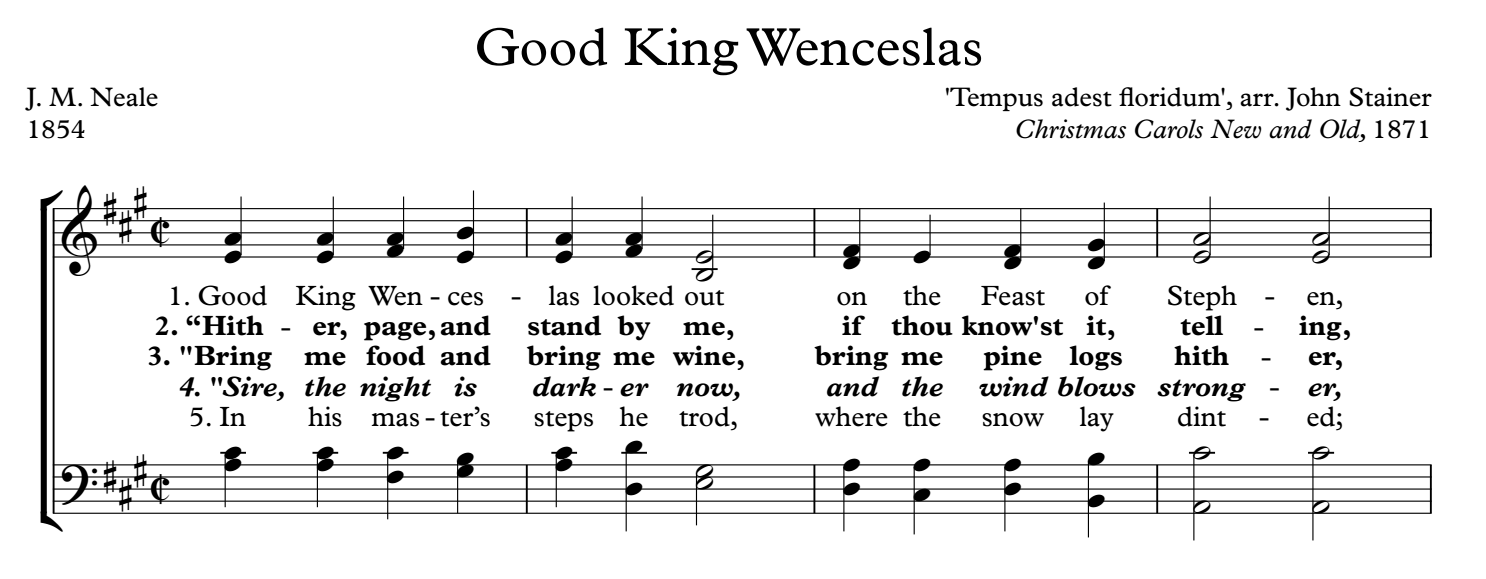
“Good King Wenceslas” is a Christmas carol that tells the story of a generous and kind-hearted Bohemian king who braved harsh winter weather to provide charity to a poor peasant. The lyrics, penned by John Mason Neale in the 19th century, are set to the melody of a 13th-century spring carol called “Tempus adest floridum.” The combination of the heartwarming tale and the uplifting melody has made Good King Wenceslas a cherished part of holiday celebrations worldwide.

This festive carol is well-suited for the piano, allowing pianists to showcase their skills while spreading holiday cheer. The piece typically features a moderate tempo and a straightforward time signature, making it accessible to a wide range of pianists. The arrangement often includes a mix of chords, arpeggios, and melodic lines that provide both challenge and enjoyment for players.
PREVIEW

Christmas Sheet Music

“Santa Claus Is Comin’ to Town” is a popular Christmas song written by J. Fred Coots and Haven Gillespie. It was first introduced in 1934 when it was performed on the Eddie Cantor radio show and has since become a classic holiday tune. The song conveys the anticipation and excitement of Santa Claus’s arrival on Christmas Eve and encourages children …

“Good King Wenceslas” is a Christmas carol that tells the story of a generous and kind-hearted Bohemian king who braved harsh winter weather to provide charity to a poor peasant. The lyrics, penned by John Mason Neale in the 19th century, are set to the melody of a 13th-century spring carol called “Tempus adest floridum.” The combination of the heartwarming …

Holst composed the music for this carol in 1906 as part of his collection of choral settings titled “Two Carols,” which also included “A Christmas Carol.” Holst’s musical setting of “In the Bleak Midwinter” has become one of the most well-known and beloved renditions of the carol, and it is often performed during the Christmas season.

“December: Christmas” is the twelfth and final piece in Pyotr Ilyich Tchaikovsky’s collection “The Seasons.” This piece is a musical representation of the Christmas holiday, capturing the festive and joyous atmosphere associated with this time of the year. Tchaikovsky incorporates traditional Christmas themes into the composition, creating a musical portrayal of the joy, warmth, and camaraderie associated with Christmas celebrations.

Composed as part of Handel’s renowned oratorio “Messiah,” this chorus erupts with triumphant joy, announcing the birth of Jesus Christ. The soaring soprano lines and rich choral harmonies paint a vivid picture of heavenly hosts proclaiming the good news. Handel’s “For unto us a child is born” is a timeless masterpiece, a cornerstone of the Christmas season and a powerful …

Bach’s Christmas Oratorio is a monumental work composed for the Christmas season, celebrating the birth of Christ through vibrant choruses, arias, and recitatives. It is written for a full choir, soloists, and orchestra, with text from the Gospels of Luke and Matthew, and draws on both sacred and secular themes. The six parts of the oratorio each have their own …

The origins of “Away in a Manger” are somewhat disputed, and it’s often attributed to various sources. One popular version of the carol suggests that it was written by Martin Luther, the 16th-century German theologian, though historical evidence for this claim is limited. The most widely accepted attribution is to an American hymn writer named James R. Murray, who published …

“Wachet auf, ruft uns die Stimme” BWV 645 is part of Bach’s Orgelbüchlein (Little Organ Book), which is a collection of chorale preludes for the organ. This particular chorale prelude is based on the hymn of the same name by Philipp Nicolai. The hymn itself is associated with the Advent season and is often used in church services. The piece …

The hymn “While Shepherds Watched Their Flocks” is a classic Christmas carol with a rich history. It is commonly sung to the tune “Winchester Old,” and the lyrics are attributed to Irish hymnist Nahum Tate. The carol is based on the account of the shepherds receiving the angelic announcement of the birth of Jesus from the Gospel of Luke in …

The lyrics for “Hark! The Herald Angels Sing” were written by Charles Wesley, an English hymn writer, and brother of John Wesley, the founder of Methodism. The original text, which was titled “Hymn for Christmas Day,” was written in 1739. The music for the carol was composed by Felix Mendelssohn, a German composer, in 1840. Mendelssohn originally composed the music …

“In Dulci Jubilo,” which translates to “In Sweet Rejoicing,” is a traditional German carol that dates back to the 14th century. Its jubilant melody and lively rhythm make it a perfect choice for violinists seeking to showcase their skills while spreading holiday cheer. The piece is characterized by its dance-like quality, combining elements of medieval and Renaissance music with a …

“O Come, All Ye Faithful” is a popular Christmas carol with lyrics attributed to John Francis Wade, and it is often sung to the tune known as “Adeste Fideles.” The carol is also sometimes referred to by its Latin incipit, “Adeste Fideles.” The melody of “O Come, All Ye Faithful” is relatively straightforward, making it accessible to a broad range …

This carol is a traditional French Christmas carol that tells the story of the birth of Jesus. The carol is in a simple strophic form, with each verse sung to the same melody. The melody is joyful and uplifting, and it is often sung in a bright, bouncy tempo. The text of the carol is full of religious imagery, and …

“The Christmas Tree” (Elka in Russian), Op. 21 is a suite of piano pieces that depict scenes related to a Christmas tree and its decorations. The suite is often performed as a set of miniatures, each capturing a different aspect of the holiday season. It is considered one of Rebikov’s most well-known and charming works. The “Christmas Tree Waltz” is …

“O Little Town of Bethlehem” is a well-known Christmas carol with lyrics written by Phillips Brooks and music composed by Lewis Redner. The song was first performed in 1868 and has become a classic in the Christmas music repertoire. It paints a peaceful and reverent picture of the town of Bethlehem on the night of Jesus’ birth. The original version …