
Mozart – Piano Concerto No.20 K.466

Home » Piano Sheet Music » Mozart – Piano Concerto No.20 K.466

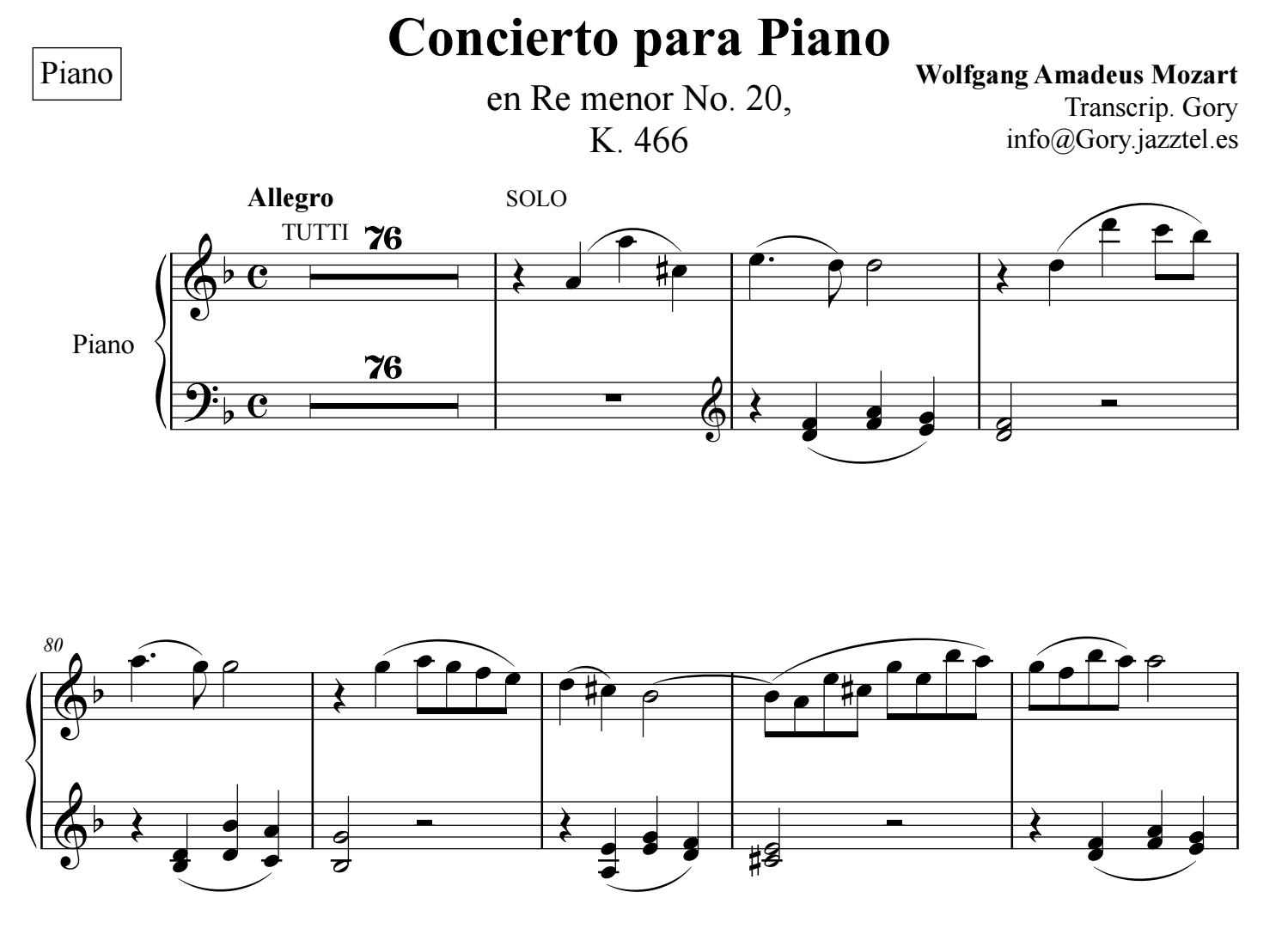
Wolfgang Amadeus Mozart, a musical genius of the Classical era, left an indelible mark on the world with his remarkable compositions. Among his vast body of work, the Piano Concerto No. 20 in D Minor, K. 466 stands out as a masterpiece that continues to captivate audiences with its depth and emotion.

Composed in 1785, this concerto is a testament to Mozart’s compositional prowess. The piece opens with a dramatic and brooding theme, setting the tone for the entire work. Throughout the concerto, Mozart weaves a melodic tapestry that seamlessly blends the solo piano with the orchestral accompaniment. The second movement, marked by its lyrical beauty, contrasts with the fiery and passionate character of the first and third movements.

This concerto is generally considered to be of an advanced difficulty level. Pianists tackling K. 466 should possess a solid command of technique, including finger dexterity, agility, and control. The ability to convey the subtleties of Mozart’s phrasing and dynamics is equally essential. Aspiring performers should have experience with other challenging classical compositions before attempting this concerto.
PREVIEW

Free Violin Sheet Music

Haydn’s Symphony No. 94 in G major, “Surprise Symphony” gained its nickname from the unexpected loud chord that appears in the second movement after a soft, lyrical theme. The sudden fortissimo chord, or “surprise,” was added by Haydn to wake up the audience, as it was customary during the performances for the audience to become a bit too relaxed. This …

George Frideric Handel composed a set of six violin sonatas, commonly referred to as “Sonatas for Violin and Continuo” or “Violin Sonatas, Op. 1.” Violin Sonata No. 4 in D major, HWV 371, is one of these delightful compositions.

Prokofiev’s “Romeo and Juliet” Op.64 specifically the movement titled “The Montagues and the Capulets” also known as “Dance of the Knights,” is a powerful and dramatic piece that captures the tension and conflict between the two feuding families in Shakespeare’s play. The violin part in this piece contributes significantly to the overall drama, intensity, and emotional impact of the composition. …

The melody for “Twinkle, Twinkle, Little Star” is also the same as that of the French nursery rhyme “Ah! vous dirai-je, maman” and Wolfgang Amadeus Mozart famously used this melody for his variations for piano, K. 265/300e. The simple and repetitive nature of the rhyme makes it a favorite for young children and is often one of the first songs …

The Polovtsian Dances from Borodin’s opera “Prince Igor” are a whirlwind of vibrant colors, pulsating rhythms, and unbridled energy. But within this orchestral tapestry, the violin emerges as a captivating soloist, weaving its own story of passion, defiance, and ultimately, triumphant liberation. The violin’s journey begins with a gentle introduction, its melody like a whispered secret shared between lovers under …

“The Blue Danube” is perhaps one of the most recognizable and celebrated waltzes in the world. It has become a symbol of Vienna and its New Year’s Concerts. The piece is known for its flowing and graceful melodies, which evoke the majestic beauty of the Danube River and the romantic charm of Vienna. The opening bars of “The Blue Danube” …

Brahms began composing his Piano Concerto No. 2 in 1878 and completed it in 1881. It premiered in Budapest in 1881, with Brahms himself as the soloist. This concerto was a significant departure from his first piano concerto in terms of structure and emotional depth. This concerto is a monumental work in the piano concerto repertoire and showcases Brahms’s mastery …

Bach’s Partita No. 2 in D minor, BWV 1004, is a portal into the Baroque soul, a tapestry of intricate counterpoint and profound emotion woven for the violin. While traditionally heard in its orchestral splendor, this masterpiece holds a captivating secret: its essence whispers through the solitary voice of a solo violin. The Allemanda, the opening movement, sheds its orchestral …

Composed in 1788 during Haydn’s second trip to London, Symphony No. 90 is a work that epitomizes the Classical era. Its three-movement structure combines Haydn’s trademark wit and inventive orchestration. The spirited Allegro, the graceful Andante, and the lively Finale collectively form a musical tapestry that captivates listeners with its charm and sophistication. Haydn’s Symphony No. 90 is a staple …

Symphony No. 73 in D major, “La Chasse” (The Hunt) nickname “La Chasse” is attributed to the spirited and lively character of the symphony, especially the final movement. The Hunt Symphony is known for its use of hunting calls and rhythmic elements that evoke the atmosphere of a hunting expedition. Haydn’s inventive use of musical elements makes this symphony a …

“Abdelazer” is an example of Purcell’s ability to integrate music seamlessly into a dramatic context. The combination of spoken drama and musical elements creates a multi-faceted experience that was characteristic of the semi-opera genre in Restoration England. The work remains a valuable contribution to the rich tapestry of Purcell’s theatrical compositions. “Abdelazer” was composed as incidental music for a play …

“Spring” concerto, which is officially known as “Concerto No. 1 in E major, Op. 8, RV 269, Spring (La primavera)” is the opening concerto from Antonio Vivaldi’s composition “The Four Seasons” (Italian: “Le quattro stagioni”). “The Four Seasons” is a set of four violin concertos, and each concerto represents a different season of the year. “Spring” is dedicated to the …

Rachmaninoff’s Piano Concerto No. 2 in C minor, Op. 18, is one of his most famous and beloved compositions. It was composed between 1900 and 1901 and is considered a masterpiece of the Romantic era in classical music. The first movement is marked by its lyrical and passionate melodies. It begins with a hauntingly beautiful piano solo before the orchestra …

“Czardas” is a well-known composition for violin and orchestra by Italian composer Vittorio Monti. It is one of Monti’s most famous works and is often performed in both classical and folk music settings. “Czardas” is characterized by its fiery and virtuosic violin passages, making it a favorite among violinists for showcasing their technical skills. The piece is named after the …

Felix Mendelssohn’s String Octet in E-flat major, Op. 20, is a chamber music masterpiece that continues to captivate audiences and challenge performers alike. Written at the tender age of 16, this effervescent work exudes youthful energy, intricate counterpoint, and a melodic invention that transcends its time. For violinists, tackling the Octet is an opportunity to step into a vibrant sonic …