
Amazing Grace

Home » Violin Sheet Music » Amazing Grace

“Amazing Grace” is a well-known Christian hymn that has become a classic in the realm of religious and folk music. The lyrics were written by John Newton, a British sailor and former slave trader, and the music is a traditional tune, possibly of Scottish origin. The hymn reflects Newton’s personal spiritual transformation and his understanding of divine grace and forgiveness.
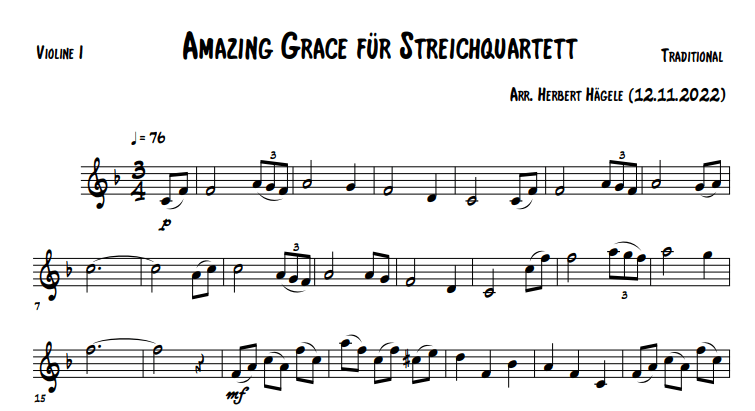
PREVIEW

Free Violin Sheet Music

George Frideric Handel composed a set of six violin sonatas, commonly referred to as “Sonatas for Violin and Continuo” or “Violin Sonatas, Op. 1.” Violin Sonata No. 4 in D major, HWV 371, is one of these delightful compositions.

Paganini’s La Campanella – the very name evokes images of a virtuoso violinist, fingers dancing across the strings with dazzling speed and precision, conjuring the delicate tinkling of a bell through the melody. Played as the final movement of Paganini’s Violin Concerto No. 2 in B minor, Op. 7, La Campanella is a showstopper, demanding both technical mastery and artistic …

Gioachino Rossini’s effervescent La scala di seta (The Silken Ladder) isn’t just an opera – it’s a whirlwind of comedic intrigue set to music. And its overture, a dazzling display of operatic fireworks, is a violinist‘s playground. Let’s delve into the intricacies of bringing this iconic piece to life on the strings. The overture itself is a microcosm of the …

“Spring” concerto, which is officially known as “Concerto No. 1 in E major, Op. 8, RV 269, Spring (La primavera)” is the opening concerto from Antonio Vivaldi’s composition “The Four Seasons” (Italian: “Le quattro stagioni”). “The Four Seasons” is a set of four violin concertos, and each concerto represents a different season of the year. “Spring” is dedicated to the …

Nielsen’s Symphony No. 4, subtitled “The Inextinguishable” (Op. 29), is a remarkable and powerful composition that holds a special place in the world of classical music. The nickname “The Inextinguishable” reflects the symphony’s theme of life’s eternal and indomitable force. Nielsen composed this symphony during World War I, and it’s believed that the turmoil of the war deeply influenced his …

Composed in the 19th century, this piece showcases Wieniawski’s brilliance as a violinist and composer. Wieniawski’s Fantaisie Brillante is based on themes from Charles Gounod’s opera “Faust.” It was a common practice in the Romantic era for composers to create virtuosic works based on popular operatic themes. The piece weaves together various themes from “Faust,” allowing the violinist to explore …

Symphony No. 6 in D major, “Le Matin” (Morning) was composed by Haydn in 1761-1763, during his early years with the Esterházy court. The nickname “Le Matin” suggests a morning or sunrise theme, though it is not entirely clear why this nickname was attached to the symphony. Some believe it could be due to the bright and cheerful character of …

Borodin’s Symphony No. 3 in A Major, also known as the “Heroic Symphony,” is a cornerstone of the Romantic repertoire. Premiered in 1886, it’s a vibrant tapestry of passion, heroism, and melancholic beauty, woven together with masterful skill. But for the violinist, the symphony holds a special allure, for the violin part is not merely an accompaniment, but a protagonist …

Symphony No. 52 in C minor, composed by Franz Joseph Haydn, is believed to have been written around 1771-1772 during his time at the Esterházy court. This period marked a significant phase in Haydn’s career, showcasing his growing maturity as a composer. Players participating in the performance of Symphony No. 52 will benefit from a thorough understanding of Classical period …

“Night on Bald Mountain” (Ночь на Лысой горе), also known as “Night on Bare Mountain,” is one of Modest Mussorgsky’s most famous and evocative compositions. This tone poem, written in 1867, captures a vivid and macabre scene of a witches’ sabbath on St. John’s Eve atop a bald mountain. Mussorgsky drew inspiration from Russian folklore and legends, particularly the idea …

While playing the entire Beethoven String Quartet No. 18 in F major, Op. 18, No. 1 on the violin is technically impossible, the spirit of the piece can be enjoyed in several ways on your instrument: Focus on individual movements: Choose a specific movement, like the graceful Allegro con brio or the passionate Adagio affettuoso ed appassionato, and adapt it for …

Wolfgang Amadeus Mozart, a musical genius of the Classical era, left an indelible mark on the world of classical music with his timeless compositions. One such masterpiece is the String Quartet No. 12 in B-flat major, K.172. This enchanting piece, composed in 1773 when Mozart was just 17 years old, showcases his exceptional ability to weave together intricate melodies and …

“Tristan and Isolde” opera is known for its seamless and continuous music, with few traditional arias or recitatives. Wagner’s approach creates a sense of timelessness and intensity. The score features lush orchestration and Wagner’s skillful use of leitmotifs (recurring musical themes associated with characters, emotions, or ideas). Certain parts of “Tristan und Isolde,” including the Prelude and the Liebestod, are …

The “Song of India,” also known as the “Song of the Hindu,” is an excerpt from the opera “Sadko” composed by Nikolai Rimsky-Korsakov. “Sadko” is a Russian opera that premiered in 1898 and is based on a Russian epic fairy tale. The “Song of India” is one of the most famous and recognizable pieces from this opera. The “Song of …

Symphony No. 73 in D major, “La Chasse” (The Hunt) nickname “La Chasse” is attributed to the spirited and lively character of the symphony, especially the final movement. The Hunt Symphony is known for its use of hunting calls and rhythmic elements that evoke the atmosphere of a hunting expedition. Haydn’s inventive use of musical elements makes this symphony a …