
Bach – Weihnachtsoratorium

Home » Violin Sheet Music » Christmas Violin Sheet Music » Bach – Weihnachtsoratorium

Bach’s Weihnachtsoratorium, or Christmas Oratorio, is a masterpiece that has stood the test of time, showcasing the genius of Johann Sebastian Bach. Originally composed for the Christmas season, the oratorio has become a beloved piece in the classical music repertoire. While it is often performed by orchestras and choirs, tackling it on the violin is a challenge that demands both technical proficiency and artistic interpretation.
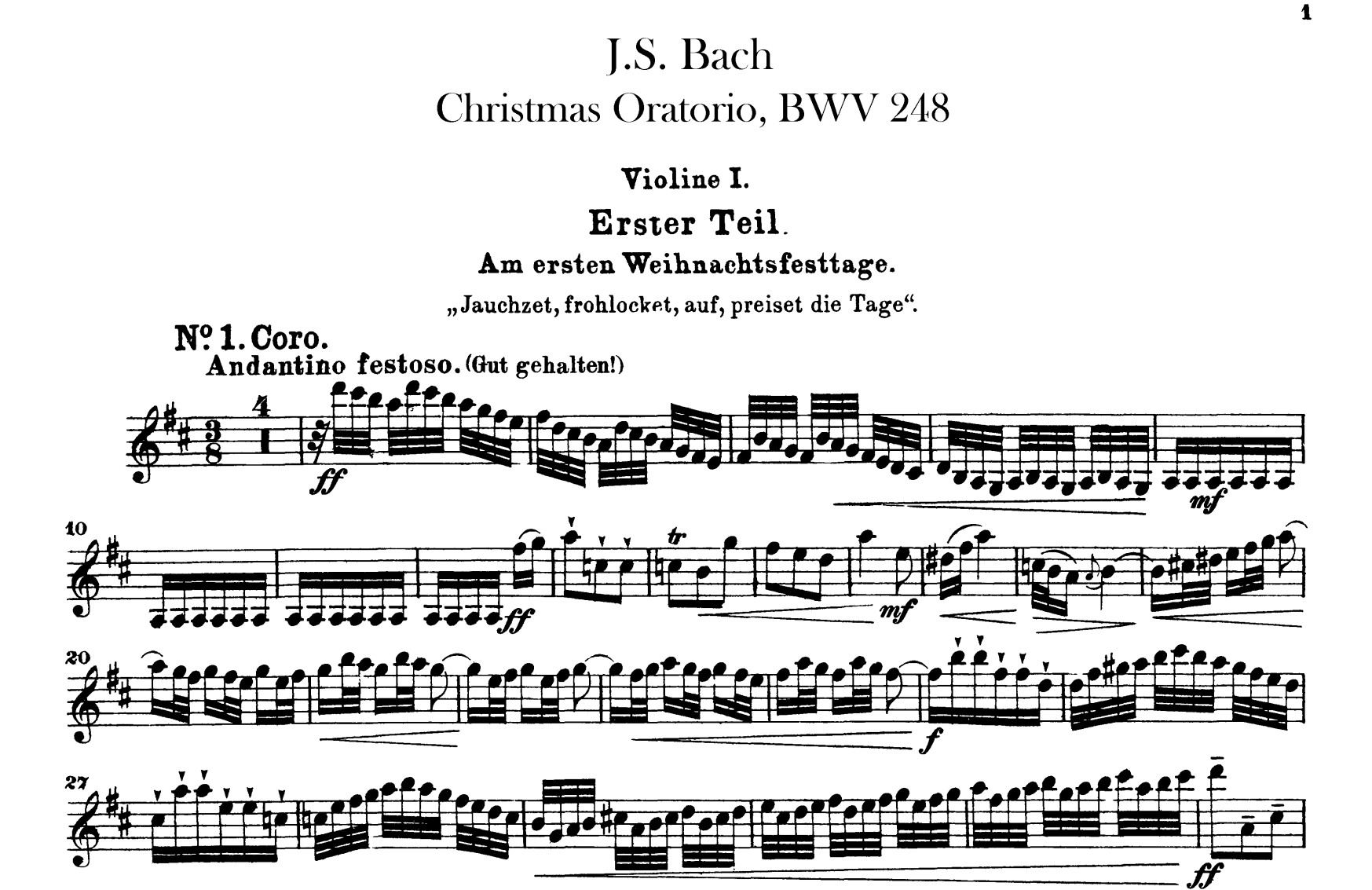
Bach’s Weihnachtsoratorium, or Christmas Oratorio, is a masterpiece that has stood the test of time, showcasing the genius of Johann Sebastian Bach. Originally composed for the Christmas season, the oratorio has become a beloved piece in the classical music repertoire. While it is often performed by orchestras and choirs, tackling it on the violin is a challenge that demands both technical proficiency and artistic interpretation.

PREVIEW

Christmas Sheet Music

The Waltz of the Flowers is a dazzling segment from the second act of “The Nutcracker,” where the Sugar Plum Fairy welcomes the arrival of the beautiful flowers. Tchaikovsky’s genius is evident in the intricate melodies, lush harmonies, and graceful waltz rhythm that characterize this piece. Adapting it for the piano allows musicians to explore the rich tapestry of Tchaikovsky’s …

Tchaikovsky’s Nutcracker Overture is a timeless masterpiece that has captivated audiences for generations. While commonly associated with orchestral performances, this enchanting composition can also be brought to life on the piano, offering pianists a chance to immerse themselves in the magical world created by Tchaikovsky. The Nutcracker Overture serves as the opening piece for Tchaikovsky’s famous ballet, “The Nutcracker.” Its …

“German Dance, K.605 No.3” or “Sleigh Ride” or in German “Die Schlittenfahrt” from the set of Three German Dances, K.605 is a lively and festive composition that captures the joyful spirit of a sleigh ride. “Die Schlittenfahrt” is originally a piano piece, but its lively and spirited character makes it a perfect candidate for adaptation to the violin. In terms …

The lyrics for “Hark! The Herald Angels Sing” were written by Charles Wesley, an English hymn writer, and brother of John Wesley, the founder of Methodism. The original text, which was titled “Hymn for Christmas Day,” was written in 1739. The music for the carol was composed by Felix Mendelssohn, a German composer, in 1840. Mendelssohn originally composed the music …

Franz Liszt, the Hungarian composer and virtuoso pianist of the Romantic era, left an indelible mark on the world of classical music with his innovative compositions. One such gem that often goes overlooked in his extensive repertoire is “In Hungarian Style,” a delightful piece from his collection “The Christmas Tree.” This composition, rich in Hungarian folk influences, is a perfect …

The Chorus of Shepherds is part of Reinecke’s larger body of work, which often drew inspiration from nature and storytelling. In this particular piece, Reinecke invites pianists to paint a musical picture of shepherds gathering in the countryside, their simple melodies echoing through the air. The composition is characterized by its light-hearted and joyful atmosphere, with cascading arpeggios and graceful …

“God Rest Ye Merry, Gentlemen” is one of the most well-known traditional English Christmas carols. It dates back to the 16th century and has a timeless, solemn melody that lends itself well to a variety of arrangements, including for the cello. This piece can benefit from dynamic contrast, especially to convey the solemn and majestic feel of the carol. Use …

The Ave Maria is a traditional Catholic prayer that is a tribute to the Virgin Mary. It’s based on the Annunciation, where the angel Gabriel announced to Mary that she would conceive and give birth to Jesus. There have been various musical compositions set to the words of the Ave Maria, with one of the most famous being composed by …

“Here Comes Santa Claus” was written by Gene Autry, the famous American singer, actor, and cowboy entertainer, along with Oakley Haldeman. Autry recorded and released the song in 1947. Playing “Here Comes Santa Claus” on the piano can be done using standard chords and the lively melody. It’s a cheerful and upbeat song that’s perfect for spreading holiday joy and …

Pyotr Ilyich Tchaikovsky’s “Waltz of the Snowflakes” is a mesmerizing piece of classical music that captures the enchantment and beauty of winter. Originally composed for the ballet “The Nutcracker,” this waltz has become a timeless favorite, evoking images of swirling snowflakes dancing in a winter wonderland. The “Waltz of the Snowflakes” is part of the second act of “The Nutcracker” …

“Silent Night” was composed by Franz Xaver Gruber, an Austrian schoolteacher, in 1818. The lyrics were written by Joseph Mohr, an Austrian priest, in the same year. The carol was first performed on Christmas Eve of 1818 at St. Nicholas Church in Oberndorf bei Salzburg, Austria.

Also known as “See Amid the Winter’s Snow” is a traditional Christmas carol with lyrics written by Edward Caswall and music composed by Sir John Goss. It was first published in 1854. This carol is known for its serene and reflective lyrics that tell the story of the birth of Jesus Christ and the adoration of the shepherds and angels. …

“December: Christmas” is the twelfth and final piece in Pyotr Ilyich Tchaikovsky’s collection “The Seasons.” This piece is a musical representation of the Christmas holiday, capturing the festive and joyous atmosphere associated with this time of the year. Tchaikovsky incorporates traditional Christmas themes into the composition, creating a musical portrayal of the joy, warmth, and camaraderie associated with Christmas celebrations.

Franz Liszt, the Hungarian composer and virtuoso pianist of the Romantic era, left an indelible mark on the world of classical music with his innovative compositions and unparalleled piano skills. One of his lesser-known yet captivating pieces is “March of The Three Magi” (S. 388), a musical gem that takes the listener on a majestic journey. Playing this piece on …

Max Reger’s Opus 17, No. 9 “Weihnachtstraum” refers to one of the pieces in his collection of solo piano works. It is a German phrase that translates to “Christmas dream” in English. It evokes a sense of the holiday season and the magical, dreamlike atmosphere that often accompanies Christmas celebrations. Reger’s “Silent Night” arrangement, also known as “Weihnachtstraum,” offers a …