
Rudolph the Red-Nosed Reindeer

Home » Piano Sheet Music » Rudolph the Red-Nosed Reindeer

“Rudolph the Red-Nosed Reindeer” is a beloved Christmas song written by Johnny Marks in 1949. The song was inspired by a storybook of the same name, written by Robert L. May in 1939. It tells the tale of Rudolph, a reindeer with a red, glowing nose, who becomes a hero when his unique feature helps Santa Claus guide his sleigh through a foggy Christmas Eve.

The original version of “Rudolph the Red-Nosed Reindeer” was composed by Johnny Marks and first recorded by Gene Autry in 1949. The arrangement is relatively straightforward, making it accessible to pianists of varying skill levels. The piece primarily involves playing the melody with basic chords, making it an excellent choice for beginner and intermediate players.
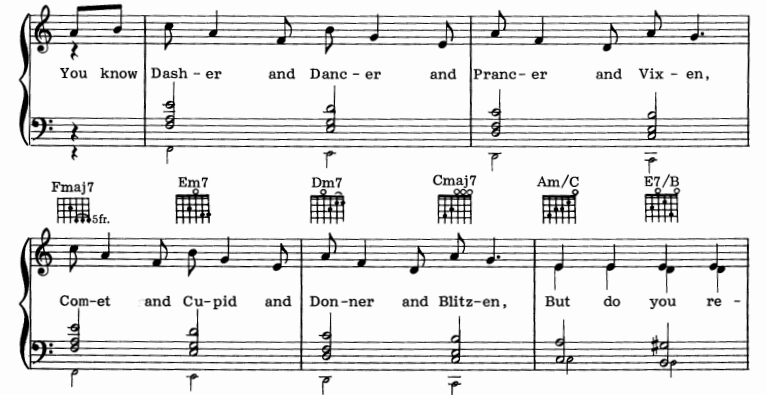
PREVIEW

Christmas Sheet Music

The “Chinese Dance” is part of Act II of “The Nutcracker” and is also known as the “Tea Dance.” This act is set in the Land of Sweets, where various international character dances are performed to entertain Clara and the Nutcracker Prince. This dance represents Chinese culture and is characterized by its distinctive and exotic musical motifs. Tchaikovsky employs pentatonic …

“The First Noel” is a traditional Christmas carol that dates back to the 18th century, possibly earlier. The exact origin of the song is unclear, but it is believed to have originated in England. The carol tells the story of the nativity of Jesus Christ and the shepherds who were the first to hear the news of His birth from …

Frank Loesser wrote “Baby, It’s Cold Outside” in 1944. The song features a playful and flirtatious duet between a man (referred to as “the Wolf” in the original sheet music) and a woman (referred to as “the Mouse”). In the song, the woman is expressing her reluctance to leave the man’s company due to the cold weather outside, while the …

The melody used in “Joy to the World” is actually from Handel’s Messiah, but the lyrics were written by Watts to celebrate the second coming of Jesus Christ, rather than his birth. The song has since become associated with Christmas and is commonly sung during the holiday season.

“Amazing Grace” is a traditional hymn with uncertain authorship. It is often attributed to John Newton, a former slave trader turned Christian minister, who wrote the lyrics in the late 18th century. However, the melody used today is believed to have been added later. The melody used for “Amazing Grace” is simple yet deeply moving. It is typically sung in …

Liszt’s “Slumber Song” is a lovely and tranquil piano composition that showcases the composer’s ability to create delicate and melodic pieces. Although Liszt is often associated with virtuosic and dramatic works, “Slumber Song” is a departure from his more grandiose style, offering a gentle and soothing musical experience. This composition is part of Liszt’s collection titled “Weihnachtsbaum” (The Christmas Tree), …

“O Nata Lux de Lumine” or “O Light Born of Light” is a hymn often associated with the Christian liturgy, particularly the office of Compline. It is commonly used during the Advent season.

“December: Christmas” is the twelfth and final piece in Pyotr Ilyich Tchaikovsky’s collection “The Seasons.” This piece is a musical representation of the Christmas holiday, capturing the festive and joyous atmosphere associated with this time of the year. Tchaikovsky incorporates traditional Christmas themes into the composition, creating a musical portrayal of the joy, warmth, and camaraderie associated with Christmas celebrations.

The lyrics for this carol were written by the English hymn writer Isaac Watts. Watts was known for his prolific hymn writing, and “Joy to the World” is one of his most famous compositions. This sheet music is arranged for the flute.

“Formerly” is one of the delightful pieces from Franz Liszt’s “Weihnachtsbaum” (The Christmas Tree) collection. This collection, composed in 1874, consists of 12 short piano pieces, each inspired by different aspects of the Christmas season. “Formerly” is a charming and nostalgic piece that reflects on the joys and memories of Christmases past. Liszt’s musical language beautifully captures the sentiment of …

The lyrics for “Hark! The Herald Angels Sing” were written by Charles Wesley, an English hymn writer, and brother of John Wesley, the founder of Methodism. The original text, which was titled “Hymn for Christmas Day,” was written in 1739. The music for the carol was composed by Felix Mendelssohn, a German composer, in 1840. Mendelssohn originally composed the music …

“The Sussex Mummers’ Christmas Carol” is a traditional English carol that originated in the county of Sussex, England. It is also known by other titles, including “The Cherry Tree Carol” and “Joseph Was An Old Man.” The carol tells the story of the Nativity, particularly focusing on Joseph’s reaction to Mary’s pregnancy. While the piece carries a certain level of …

In the vast tapestry of Christmas carols, few compositions resonate as beautifully and timelessly as Herbert Hughes’ “Carol of Jesus Child.” This enchanting piece, originally written for voice and piano, captures the essence of the holiday season with its evocative melodies and tender harmonies. Today, let’s explore the charm of this carol and discuss the skill level required for pianists …

Daquin’s compositions are known for their expressive and emotive qualities. In the “Livre de Noëls,” he effectively captures the joy and spirit of the Christmas season through his inventive use of musical devices. Daquin’s “Livre de Noëls” is considered an important contribution to the French Baroque keyboard repertoire. It provides valuable insights into the musical tastes and practices of the …

The Chorus of Shepherds is part of Reinecke’s larger body of work, which often drew inspiration from nature and storytelling. In this particular piece, Reinecke invites pianists to paint a musical picture of shepherds gathering in the countryside, their simple melodies echoing through the air. The composition is characterized by its light-hearted and joyful atmosphere, with cascading arpeggios and graceful …