
O Come All Ye Faithful

Home » Violin Sheet Music » O Come All Ye Faithful

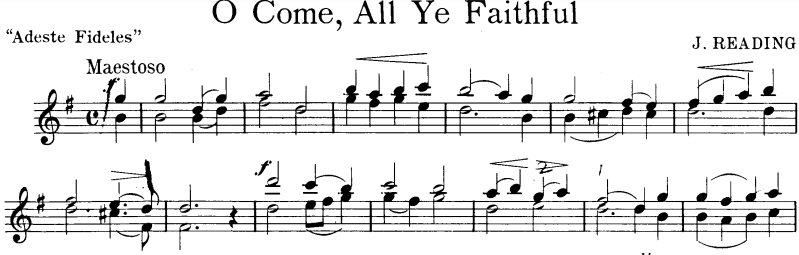
“O Come, All Ye Faithful” is a popular Christmas carol with lyrics attributed to John Francis Wade, and it is often sung to the tune known as “Adeste Fideles.” The carol is also sometimes referred to by its Latin incipit, “Adeste Fideles.”

The melody of “O Come, All Ye Faithful” is relatively straightforward, making it accessible to a broad range of skill levels. For beginners, focusing on the main melody and simple bowing techniques can create a lovely rendition. More advanced players can explore additional ornamentation, dynamics, and expressive techniques to add depth and emotion to their performance.
PREVIEW

Christmas Sheet Music

“Hark! The Herald Angels Sing” is a popular Christmas carol with lyrics written by Charles Wesley in 1739. The music for the carol was composed by Felix Mendelssohn in 1840. The carol is traditionally sung to celebrate the birth of Jesus Christ and is a staple in Christmas celebrations and church services. The carol goes on to tell the story …

Also known as “See Amid the Winter’s Snow” is a traditional Christmas carol with lyrics written by Edward Caswall and music composed by Sir John Goss. It was first published in 1854. This carol is known for its serene and reflective lyrics that tell the story of the birth of Jesus Christ and the adoration of the shepherds and angels. …

“It Came Upon the Midnight Clear” is a popular Christmas carol with lyrics written by Edmund Hamilton Sears in 1849 and music composed by Richard Storrs Willis. The song’s lyrics emphasize peace and goodwill and reflect on the angels’ message of peace to the shepherds on the night of Christ’s birth. “It Came Upon The Midnight Clear” is characterized by …

“Go Tell It on the Mountain” is a traditional African-American spiritual and Christmas gospel song that has become a well-loved and widely performed piece. It is believed to have roots in the African-American slave tradition, where enslaved individuals used music to express their faith and communicate messages. The lyrics convey the message of proclaiming the news of the birth of …

“Amazing Grace” is a well-known Christian hymn with a history that dates back to the 18th century. The lyrics were written by the English poet and clergyman John Newton, and the music is often attributed to an anonymous composer. The hymn has become a staple in Christian worship and is widely recognized and appreciated for its profound and uplifting message.

“Silent Night” was composed by Franz Xaver Gruber, an Austrian schoolteacher, in 1818. The lyrics were written by Joseph Mohr, an Austrian priest, in the same year. The carol was first performed on Christmas Eve of 1818 at St. Nicholas Church in Oberndorf bei Salzburg, Austria.

“Quem Pastores Laudavere” is a traditional German Christmas carol that has been cherished for centuries. The title translates to “Whom the Shepherds Praised” in English. The origins of “Quem Pastores Laudavere” can be traced back to medieval Germany, likely around the 14th century. This carol has endured the test of time and has become a beloved part of the Christmas …

“Christ Was Born on Christmas Day” is a traditional Christmas carol that celebrates the birth of Jesus Christ. The lyrics emphasize the joy and significance of this momentous event in Christian theology. The carol is often sung during the Christmas season in various Christian denominations and has been performed and recorded by numerous artists. The carol typically reflects on the …

“O Holy Night” (French: “Cantique de Noël”) is a Christmas carol that was written in French by poet Placide Cappeau and set to music by composer Adolphe Adam. Cappeau wrote the lyrics in 1843, and Adam composed the music later the same year. The carol was first performed in Roquemaure, France, during a midnight Mass on Christmas Eve in 1847.. …

The origins of “Away in a Manger” are somewhat disputed, and it’s often attributed to various sources. One popular version of the carol suggests that it was written by Martin Luther, the 16th-century German theologian, though historical evidence for this claim is limited. The most widely accepted attribution is to an American hymn writer named James R. Murray, who published …

“Jolly Old Saint Nicholas” is a traditional Christmas song that dates back to the 19th century. The lyrics were written by Benjamin Hanby in 1864, and the melody is believed to be a traditional American tune. The song is a festive and lively portrayal of Santa Claus, capturing the anticipation and joy of the holiday season. “Jolly Old Saint Nicholas” …

Niels Gade, a Danish composer and conductor of the Romantic era, created the “Christmas Tree” as part of a set of piano pieces dedicated to his children. Op.36 No.2 is particularly charming, with its playful melodies and evocative harmonies that transport listeners to a winter wonderland adorned with twinkling lights and festive decorations. The piece is characterized by its joyous …

“O Christmas Tree,” also known as “O Tannenbaum,” is a traditional German Christmas carol. The melody for this song has been used for various purposes over the years, including other Christmas songs. The song is typically performed in a reflective and reverent manner, paying homage to the tradition of decorating Christmas trees. Whether you’re a beginner pianist embarking on your …

“Away in a Manger” is a traditional Christmas carol, often associated with nativity celebrations. Its origins are somewhat disputed, with the first two verses historically attributed to Martin Luther, though this claim is debated. The melody, most commonly associated with this carol, comes in two popular versions: one by William J. Kirkpatrick (1887) and another by James R. Murray (1885). …

This masterpiece, also known as “Concerto Grosso in G minor, Op. 6, No. 8,” holds a special place in the repertoire of Baroque music. Composed by Arcangelo Corelli around 1690, this concerto is part of his renowned set of twelve concerti grossi. Corelli’s Christmas Concerto has remained a popular choice for holiday performances, admired for its exuberance and the timeless …