
Amazing Grace

Home » Organ Sheet Music » Amazing Grace

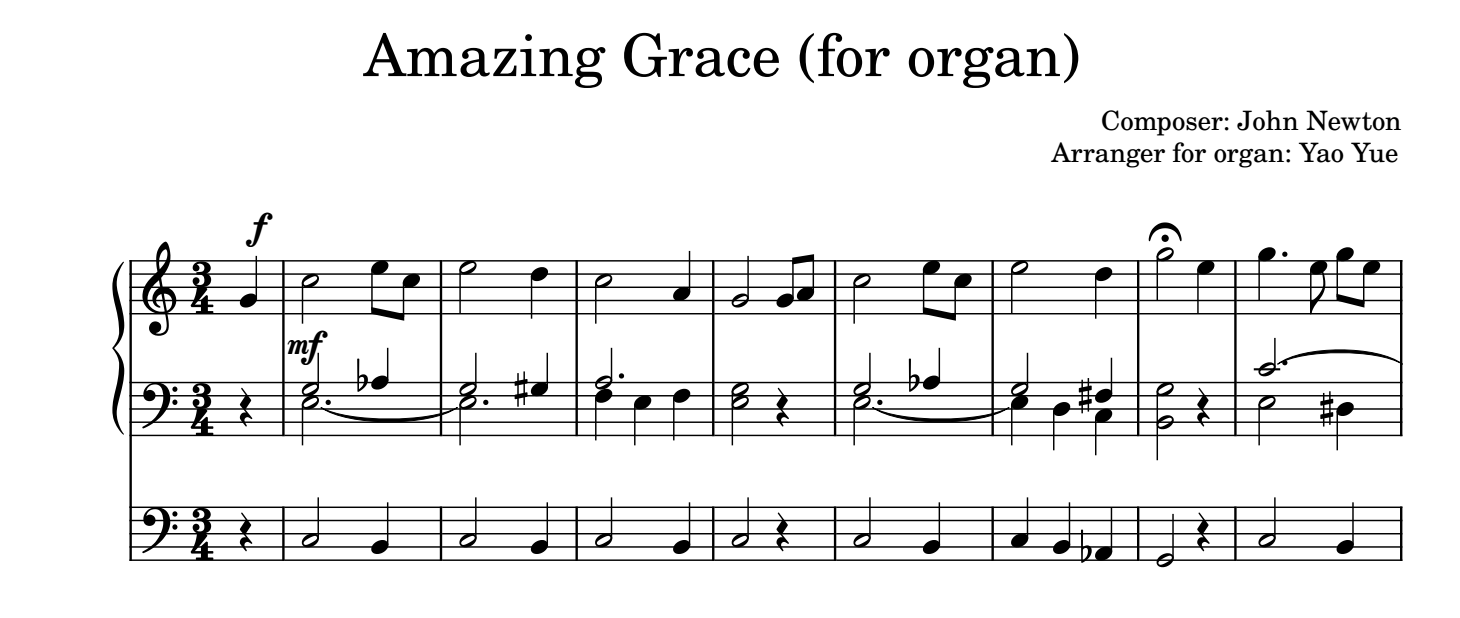
“Amazing Grace” is a well-known Christian hymn with a history that dates back to the 18th century. The lyrics were written by the English poet and clergyman John Newton, and the music is often attributed to an anonymous composer. The hymn has become a staple in Christian worship and is widely recognized and appreciated for its profound and uplifting message.
PREVIEW

Christmas Sheet Music

The English lyrics for “Carol of the Bells” were written by Peter J. Wilhousky in 1936. Wilhousky’s version of the song tells the story of the bells announcing the arrival of Christmas. The melody for “Carol of the Bells” is derived from a Ukrainian folk chant called “Shchedryk” (sometimes spelled “Shchedrik”), which was composed by Mykola Leontovych in 1916. The …

The “Sonata in C major, K. 513” is often referred to as the “Pastorale” due to its charming and pastoral character. Scarlatti’s keyboard sonatas are known for their virtuosity, inventive use of keyboard techniques, and exploration of various styles and moods. Sonata Pastorale is characterized by its pastoral charm, with a lively tempo and playful melodies that evoke images of …

The melody of “O Come, All Ye Faithful” is lyrical and flowing, which suits the cello’s natural singing tone. Focus on making each phrase sound vocal, as though you are singing through the instrument. Start gently and build towards the climactic phrase “O come, let us adore Him.” Use controlled crescendos to bring warmth and richness to the tune, especially …

“Angels We Have Heard on High” is a traditional Christmas carol with French origins. The English lyrics were written by James Chadwick, an English Roman Catholic bishop, in the mid-19th century. The music for “Angels We Have Heard on High” is based on the traditional French melody of “Gloria in excelsis Deo,” which means “Glory to God in the Highest.” …

“Hark! The Herald Angels Sing” is a well-known Christmas carol that has been sung and arranged for various instruments since its inception. Mendelssohn’s original music is jubilant and stately, making it a popular piece during holiday performances. The melody should be played with smooth, lyrical phrasing to reflect the carol’s uplifting and joyful nature. Emphasize dynamic contrasts. Play softly during …

“O Holy Night” (French: “Cantique de Noël”) is a Christmas carol that was written in French by poet Placide Cappeau and set to music by composer Adolphe Adam. Cappeau wrote the lyrics in 1843, and Adam composed the music later the same year. The carol was first performed in Roquemaure, France, during a midnight Mass on Christmas Eve in 1847.. …

“Here Comes Santa Claus” was written by Gene Autry, the famous American singer, actor, and cowboy entertainer, along with Oakley Haldeman. Autry recorded and released the song in 1947. Playing “Here Comes Santa Claus” on the piano can be done using standard chords and the lively melody. It’s a cheerful and upbeat song that’s perfect for spreading holiday joy and …

Franz Liszt, the Hungarian composer and virtuoso pianist of the Romantic era, left an indelible mark on the world of classical music with his innovative compositions and unparalleled piano skills. One of his lesser-known yet captivating pieces is “March of The Three Magi” (S. 388), a musical gem that takes the listener on a majestic journey. Playing this piece on …

Tchaikovsky’s Nutcracker Overture is a timeless masterpiece that has captivated audiences for generations. While commonly associated with orchestral performances, this enchanting composition can also be brought to life on the piano, offering pianists a chance to immerse themselves in the magical world created by Tchaikovsky. The Nutcracker Overture serves as the opening piece for Tchaikovsky’s famous ballet, “The Nutcracker.” Its …

“O Come, All Ye Faithful,” also known as “Adeste Fideles” in Latin, is a classic Christmas carol. The original Latin text is attributed to John Francis Wade, an 18th-century hymnist, and the English translation is often attributed to Frederick Oakeley. The melody is believed to have been written by John Reading in the 18th century. It is typically performed in …

The Waltz of the Flowers is a dazzling segment from the second act of “The Nutcracker,” where the Sugar Plum Fairy welcomes the arrival of the beautiful flowers. Tchaikovsky’s genius is evident in the intricate melodies, lush harmonies, and graceful waltz rhythm that characterize this piece. Adapting it for the piano allows musicians to explore the rich tapestry of Tchaikovsky’s …

Bach’s “Gloria in excelsis Deo,” BWV 191, is a separate and shorter work compared to the larger Mass in B minor. It is a sacred choral composition, and it consists of the Gloria section of the Latin Mass.

“Die musikalische Schlittenfahrt,” which translates to “The Musical Sleigh Ride” in English, is a delightful and festive composition by the German composer Leopold Mozart. Leopold Mozart, father of the renowned Wolfgang Amadeus Mozart, was a composer, conductor, and violinist during the 18th century. Leopold Mozart’s “Die musikalische Schlittenfahrt” is a musical depiction of a sleigh ride, capturing the joy and …

Good King Wenceslas is a popular Christmas carol that tells the story of the 10th-century Duke of Bohemia, Wenceslas I, who was later canonized as a saint. The carol’s lyrics were written by John Mason Neale in 1853, and the tune is based on a 13th-century spring carol, “Tempus adest floridum” (“The time is near for flowering”). The melody has …

Schubert’s “Ave Maria” is a poignant and reverent piece that has been embraced for its emotional depth and melodic richness. It has been widely used in religious ceremonies, including weddings and other solemn occasions. The lyrics are based on a German translation of Sir Walter Scott’s poem “The Lady of the Lake.”