
Liszt – Slumber Song

Home » Piano Sheet Music » Liszt – Slumber Song

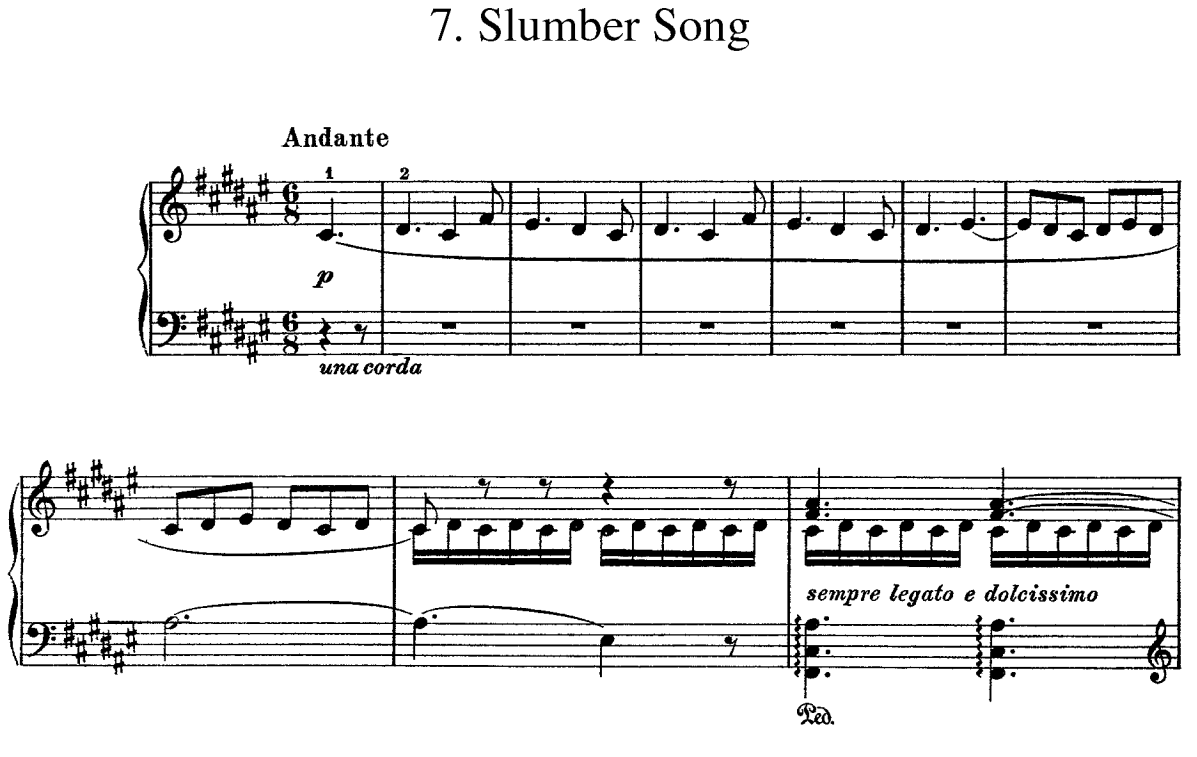
Liszt’s “Slumber Song” is a lovely and tranquil piano composition that showcases the composer’s ability to create delicate and melodic pieces. Although Liszt is often associated with virtuosic and dramatic works, “Slumber Song” is a departure from his more grandiose style, offering a gentle and soothing musical experience.

This composition is part of Liszt’s collection titled “Weihnachtsbaum” (The Christmas Tree), which features 12 short piano pieces, each inspired by various aspects of the Christmas season. “Slumber Song” is evocative of the peaceful moments associated with the holiday season.

In terms of difficulty, “Slumber Song” is well-suited for intermediate to advanced pianists. The piece’s moderate tempo and melodic lines allow intermediate players to delve into Liszt’s world while providing advanced pianists with the opportunity to showcase their interpretive skills. The key lies in capturing the subtleties of the piece, paying attention to phrasing, dynamics, and the delicate balance between the left and right hands.
PREVIEW

Christmas Sheet Music

“Bring a Torch, Jeanette, Isabella” is a traditional French Christmas carol, known as “Un flambeau, Jeanette, Isabelle” in French. It dates back to the 16th century and is still popular during the Christmas season today. It is generally considered a relatively easy Christmas carol to play on the piano, making it a suitable choice for pianists of various skill levels. …

“Jesus Christ the Apple Tree” is a popular English hymn that dates back to the 18th century. The lyrics of this hymn are often attributed to an unknown author. It is sometimes referred to as “The Apple-Tree Song” or simply “The Apple Tree.” The hymn uses the metaphor of an apple tree to represent Jesus Christ, drawing parallels between the …

In addition to its Latin version, “Gaudete” has been translated into various languages, and there are many different musical arrangements of the carol. One of the most well-known versions is by the folk group Steeleye Span, which popularized the song in the 1970s with their recording of it. Since then, it has become a beloved and often-performed Christmas carol, both …

“Christmas in Sicily” is one of the masterpieces of Italian-American composer Pietro Alessandro Yon. Yon was a renowned organist and composer known for his contributions to sacred and holiday music.

“Rudolph the Red-Nosed Reindeer” is a beloved Christmas song written by Johnny Marks in 1949. The song was inspired by a storybook of the same name, written by Robert L. May in 1939. It tells the tale of Rudolph, a reindeer with a red, glowing nose, who becomes a hero when his unique feature helps Santa Claus guide his sleigh …

“O Holy Night” (French: “Cantique de Noël”) is a Christmas carol that was written in French by poet Placide Cappeau and set to music by composer Adolphe Adam. Cappeau wrote the lyrics in 1843, and Adam composed the music later the same year. The carol was first performed in Roquemaure, France, during a midnight Mass on Christmas Eve in 1847.. …

Carl Thiel (1902–1982) was a German composer and arranger known for his contributions to piano music. Thiel’s arrangements often featured a delicate balance of technical proficiency and emotional expressiveness, making them accessible to a wide range of pianists. Carl Thiel’s arrangement of “In Dulci Jubilo” for piano is a delightful and uplifting piece that brings the joy of the holiday …

“O Nata Lux de Lumine” or “O Light Born of Light” is a hymn often associated with the Christian liturgy, particularly the office of Compline. It is commonly used during the Advent season.

Max Reger’s Opus 17, No. 9 “Weihnachtstraum” refers to one of the pieces in his collection of solo piano works. It is a German phrase that translates to “Christmas dream” in English. It evokes a sense of the holiday season and the magical, dreamlike atmosphere that often accompanies Christmas celebrations. Reger’s “Silent Night” arrangement, also known as “Weihnachtstraum,” offers a …

“Christmas Chimes” (Juleklokkerne in Danish) is one of Gade’s compositions, and it’s a festive piece that captures the spirit of the holiday season. It’s often performed during Christmas concerts and celebrations. Niels Gade was a prominent Romantic composer, conductor, and violinist, known for his contributions to Danish music in the 19th century. Christmas Chimes Op.36 No.1 is well-suited for intermediate …

“Jingle Bells” was written by James Lord Pierpont and published under the title “One Horse Open Sleigh” in 1857. The song’s catchy melody and upbeat lyrics have made it a holiday classic that is often associated with the joy and festivities of the Christmas season. It is a relatively simple song to play on the piano, making it a popular …

The word “mirliton” refers to a toy kazoo-like instrument made from a paper tube and waxed paper, which produces a buzzing sound. The French translation aptly captures the lighthearted and playful nature of the music and choreography in this part of Tchaikovsky’s ballet classic, The Nutcracker. The music is characterized by its high-pitched, staccato notes, which mimic the sound of mirlitons.

“German Dance, K.605 No.3” or “Sleigh Ride” or in German “Die Schlittenfahrt” from the set of Three German Dances, K.605 is a lively and festive composition that captures the joyful spirit of a sleigh ride. Arranged for violin.

“O Come, All Ye Faithful” is a popular Christmas carol that is also known by its Latin title, “Adeste Fideles.” The carol is traditionally sung during the Christmas season and is often heard in churches, as well as in various secular settings. It’s a joyful and uplifting hymn that celebrates the birth of Jesus Christ and encourages all believers to …

The lyrics for “Hark! The Herald Angels Sing” were written by Charles Wesley, an English hymn writer, and brother of John Wesley, the founder of Methodism. The original text, which was titled “Hymn for Christmas Day,” was written in 1739. The music for the carol was composed by Felix Mendelssohn, a German composer, in 1840. Mendelssohn originally composed the music …