
Away In A Manger

Home » Cello Sheet Music » Away In A Manger

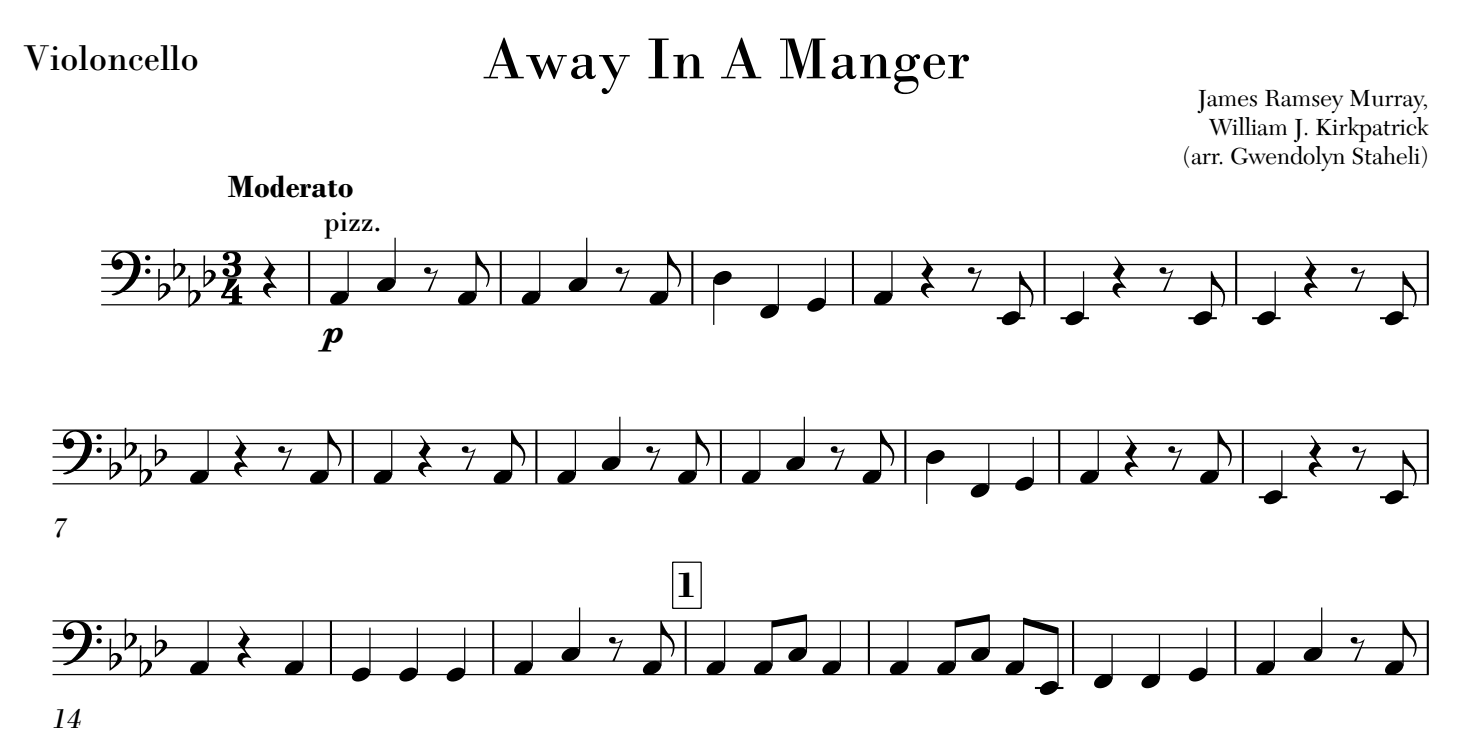
“Away in a Manger” is a traditional Christmas carol, often associated with nativity celebrations. Its origins are somewhat disputed, with the first two verses historically attributed to Martin Luther, though this claim is debated. The melody, most commonly associated with this carol, comes in two popular versions: one by William J. Kirkpatrick (1887) and another by James R. Murray (1885). The carol’s gentle, lullaby-like nature makes it ideal for instrumental adaptations, including the cello.

Slurred bowing can help maintain the flowing quality of the piece. For instance, slur two or three notes per bow in the waltz-like rhythm. Keep the tempo moderate to slow (around 60-70 bpm), so the melody feels like a lullaby. Avoid rushing through the phrases, as the beauty of the carol lies in its gentle simplicity.
PREVIEW

Christmas Sheet Music

“Let Our Gladness Have No End” is a hymn that celebrates joy and gratitude and a great addition to your Christmas song list! “Let Our Gladness Have No End” is a delightful addition to any pianist’s repertoire. Its joyful and celebratory nature makes it an uplifting piece to play, and with dedication and practice, intermediate to advanced pianists can bring …

“Jingle Bells” was written by James Lord Pierpont and published under the title “One Horse Open Sleigh” in 1857. The song’s catchy melody and upbeat lyrics have made it a holiday classic that is often associated with the joy and festivities of the Christmas season. It is a relatively simple song to play on the piano, making it a popular …

“Jesus Christ the Apple Tree” is a popular English hymn that dates back to the 18th century. The lyrics of this hymn are often attributed to an unknown author. It is sometimes referred to as “The Apple-Tree Song” or simply “The Apple Tree.” The hymn uses the metaphor of an apple tree to represent Jesus Christ, drawing parallels between the …

“Once in Royal David’s City” is a popular Christmas carol that is often sung during the Christmas season. It was written by the English poet Cecil Frances Alexander and was first published in 1848. The hymn is typically sung to the tune “Irby,” which was composed by Henry John Gauntlett.

Max Reger’s Opus 17, No. 9 “Weihnachtstraum” refers to one of the pieces in his collection of solo piano works. It is a German phrase that translates to “Christmas dream” in English. It evokes a sense of the holiday season and the magical, dreamlike atmosphere that often accompanies Christmas celebrations. Reger’s “Silent Night” arrangement, also known as “Weihnachtstraum,” offers a …

“It Came Upon a Midnight Clear” is a Christmas carol that was written by American pastor and poet Edmund Hamilton Sears in 1849. The carol is set to music composed by Richard Storrs Willis, and it was first published in the “Christian Register” in Boston in December 1850. The lyrics of the carol reflect themes of peace and the message …

“Silver Bells” is a classic Christmas song written by Jay Livingston and Ray Evans. It was first performed by Bob Hope and Marilyn Maxwell in the 1951 film “The Lemon Drop Kid.” The song is known for its cheerful and festive lyrics, which evoke the joyful atmosphere of the holiday season in a bustling city. The original version of “Silver …

“O Holy Night” (French: “Cantique de Noël”) is a Christmas carol that was written in French by poet Placide Cappeau and set to music by composer Adolphe Adam. Cappeau wrote the lyrics in 1843, and Adam composed the music later the same year. The carol was first performed in Roquemaure, France, during a midnight Mass on Christmas Eve in 1847. …

The melody of “O Come, All Ye Faithful” is lyrical and flowing, which suits the cello’s natural singing tone. Focus on making each phrase sound vocal, as though you are singing through the instrument. Start gently and build towards the climactic phrase “O come, let us adore Him.” Use controlled crescendos to bring warmth and richness to the tune, especially …

“Quem Pastores Laudavere” is a traditional German Christmas carol that has been cherished for centuries. The title translates to “Whom the Shepherds Praised” in English. The origins of “Quem Pastores Laudavere” can be traced back to medieval Germany, likely around the 14th century. This carol has endured the test of time and has become a beloved part of the Christmas …

“O Christmas Tree,” also known as “O Tannenbaum,” is a traditional German Christmas carol. The melody for this song has been used for various purposes over the years, including other Christmas songs. The song is typically performed in a reflective and reverent manner, paying homage to the tradition of decorating Christmas trees. Whether you’re a beginner pianist embarking on your …

“Gabriel’s Message” is a Christmas carol based on the biblical story of the Annunciation, where the angel Gabriel delivers the message to the Virgin Mary that she will conceive and give birth to Jesus, the Son of God. The carol is also known as “The Angel Gabriel from Heaven Came.” “Gabriel’s Message” is a piece that accommodates a range of …

Liszt’s “Slumber Song” is a lovely and tranquil piano composition that showcases the composer’s ability to create delicate and melodic pieces. Although Liszt is often associated with virtuosic and dramatic works, “Slumber Song” is a departure from his more grandiose style, offering a gentle and soothing musical experience. This composition is part of Liszt’s collection titled “Weihnachtsbaum” (The Christmas Tree), …

“Christmas in Sicily” is one of the masterpieces of Italian-American composer Pietro Alessandro Yon. Yon was a renowned organist and composer known for his contributions to sacred and holiday music.

“Angels We Have Heard on High” is a traditional Christmas carol, originating from France. The song is best known for its “Gloria in excelsis Deo” refrain, which reflects the biblical story of angels proclaiming the birth of Jesus to shepherds. The melody, known as “Gloria”, is believed to have been written in the 18th century, while the English lyrics were …