
Saint-Saens – Christmas Oratorio

Home » Cello Sheet Music » Saint-Saens – Christmas Oratorio

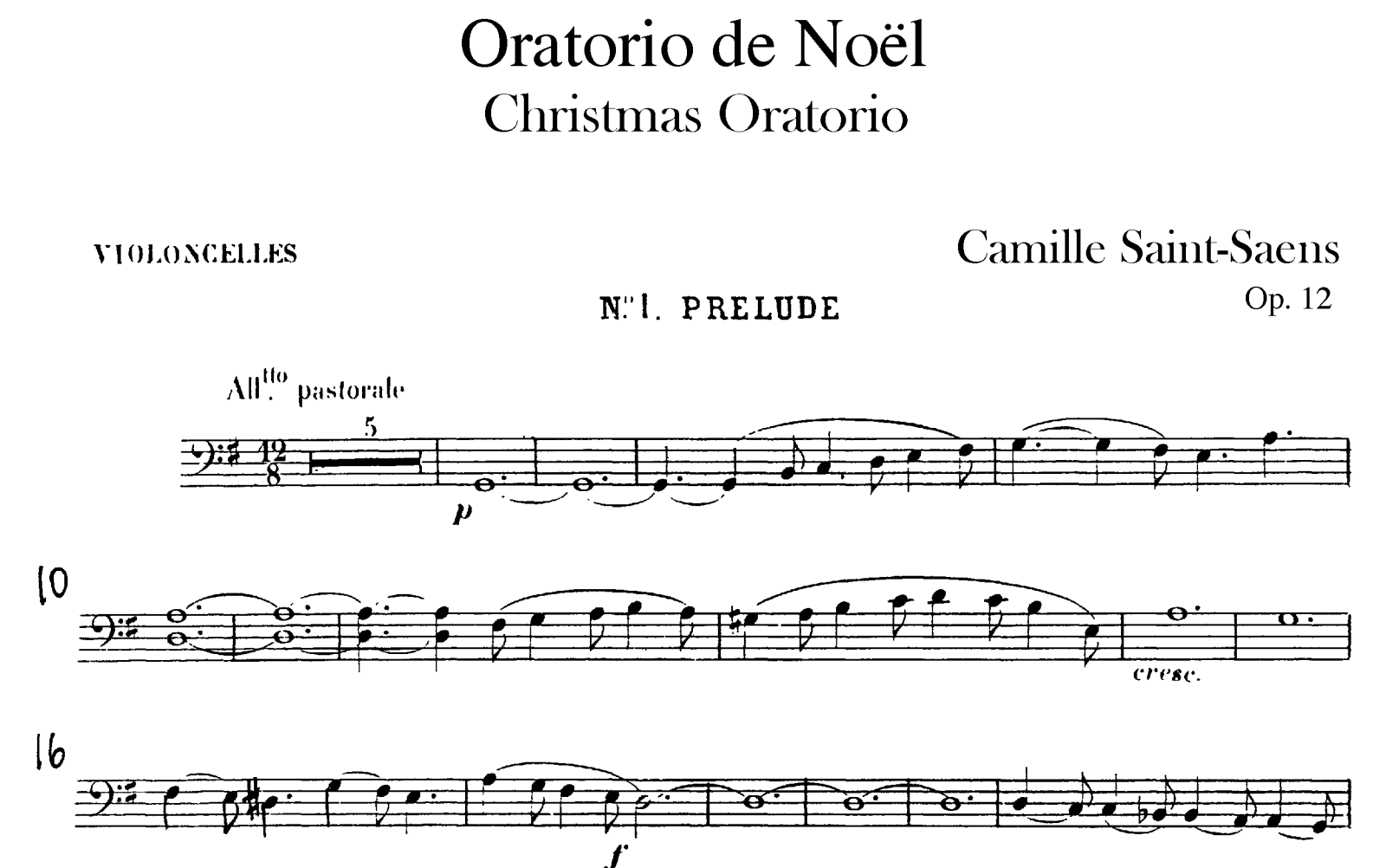
Camille Saint-Saëns’ “Christmas Oratorio” (Oratorio de Noël), Op. 12, is a beautifully crafted sacred work for choir, soloists, and small orchestra. Composed in 1858, it is often performed during the Advent or Christmas season and is notable for its lyrical and serene character. The piece features 10 movements, and it is imbued with a sense of warmth and intimacy rather than the grandeur typically associated with oratorios.

The cello part in Saint-Saëns’ Christmas Oratorio is vital for establishing the warm, rich texture of the ensemble. The cello frequently supports the vocal lines and creates a lyrical, cantabile mood throughout.

The Christmas Oratorio often features gentle, flowing melodies, and the cello frequently mirrors or supports the vocalists, especially in arias and choruses. Pay close attention to phrasing, as Saint-Saëns’ music requires a very vocal, singing quality. Saint-Saëns’ writing in this oratorio often evokes Baroque and Classical styles, especially in its use of ornamentation and rhythmic patterns. Be mindful of lightness and precision in faster movements, and use a delicate touch when playing ornaments or embellishments.
PREVIEW

Christmas Sheet Music

“The Nutcracker” is traditionally performed during the holiday season, making it a cherished part of many people’s Christmas celebrations. The ballet’s festive and magical atmosphere has made it a family favorite for generations.”The Nutcracker” is known for its iconic pieces, including the “Dance of the Sugar Plum Fairy,” the “Waltz of the Flowers,” the “Russian Dance (Trepak),” and the “March,” …

Composed in the 19th century, Raff’s “Around the Christmas Tree” is a delightful piano piece that has stood the test of time. The music conjures images of a cozy family gathering, with loved ones gathered around a beautifully adorned Christmas tree, exchanging gifts and enjoying each other’s company. In terms of difficulty, Raff’s “Around the Christmas Tree” is accessible to …

“In Dulci Jubilo,” which translates to “In Sweet Rejoicing,” is a traditional German carol that dates back to the 14th century. Its jubilant melody and lively rhythm make it a perfect choice for violinists seeking to showcase their skills while spreading holiday cheer. The piece is characterized by its dance-like quality, combining elements of medieval and Renaissance music with a …

“Song of the Bagpipers” in Neapolitan is known as “Canzone dei Zampognari.” This traditional Neapolitan Christmas song is often associated with the image of bagpipers playing festive music during the holiday season in Southern Italy. Due to the technical demands and nuanced expression required, “Song of the Bagpipers” is best suited for intermediate to advanced pianists. A solid understanding of …

“Amazing Grace” is a well-known Christian hymn with a history that dates back to the 18th century. The lyrics were written by the English poet and clergyman John Newton, and the music is often attributed to an anonymous composer. The hymn has become a staple in Christian worship and is widely recognized and appreciated for its profound and uplifting message.

“O Nata Lux de Lumine” or “O Light Born of Light” is a hymn often associated with the Christian liturgy, particularly the office of Compline. It is commonly used during the Advent season.

“Ave Maria” in A major is part of his larger work, the “Six Duets for Two Voices and Organ,” Op. 10. This collection includes settings of various sacred texts, and the “Ave Maria” in A major is one of the pieces within this set. These duets were composed in 1858 and showcase Saint-Saëns’s mastery of choral writing and his ability …

“Frosty the Snowman” was written by Walter “Jack” Rollins and Steve Nelson. They composed the song in 1950. The song tells the story of Frosty, a snowman who comes to life when a magical hat is placed on his head. Frosty then leads the children in the song on various adventures before eventually melting away, promising to return again someday. …

“In Polish Style” is one of the delightful pieces from Franz Liszt’s “Weihnachtsbaum” (The Christmas Tree) collection. This collection, composed in 1874, consists of 12 short piano pieces, each inspired by different aspects of the Christmas season. Performing Liszt’s “In Polish Style” on the piano requires a blend of technical skill, musicality, and a deep understanding of the composer’s stylistic …

In addition to its Latin version, “Gaudete” has been translated into various languages, and there are many different musical arrangements of the carol. One of the most well-known versions is by the folk group Steeleye Span, which popularized the song in the 1970s with their recording of it. Since then, it has become a beloved and often-performed Christmas carol, both …

Gounod’s “L’Angelus” captures the solemnity and reverence of the Angelus prayer through its expressive melodies and harmonies. The title is French for “The Angelus,” and the music aims to convey the spirit of this prayerful moment. “L’Angelus” is a vocal work that draws inspiration from the traditional Catholic devotion known as the Angelus, commemorating the Annunciation. The piece is typically …

“Es ist ein Ros entsprungen” is a traditional German Christmas carol. This version is the number 8 of Brahm’s 11 Chorale Preludes from Op. 122.

“O Little Town of Bethlehem” is a well-known Christmas carol with lyrics written by Phillips Brooks and music composed by Lewis Redner. The song was first performed in 1868 and has become a classic in the Christmas music repertoire. It paints a peaceful and reverent picture of the town of Bethlehem on the night of Jesus’ birth. The original version …

“Shepherds, Shake Off Your Drowsy Sleep” is a traditional Christmas carol. The song’s lyrics encourage shepherds to wake up and go to Bethlehem to witness the birth of Jesus. The carol reflects the Biblical account of the shepherds who were visited by angels and instructed to go and see the newborn Christ. Due to the technical demands and the need …

“Silent Night” (German: “Stille Nacht, heilige Nacht”) is a widely cherished Christmas carol known for its simple and serene melody. It was originally written in German by Joseph Mohr, with music composed by Franz Xaver Gruber.