
Good King Wenceslas

Home » Piano Sheet Music » Good King Wenceslas

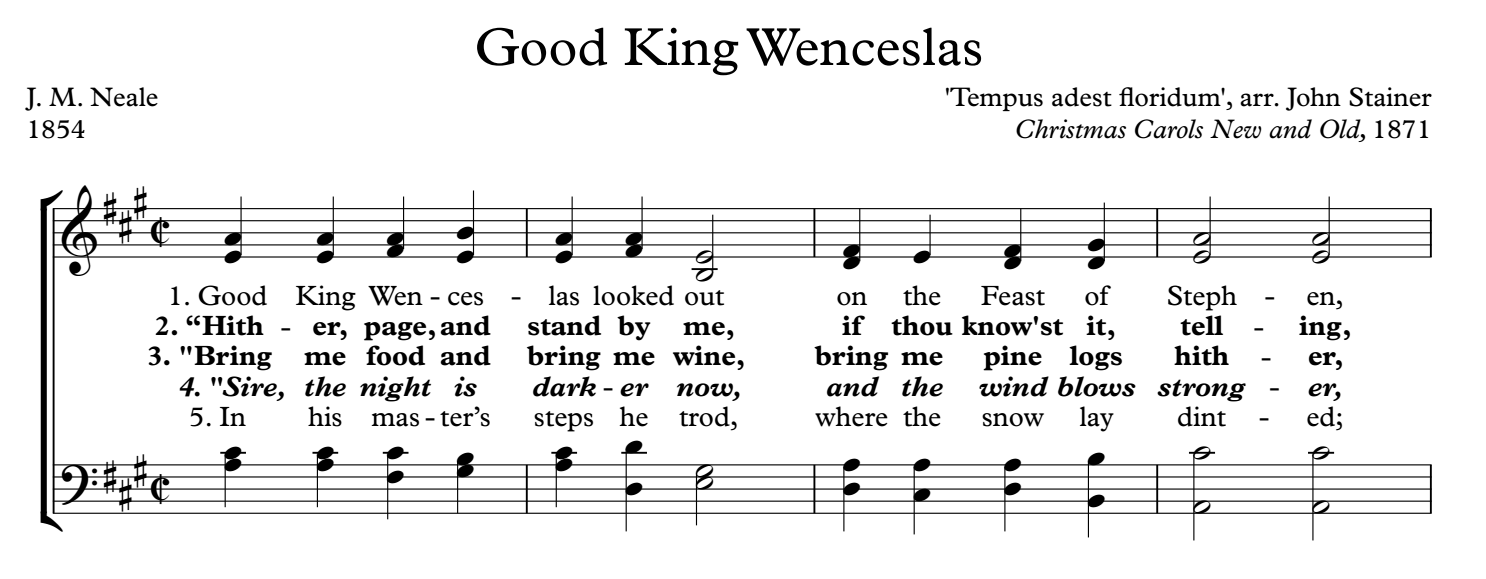
“Good King Wenceslas” is a Christmas carol that tells the story of a generous and kind-hearted Bohemian king who braved harsh winter weather to provide charity to a poor peasant. The lyrics, penned by John Mason Neale in the 19th century, are set to the melody of a 13th-century spring carol called “Tempus adest floridum.” The combination of the heartwarming tale and the uplifting melody has made Good King Wenceslas a cherished part of holiday celebrations worldwide.

This festive carol is well-suited for the piano, allowing pianists to showcase their skills while spreading holiday cheer. The piece typically features a moderate tempo and a straightforward time signature, making it accessible to a wide range of pianists. The arrangement often includes a mix of chords, arpeggios, and melodic lines that provide both challenge and enjoyment for players.
PREVIEW

Christmas Sheet Music

“Jesus Christ the Apple Tree” is a popular English hymn that dates back to the 18th century. The lyrics of this hymn are often attributed to an unknown author. It is sometimes referred to as “The Apple-Tree Song” or simply “The Apple Tree.” The hymn uses the metaphor of an apple tree to represent Jesus Christ, drawing parallels between the …

“O Holy Night” (French: “Cantique de Noël”) is a Christmas carol that was written in French by poet Placide Cappeau and set to music by composer Adolphe Adam. Cappeau wrote the lyrics in 1843, and Adam composed the music later the same year. The carol was first performed in Roquemaure, France, during a midnight Mass on Christmas Eve in 1847.. …

“Christ Was Born on Christmas Day” is a traditional Christmas carol that celebrates the birth of Jesus Christ. The lyrics emphasize the joy and significance of this momentous event in Christian theology. The carol is often sung during the Christmas season in various Christian denominations and has been performed and recorded by numerous artists. The carol typically reflects on the …

“Es ist ein Ros entsprungen” is a traditional German Christmas carol. This version is the number 8 of Brahm’s 11 Chorale Preludes from Op. 122.

“Christmas Chimes” (Juleklokkerne in Danish) is one of Gade’s compositions, and it’s a festive piece that captures the spirit of the holiday season. It’s often performed during Christmas concerts and celebrations. Niels Gade was a prominent Romantic composer, conductor, and violinist, known for his contributions to Danish music in the 19th century. Christmas Chimes Op.36 No.1 is well-suited for intermediate …

“Silent Night” was composed by Franz Xaver Gruber, an Austrian schoolteacher, in 1818. The lyrics were written by Joseph Mohr, an Austrian priest, in the same year. The carol was first performed on Christmas Eve of 1818 at St. Nicholas Church in Oberndorf bei Salzburg, Austria.

“God Rest Ye Merry, Gentlemen” is one of the most well-known traditional English Christmas carols. It dates back to the 16th century and has a timeless, solemn melody that lends itself well to a variety of arrangements, including for the cello. This piece can benefit from dynamic contrast, especially to convey the solemn and majestic feel of the carol. Use …

Liszt’s “Slumber Song” is a lovely and tranquil piano composition that showcases the composer’s ability to create delicate and melodic pieces. Although Liszt is often associated with virtuosic and dramatic works, “Slumber Song” is a departure from his more grandiose style, offering a gentle and soothing musical experience. This composition is part of Liszt’s collection titled “Weihnachtsbaum” (The Christmas Tree), …

The Ave Maria is a traditional Catholic prayer that is a tribute to the Virgin Mary. It’s based on the Annunciation, where the angel Gabriel announced to Mary that she would conceive and give birth to Jesus. There have been various musical compositions set to the words of the Ave Maria, with one of the most famous being composed by …

The carol “The First Nowell” is a beautiful and reverent song that reflects the wonder and adoration surrounding the birth of Jesus. It is often sung in church services and during Christmas celebrations, and its timeless message of the nativity story continues to resonate with people during the holiday season. “The First Noel” offers a delightful journey for violinists of …

“Ave Maria” in A major is part of his larger work, the “Six Duets for Two Voices and Organ,” Op. 10. This collection includes settings of various sacred texts, and the “Ave Maria” in A major is one of the pieces within this set. These duets were composed in 1858 and showcase Saint-Saëns’s mastery of choral writing and his ability …

Camille Saint-Saëns’ “Christmas Oratorio” (Oratorio de Noël), Op. 12, is a beautifully crafted sacred work for choir, soloists, and small orchestra. Composed in 1858, it is often performed during the Advent or Christmas season and is notable for its lyrical and serene character. The piece features 10 movements, and it is imbued with a sense of warmth and intimacy rather …

Tchaikovsky’s Nutcracker Overture is a timeless masterpiece that has captivated audiences for generations. While commonly associated with orchestral performances, this enchanting composition can also be brought to life on the piano, offering pianists a chance to immerse themselves in the magical world created by Tchaikovsky. The Nutcracker Overture serves as the opening piece for Tchaikovsky’s famous ballet, “The Nutcracker.” Its …

“Deck the Halls” is a Welsh carol that dates back to the 16th century. The melody is believed to have originated from a traditional Welsh New Year’s Eve carol called “Nos Galan.” The song is known for its cheerful lyrics that celebrate the holiday season and the spirit of Christmas. The refrain “Fa-la-la-la-la, la-la-la-la” is a distinctive and memorable part …

“O Holy Night” (French: “Cantique de Noël”) is a Christmas carol that was written in French by poet Placide Cappeau and set to music by composer Adolphe Adam. Cappeau wrote the lyrics in 1843, and Adam composed the music later the same year. The carol was first performed in Roquemaure, France, during a midnight Mass on Christmas Eve in 1847.. …