
Bach – Nun Komm der Heiden Heiland

Home » Organ Sheet Music » Bach – Nun Komm der Heiden Heiland

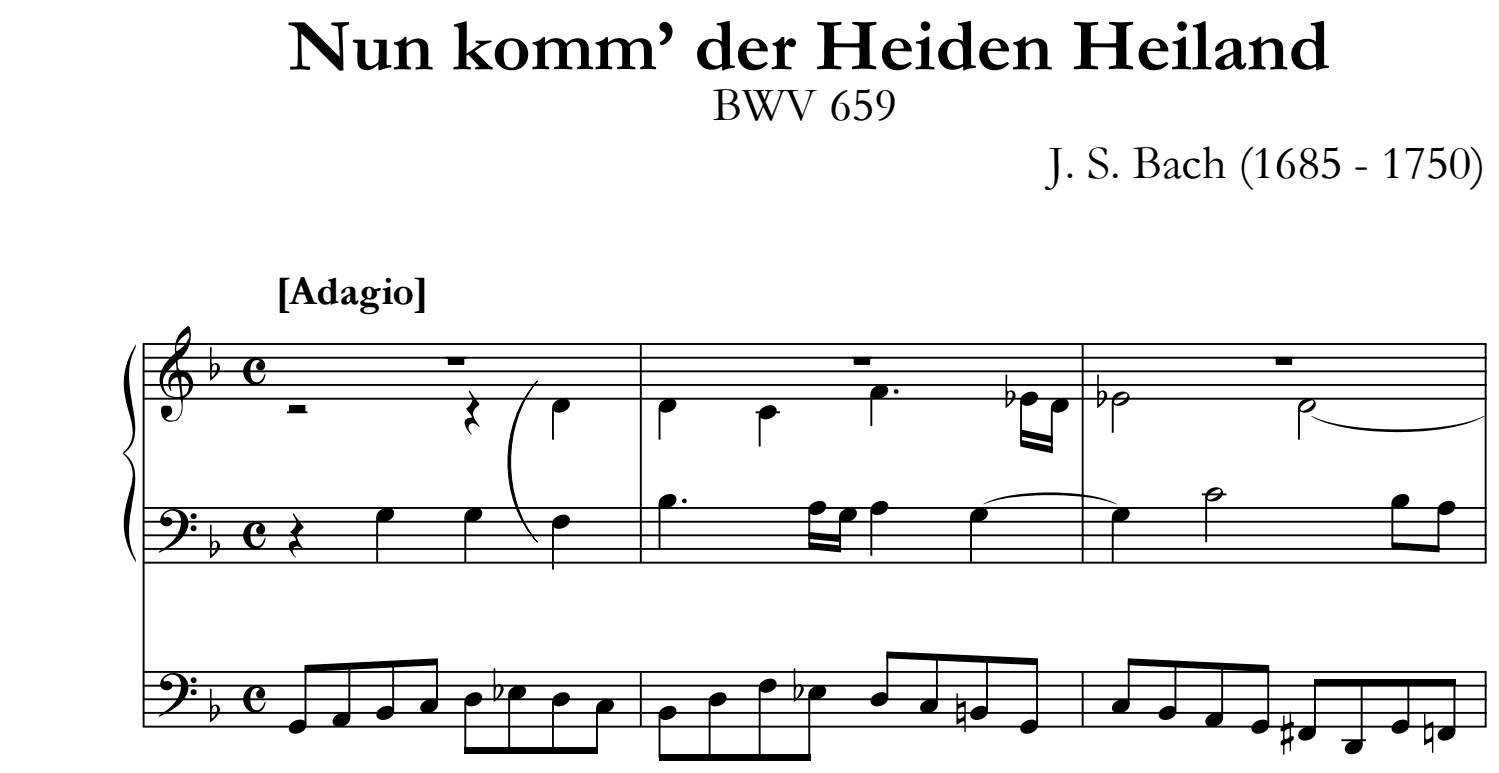
“Nun komm, der Heiden Heiland, BWV 659” is a chorale prelude composed by Johann Sebastian Bach. It is part of his larger collection of organ works, particularly those that involve chorale settings. The title translates to “Now come, Savior of the Gentiles” in English.

This chorale prelude is based on the hymn “Nun komm, der Heiden Heiland,” which is attributed to Martin Luther. The piece consists of a rich and elaborate setting of the chorale melody, showcasing Bach’s contrapuntal skills and harmonic inventiveness. The melody of the hymn is presented in a majestic and ornate manner, surrounded by intricate counterpoint and ornamentation.
PREVIEW

Christmas Sheet Music

“Joy to the World” is a classic Christmas carol often arranged for a variety of instruments, including the cello. The rich and resonant tones of the cello can bring a deep, soulful quality to this joyous melody. The melody commonly associated with “Joy to the World” was arranged by Lowell Mason in 1836, an American music educator and composer. He …

Liszt’s “Slumber Song” is a lovely and tranquil piano composition that showcases the composer’s ability to create delicate and melodic pieces. Although Liszt is often associated with virtuosic and dramatic works, “Slumber Song” is a departure from his more grandiose style, offering a gentle and soothing musical experience. This composition is part of Liszt’s collection titled “Weihnachtsbaum” (The Christmas Tree), …

“Angels from the Realms of Glory” is a Christmas carol with lyrics written by Scottish poet James Montgomery and music composed by Henry Thomas Smart. Smart was an English organist, composer, and conductor known for his hymn tunes. The carol was first published in 1816 in Montgomery’s newspaper, the Sheffield Iris, under the title “Nativity.” The lyrics of the carol …

“I Know That My Redeemer Liveth” is one of the most popular and recognizable movements from Handel’s Messiah. The aria opens with a powerful ascending melody sung by the soprano, conveying a sense of faith and hope. The music shifts between moments of quiet introspection and triumphant pronouncements, reflecting the text’s emotional journey. For pianists aspiring to master “I Know …

“O Little Town of Bethlehem” is a popular Christmas carol that has been arranged for various instruments, including the organ. When played on the organ, it typically has a majestic and reverent sound, befitting the solemnity of the Christmas season. The organ arrangement includes rich harmonies and full chords to create a grand and atmospheric rendition of the song.

“Amazing Grace” is a well-known Christian hymn that has become a classic in the realm of religious and folk music. The lyrics were written by John Newton, a British sailor and former slave trader, and the music is a traditional tune, possibly of Scottish origin. The hymn reflects Newton’s personal spiritual transformation and his understanding of divine grace and forgiveness.

Pyotr Ilyich Tchaikovsky’s timeless ballet, “The Nutcracker,” is a masterpiece that has captivated audiences for generations. Among its enchanting compositions is the charming “Dance of the Mirlitons,” a delightful piece that translates beautifully onto the piano. The Dance of the Mirlitons, also known as the Reed Flutes, is a whimsical and lively dance that occurs in Act II of The …

“Hark! The Herald Angels Sing” is a song that celebrates the joyous news of the birth of Jesus and is a staple of Christmas carol singing. The combination of Charles Wesley’s poetic lyrics and Felix Mendelssohn’s uplifting melody has made it a timeless favorite during the holiday season.

Composed by Arthur Foote (1853–1937), an American composer “And There Were Shepherds” is a common phrase found in the Christmas story from the Bible, specifically in the account of the birth of Jesus in the Gospel of Luke (Luke 2:8-20). This phrase is often associated with the announcement of the angel to the shepherds in the fields. Foote’s meticulous attention …

“Frosty the Snowman” was written by Walter “Jack” Rollins and Steve Nelson. They composed the song in 1950. The song tells the story of Frosty, a snowman who comes to life when a magical hat is placed on his head. Frosty then leads the children in the song on various adventures before eventually melting away, promising to return again someday. …

“Formerly” is one of the delightful pieces from Franz Liszt’s “Weihnachtsbaum” (The Christmas Tree) collection. This collection, composed in 1874, consists of 12 short piano pieces, each inspired by different aspects of the Christmas season. “Formerly” is a charming and nostalgic piece that reflects on the joys and memories of Christmases past. Liszt’s musical language beautifully captures the sentiment of …

“Christ Was Born on Christmas Day” is a traditional Christmas carol that celebrates the birth of Jesus Christ. The lyrics emphasize the joy and significance of this momentous event in Christian theology. The carol is often sung during the Christmas season in various Christian denominations and has been performed and recorded by numerous artists. The carol typically reflects on the …

Composed in the 19th century, Raff’s “Around the Christmas Tree” is a delightful piano piece that has stood the test of time. The music conjures images of a cozy family gathering, with loved ones gathered around a beautifully adorned Christmas tree, exchanging gifts and enjoying each other’s company. In terms of difficulty, Raff’s “Around the Christmas Tree” is accessible to …

The lyrics for “Hark! The Herald Angels Sing” were written by Charles Wesley, an English hymn writer, and brother of John Wesley, the founder of Methodism. The original text, which was titled “Hymn for Christmas Day,” was written in 1739. The music for the carol was composed by Felix Mendelssohn, a German composer, in 1840. Mendelssohn originally composed the music …

Bach – Christmas Oratorio (Weihnachtsoratorium) completed in 1734, it is a set of six cantatas intended for performance during the Christmas season. Each cantata corresponds to a specific feast day within the Christmas period.