
Carol of the Bells

Home » Piano Sheet Music » Carol of the Bells

The English lyrics for “Carol of the Bells” were written by Peter J. Wilhousky in 1936. Wilhousky’s version of the song tells the story of the bells announcing the arrival of Christmas. The melody for “Carol of the Bells” is derived from a Ukrainian folk chant called “Shchedryk” (sometimes spelled “Shchedrik”), which was composed by Mykola Leontovych in 1916. The original Ukrainian lyrics have nothing to do with Christmas; instead, they describe a swallow flying into a household to predict a prosperous year. The melody was later adapted to create the Christmas carol.

“Carol of the Bells” demands a moderate to advanced skill level from pianists due to its intricate and rapid passages. The piece is characterized by its use of ostinato patterns, where a repeating musical motif creates a hypnotic effect. The left hand is responsible for maintaining a steady rhythm reminiscent of chiming bells, while the right hand carries the intricate and agile melody.
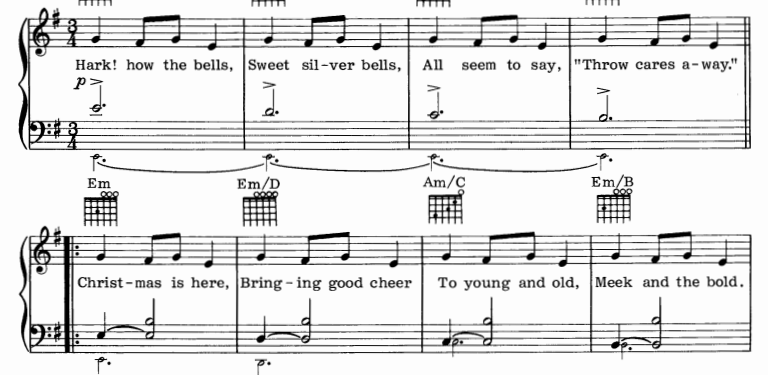
PREVIEW

Christmas Sheet Music

“The Christmas Song” is a classic Christmas song written by Mel Tormé and Bob Wells. It was first composed in 1945 and has since become one of the most iconic and beloved Christmas songs of all time. The song is also known by its opening line, “Chestnuts roasting on an open fire.” The original version of “The Christmas Song” is …

As the holiday season approaches, nothing captures the spirit of Christmas quite like music. Whether you’re a seasoned pianist or just starting to tickle the ivories, there’s something magical about playing beloved Christmas tunes. If you’re on the hunt for the perfect piano sheet music to add to your repertoire, look no further than “Have Yourself a Merry Little Christmas.” …

The melody used in “Joy to the World” is actually from Handel’s Messiah, but the lyrics were written by Watts to celebrate the second coming of Jesus Christ, rather than his birth. The song has since become associated with Christmas and is commonly sung during the holiday season.

“Joy to the World” is a classic Christmas carol often arranged for a variety of instruments, including the cello. The rich and resonant tones of the cello can bring a deep, soulful quality to this joyous melody. The melody commonly associated with “Joy to the World” was arranged by Lowell Mason in 1836, an American music educator and composer. He …

The gentle melody of Grieg’s Christmas Lullaby, also known as “Vuggesang,” paints a picture of a peaceful winter night, making it a perfect addition to any pianist’s repertoire, especially during the festive period. Playing this piece on the piano not only offers a wonderful opportunity to showcase technical skills but also allows the musician to convey the warm, comforting ambiance …

The Sussex Carol, also known as “On Christmas Night All Christians Sing,” is a traditional English Christmas carol. It is believed to have originated in the Sussex region of England, hence the name. The Sussex Carol is a popular traditional Christmas song, and it has been recorded and performed by various artists and choirs over the years. It captures the …

“Nun komm, der Heiden Heiland, BWV 659” is a chorale prelude composed by Johann Sebastian Bach. It is part of his larger collection of organ works, particularly those that involve chorale settings. The title translates to “Now come, Savior of the Gentiles” in English. This chorale prelude is based on the hymn “Nun komm, der Heiden Heiland,” which is attributed …

“The Nutcracker” is traditionally performed during the holiday season, making it a cherished part of many people’s Christmas celebrations. The ballet’s festive and magical atmosphere has made it a family favorite for generations.”The Nutcracker” is known for its iconic pieces, including the “Dance of the Sugar Plum Fairy,” the “Waltz of the Flowers,” the “Russian Dance (Trepak),” and the “March,” …

“We Wish You a Merry Christmas” is a traditional English Christmas carol that dates back to the 16th century. It’s a joyful and lively song that’s popular during the holiday season. The melody is relatively simple and repetitive, making it a great choice for beginner to intermediate cellists who are looking for festive repertoire. Since this piece has a lively …

Bach’s Christmas Oratorio is a monumental work composed for the Christmas season, celebrating the birth of Christ through vibrant choruses, arias, and recitatives. It is written for a full choir, soloists, and orchestra, with text from the Gospels of Luke and Matthew, and draws on both sacred and secular themes. The six parts of the oratorio each have their own …

“In Polish Style” is one of the delightful pieces from Franz Liszt’s “Weihnachtsbaum” (The Christmas Tree) collection. This collection, composed in 1874, consists of 12 short piano pieces, each inspired by different aspects of the Christmas season. Performing Liszt’s “In Polish Style” on the piano requires a blend of technical skill, musicality, and a deep understanding of the composer’s stylistic …

“Hark! The Herald Angels Sing” is a popular Christmas carol with lyrics written by Charles Wesley in 1739. The music for the carol was composed by Felix Mendelssohn in 1840. The carol is traditionally sung to celebrate the birth of Jesus Christ and is a staple in Christmas celebrations and church services. The carol goes on to tell the story …

Liszt’s “Slumber Song” is a lovely and tranquil piano composition that showcases the composer’s ability to create delicate and melodic pieces. Although Liszt is often associated with virtuosic and dramatic works, “Slumber Song” is a departure from his more grandiose style, offering a gentle and soothing musical experience. This composition is part of Liszt’s collection titled “Weihnachtsbaum” (The Christmas Tree), …

“O Come, All Ye Faithful” is typically sung in churches and at Christmas gatherings as a way to celebrate the birth of Jesus and express devotion to Him. It has been covered by numerous artists and is a cherished part of the Christmas musical tradition. Arranged for the Flute.

“A Great and Mighty Wonder” is a hymn with lyrics written by St. Germanus, Bishop of Constantinople, in the 7th century. The hymn reflects on the miraculous nature of the Incarnation, celebrating the birth of Jesus Christ. The text has been translated into English by various authors, and the melody is often associated with the German hymn “Es ist ein …