
Handel – For Unto Us a Child is Born

Home » Violin Sheet Music » Handel – For Unto Us a Child is Born

Composed as part of Handel’s renowned oratorio “Messiah,” this chorus erupts with triumphant joy, announcing the birth of Jesus Christ. The soaring soprano lines and rich choral harmonies paint a vivid picture of heavenly hosts proclaiming the good news. Handel’s “For unto us a child is born” is a timeless masterpiece, a cornerstone of the Christmas season and a powerful expression of hope and joy. The music, from the opening triumphant chorus to the tender solo passages, captures the essence of the Nativity story with breathtaking beauty and emotional depth.

While “For Unto Us a Child is Born” poses challenges, it is well-suited for intermediate-level violinists who have a solid foundation in fundamental techniques. Players at this level should be comfortable with various bowing styles, shifting positions, and executing moderately complex ornamentations. The piece serves as an excellent opportunity for intermediate violinists to push their boundaries and elevate their playing to a more advanced level.
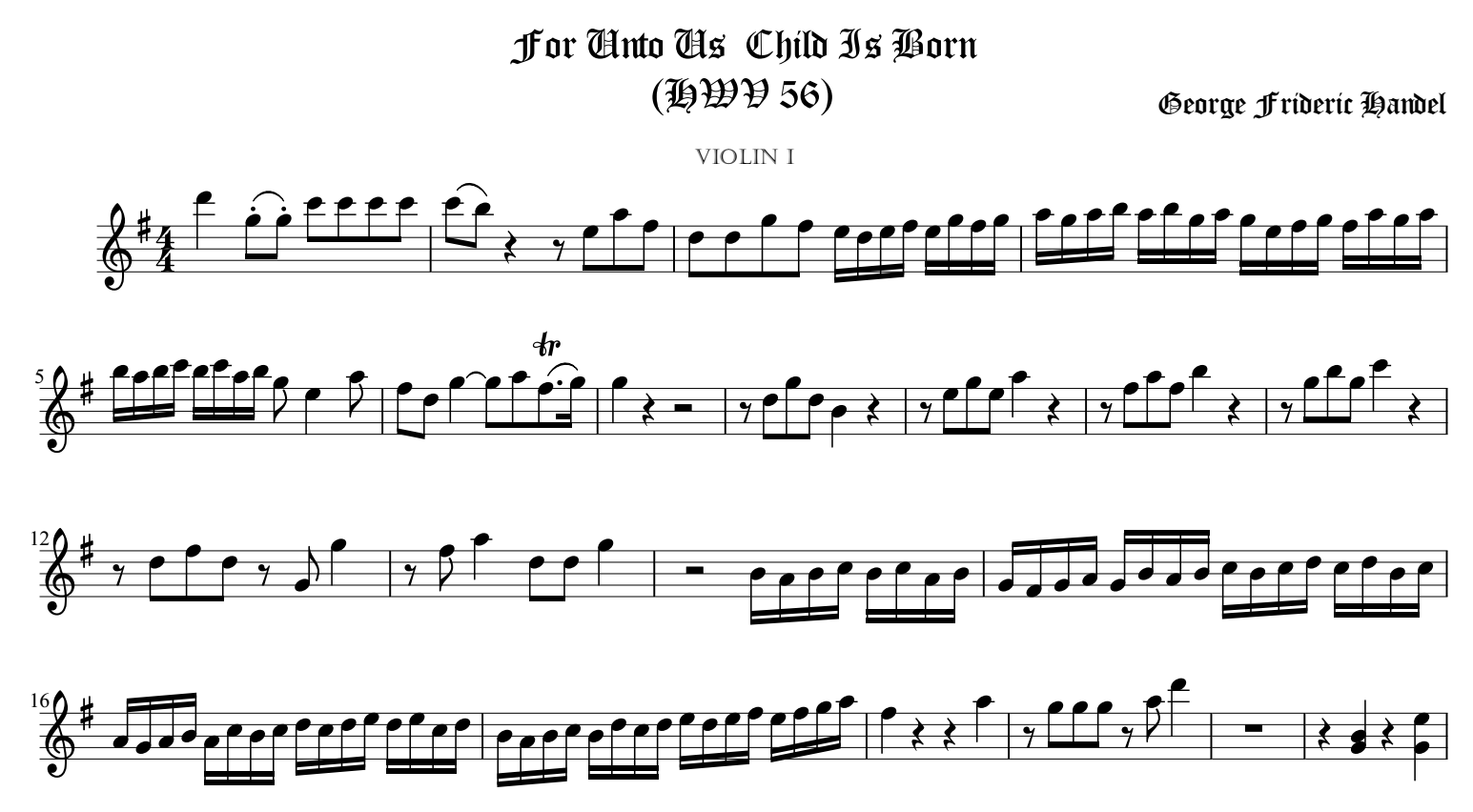
PREVIEW

Christmas Sheet Music

“Gaudete” is a sacred Christmas carol that has its origins in Latin liturgical music. The word “Gaudete” means “Rejoice” in Latin, and the carol is often associated with the Advent season, which is the period of preparation and anticipation leading up to Christmas. While “Gaudete” may seem intimidating at first glance, it is accessible to pianists with a moderate to …

Camille Saint-Saëns’ “Oratorio de Noël,” also known as his Christmas Oratorio, Op. 12, is a splendid and spiritually evocative composition. Written in 1858, this oratorio reflects Saint-Saëns’ mastery in blending sacred and festive elements. The piano rendition of Saint-Saëns’ Christmas Oratorio Op. 12 demands a pianist with an intermediate to advanced skill level. The piece presents challenges in terms of …

“O Holy Night” (French: “Cantique de Noël”) is a Christmas carol that was written in French by poet Placide Cappeau and set to music by composer Adolphe Adam. Cappeau wrote the lyrics in 1843, and Adam composed the music later the same year. The carol was first performed in Roquemaure, France, during a midnight Mass on Christmas Eve in 1847. …

“The First Noel” is a traditional Christmas carol that dates back to the 18th century, possibly earlier. The exact origin of the song is unclear, but it is believed to have originated in England. The carol tells the story of the nativity of Jesus Christ and the shepherds who were the first to hear the news of His birth from …

“The Twelve Days of Christmas” is a traditional English Christmas carol that dates back to the 18th century. The song is cumulative in nature, with each verse adding a new gift to the list. It is believed to have originated in France before coming to England and has become one of the most well-known and enduring Christmas songs. The song …

The Russian Trepak, also known as the “Russian Dance,” is a lively and energetic piece from Tchaikovsky’s Nutcracker Suite. It captures the spirit of Russian folk dance, complete with its lively tempo and infectious melodies. The music is characterized by its brisk pace, intricate rhythms, and triumphant flair, making it a favorite among both performers and listeners. While Tchaikovsky originally …

“Carol of the Bells” is a popular Christmas carol with a distinctive and recognizable melody. The music for this carol was composed by Mykola Leontovych, a Ukrainian composer, in 1914. The original composition is titled “Shchedryk,” which means “The Generous One” in Ukrainian and refers to a traditional Ukrainian folk chant that welcomed the New Year.

The Arabian Dance, also known as the Coffee Dance, is part of the second act of “The Nutcracker.” Tchaikovsky masterfully incorporates Middle Eastern influences, using rich and evocative melodies to transport listeners to a world of mystery and enchantment. The piano arrangement retains the exotic charm, allowing pianists to express the nuances of the original orchestral score. Pyotr Ilyich Tchaikovsky’s …

“Rudolph the Red-Nosed Reindeer” is a beloved Christmas song written by Johnny Marks in 1949. The song was inspired by a storybook of the same name, written by Robert L. May in 1939. It tells the tale of Rudolph, a reindeer with a red, glowing nose, who becomes a hero when his unique feature helps Santa Claus guide his sleigh …

“Ave Maria” Op.52 No.6 by Franz Schubert is a timeless and beautiful composition. Composed in 1825 as part of his work titled “Ellens dritter Gesang” (Ellen’s Third Song), it has since become known simply as “Ave Maria.” The lyrics are based on a German translation of Sir Walter Scott’s poem “The Lady of the Lake.”

Bach’s Christmas Oratorio is a monumental work composed for the Christmas season, celebrating the birth of Christ through vibrant choruses, arias, and recitatives. It is written for a full choir, soloists, and orchestra, with text from the Gospels of Luke and Matthew, and draws on both sacred and secular themes. The six parts of the oratorio each have their own …

“Once in Royal David’s City” is a popular Christmas carol that is often sung during the Christmas season. It was written by the English poet Cecil Frances Alexander and was first published in 1848. The hymn is typically sung to the tune “Irby,” which was composed by Henry John Gauntlett.

“In Dulci Jubilo,” which translates to “In Sweet Rejoicing,” is a traditional German carol that dates back to the 14th century. Its jubilant melody and lively rhythm make it a perfect choice for violinists seeking to showcase their skills while spreading holiday cheer. The piece is characterized by its dance-like quality, combining elements of medieval and Renaissance music with a …

Holst composed the music for this carol in 1906 as part of his collection of choral settings titled “Two Carols,” which also included “A Christmas Carol.” Holst’s musical setting of “In the Bleak Midwinter” has become one of the most well-known and beloved renditions of the carol, and it is often performed during the Christmas season.

“A Great and Mighty Wonder” is a hymn with lyrics written by St. Germanus, Bishop of Constantinople, in the 7th century. The hymn reflects on the miraculous nature of the Incarnation, celebrating the birth of Jesus Christ. The text has been translated into English by various authors, and the melody is often associated with the German hymn “Es ist ein …