
Beethoven – String Quartet Op.18 No.1

Home » Violin Sheet Music » Beethoven – String Quartet Op.18 No.1

While playing the entire Beethoven String Quartet No. 18 in F major, Op. 18, No. 1 on the violin is technically impossible, the spirit of the piece can be enjoyed in several ways on your instrument:

Focus on individual movements: Choose a specific movement, like the graceful Allegro con brio or the passionate Adagio affettuoso ed appassionato, and adapt it for solo violin. This might involve transposing certain parts to fit the violin’s range, simplifying harmonies, or adding double stops for a richer sound.

Remember, the true magic of the String Quartet No. 18 lies in the interplay and dynamic balance between all four instruments. While a solo violin rendition cannot fully replicate this, your focus should be on capturing the essence of each movement and expressing its emotions through your own musicality. While Beethoven’s Op.18 No.1 is undoubtedly a challenge, it is within reach for dedicated intermediate to advanced violinists.
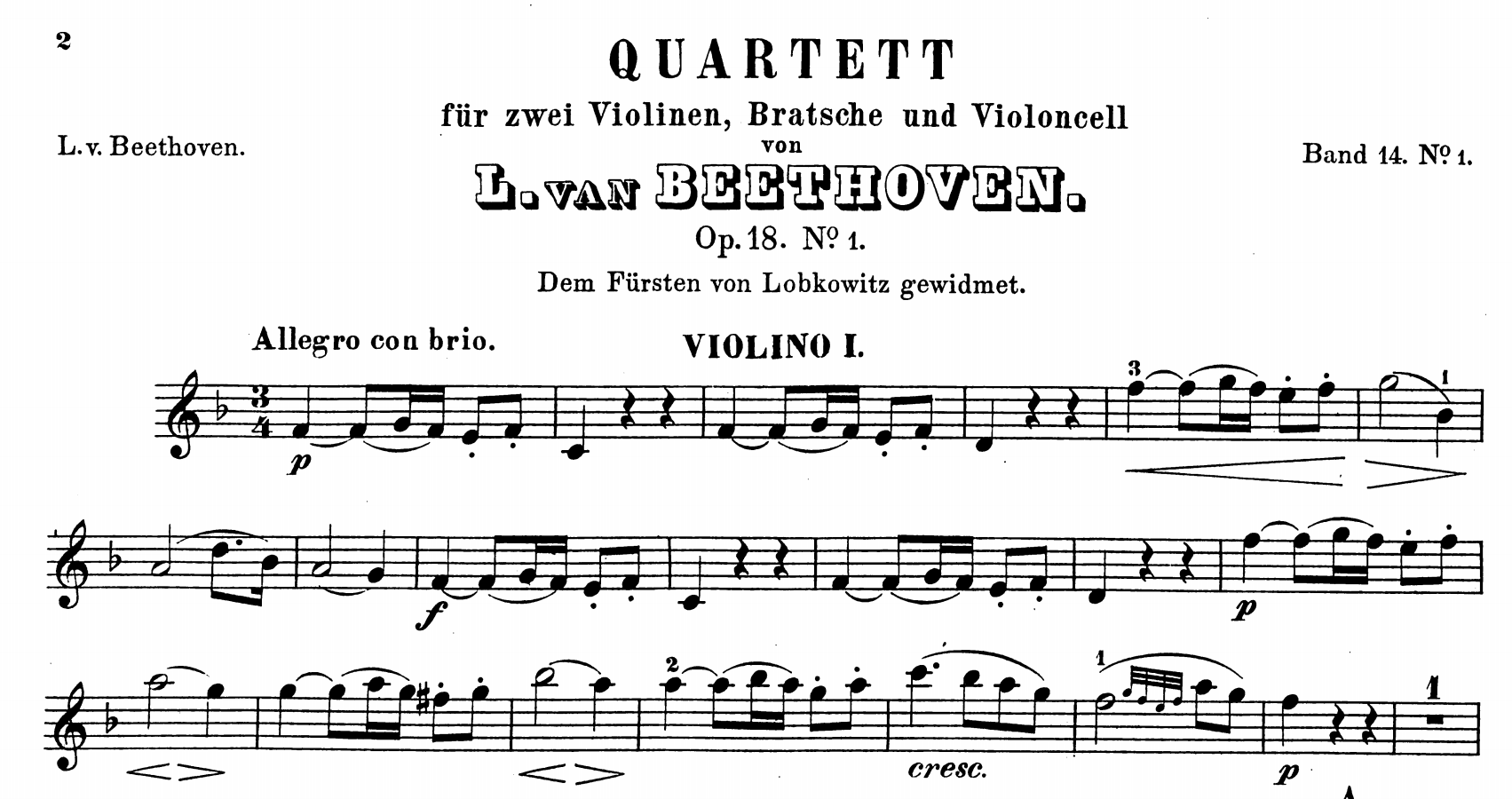
PREVIEW

Free Violin Sheet Music

“L’estro armonico” translates to “The Harmonic Inspiration” in English. This opus represents a set of twelve concertos for various combinations of solo instruments and orchestra. “L’estro armonico” was groundbreaking in its time because it introduced innovative and diverse instrumental combinations within the concerto genre. Its influence extended far beyond Vivaldi’s own time, as it played a pivotal role in shaping …

Ludwig van Beethoven’s Piano Concerto No. 4 in G major, Op. 58, is a masterpiece known for its sublime melodies, innovative structure, and emotional depth. While originally composed for the piano, this concerto has been adapted for various instruments, including the violin. Performing Beethoven’s Piano Concerto No. 4 on the violin is a daunting yet rewarding challenge that demands a …

Rossini‘s effervescent overture to La gazza ladra (The Thieving Magpie) is a cornerstone of the violin repertoire, a whirlwind of virtuosity and charm that has captivated audiences for over two centuries. Grabbing your violin and diving into this iconic piece is an exhilarating experience, demanding both technical precision and a playful spirit. For violinists, La gazza ladra presents a delightful …

Ludwig van Beethoven’s Symphony No. 9 in D minor, Op. 125, is one of the most celebrated and iconic works in the classical music repertoire. This symphony is often referred to as the “Choral Symphony” because it includes vocal soloists and a choir in its final movement. Beethoven composed it between 1817 and 1824, and it was first performed on …

Haydn’s Symphony No. 94 in G major, “Surprise Symphony” gained its nickname from the unexpected loud chord that appears in the second movement after a soft, lyrical theme. The sudden fortissimo chord, or “surprise,” was added by Haydn to wake up the audience, as it was customary during the performances for the audience to become a bit too relaxed. This …

Navarra, Op. 33 by Pablo de Sarasate! This masterpiece, composed in 1889 as a tribute to his native province of Navarre in Spain, is a cornerstone of the violin repertoire, bursting with fiery energy and evocative melodies. While it’s often performed in its vibrant orchestral version, the Navarra takes on a unique and intimate character when played on a solo …

“Dido and Aeneas” is one of Henry Purcell’s most celebrated and enduring works. Composed around 1688, this opera is a landmark in English Baroque music. “Dido and Aeneas” is a tragic opera in three acts, with a libretto by Nahum Tate. While the exact date of composition is uncertain, it is believed to have been written around 1688. The opera …

Eugene Ysaye’s Poème élégiaque, Op. 12, is a pinnacle of violin repertoire, a masterpiece of both technical challenge and emotional depth. Composed in 1892-1896, it stands as the first of his six “Poems” for violin and orchestra, each exploring a different emotion and pushing the boundaries of violinistic possibility. The Poème élégiaque, as its title suggests, is an elegy. It …

Claude Debussy’s Violin Sonata in G minor, composed in 1916-1917, is a significant work in the violin and piano chamber music repertoire. It is one of Debussy’s late compositions and reflects his mature compositional style, characterized by its impressionistic harmonies and textures.

The Queen of the Night’s aria, “Der Hölle Rache kocht in meinem Herzen” (Hell’s vengeance boils in my heart), is a truly captivating and complex piece within the opera The Magic Flute. While The Magic Flute is a Singspiel (opera with spoken dialogue), the Queen’s aria stands out as a pure operatic tour de force. It’s written in the style …

While Bach’s Violin Partita No. 1 in B minor, BWV 1002, is undoubtedly a masterpiece for solo violin, playing it on the instrument requires advanced skill and technical proficiency. It’s not exactly beginner-friendly territory. Right from the opening Allemande, Bach throws down the gauntlet with a series of double stops, playing two notes simultaneously. This requires precise intonation and coordination between both hands. …

Paganini’s La Campanella – the very name evokes images of a virtuoso violinist, fingers dancing across the strings with dazzling speed and precision, conjuring the delicate tinkling of a bell through the melody. Played as the final movement of Paganini’s Violin Concerto No. 2 in B minor, Op. 7, La Campanella is a showstopper, demanding both technical mastery and artistic …

Beethoven’s Moonlight Sonata, Op. 27 No. 2, stands as a titan of romanticism, its poignant melodies and dramatic swells captivating audiences for centuries. While often associated with the piano’s sonorous depths, this iconic piece takes on a new ethereal life when translated to the expressive voice of the violin. Playing the Moonlight Sonata on the violin isn’t simply a technical …

Holst’s “The Planets” is celebrated for its innovative orchestration. Holst used unique and imaginative combinations of instruments to evoke the characteristics of each planet. Given the technical demands and expressive nuances embedded in Holst’s “The Planets,” this piece is best suited for advanced and professional-level violinists. Players who have mastered a wide array of bowing techniques, possess exceptional control over …

Saint-Saëns incorporates humor and wit into the composition, making it accessible to a wide audience. The use of musical motifs, playful rhythms, and unexpected musical gestures contributes to the overall charm of the piece. Some of the movements include “Lion,” “Hens and Roosters,” “Tortoises,” “Elephant,” “Kangaroos,” and “The Swan.” Each movement captures the essence of the respective animal through clever …