
Holst – In The Bleak Midwinter

Home » Violin Sheet Music » Holst – In The Bleak Midwinter

Holst composed the music for this carol in 1906 as part of his collection of choral settings titled “Two Carols,” which also included “A Christmas Carol.” Holst’s musical setting of “In the Bleak Midwinter” has become one of the most well-known and beloved renditions of the carol, and it is often performed during the Christmas season.
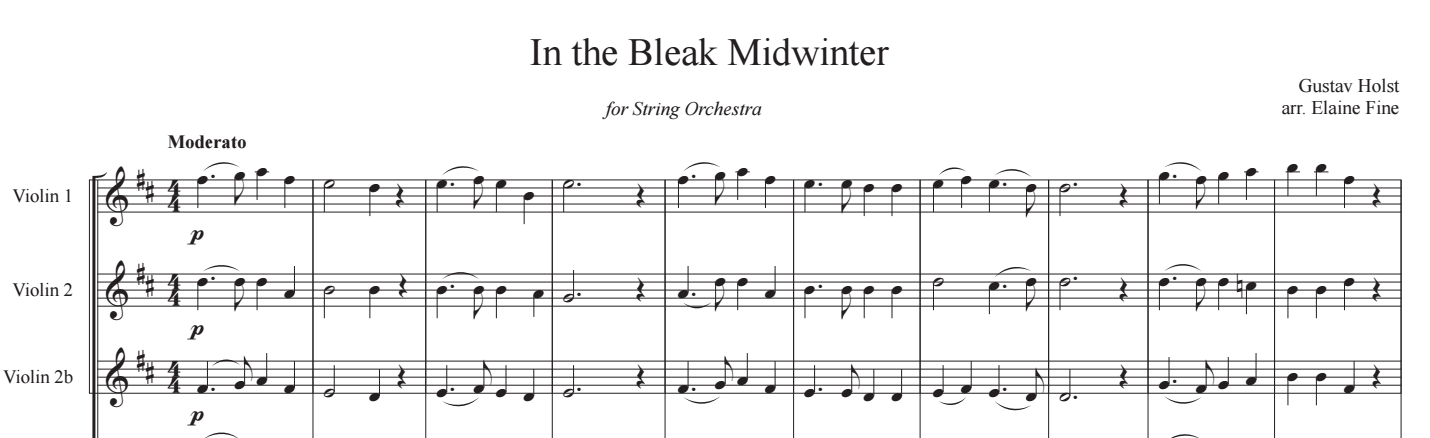
PREVIEW

Free Violin Sheet Music

Composed around 1764-1765, Symphony No. 22 is part of Haydn’s earlier works. It belongs to a set of symphonies written during his employment under Prince Nikolaus Esterházy. While the origin of the nickname “The Philosopher” is uncertain, it could be attributed to the work’s intellectual depth and the reflective nature of its movements. This symphony, with its intellectual depth and …

“Happy Birthday” is is a popular tune that can be played on the violin to celebrate someone’s special day. Enjoy making your celebration even more special with your easy violin music!

Wolfgang Amadeus Mozart, a musical prodigy of the Classical era, left an indelible mark on the world of music with his timeless compositions. Among his numerous masterpieces, Piano Concerto No. 20 in D minor, K.466, stands out as a pinnacle of expression and emotion. While typically performed on the piano, the idea of rendering this majestic concerto on the violin …

The symphony premiered on December 22, 1808, in Vienna, Austria. This historic concert, conducted by Beethoven himself, featured several of his compositions, including the Fifth Symphony. The Fifth Symphony is composed of four movements, each with its distinct character: Given the technical demands and interpretative challenges, tackling Beethoven’s Symphony No. 5 on the violin is best suited for advanced and …

“Träumerei” is part of Schumann’s collection of piano pieces titled “Kinderszenen” or “Scenes from Childhood.” The title translates to “Dreaming” in English, reflecting the piece’s introspective and nostalgic nature. The melody unfolds with gentle phrasing and a sense of wistfulness, making it a favorite among musicians and audiences alike. Transcribing piano compositions for the violin requires careful consideration of the …

“Dido and Aeneas” is one of Henry Purcell’s most celebrated and enduring works. Composed around 1688, this opera is a landmark in English Baroque music. “Dido and Aeneas” is a tragic opera in three acts, with a libretto by Nahum Tate. While the exact date of composition is uncertain, it is believed to have been written around 1688. The opera …

Felix Mendelssohn’s Violin Concerto in E minor, Op. 64, is one of the most beloved and frequently performed violin concertos in the classical repertoire. Mendelssohn composed this concerto in 1844, and it has since become a staple for violinists due to its beautiful melodies, lyrical passages, and virtuosic elements.

Composed in 1829 as part of Rossini’s opera “William Tell,” the overture is divided into four distinct sections: the pastoral introduction featuring the famous solo for English horn, the stormy Allegro section, the calm and lyrical Andante, and the finale, which is marked by its galloping pace and heroic themes. Adapting this symphonic work for the violin requires not only …

Handel’s Samson is a magnificent three-act oratorio, considered one of his finest dramatic works. Composed in 1741, immediately after the completion of his celebrated Messiah, it tells the story of the biblical Samson, a powerful Israelite judge who is betrayed by his lover Delilah and eventually brings down the Philistine temple upon himself and his enemies. Several of the arias …

The Piano Concerto No. 1 in B-flat minor, Op. 23, is one of the most famous and frequently performed piano concertos in the classical repertoire. The concerto is known for its dramatic and virtuosic piano writing, particularly in the first movement. It features beautiful and memorable melodies, powerful orchestration, and a strong emotional range. The second movement is a lyrical …

“Abdelazer” is an example of Purcell’s ability to integrate music seamlessly into a dramatic context. The combination of spoken drama and musical elements creates a multi-faceted experience that was characteristic of the semi-opera genre in Restoration England. The work remains a valuable contribution to the rich tapestry of Purcell’s theatrical compositions. “Abdelazer” was composed as incidental music for a play …

Saint-Saëns incorporates humor and wit into the composition, making it accessible to a wide audience. The use of musical motifs, playful rhythms, and unexpected musical gestures contributes to the overall charm of the piece. Some of the movements include “Lion,” “Hens and Roosters,” “Tortoises,” “Elephant,” “Kangaroos,” and “The Swan.” Each movement captures the essence of the respective animal through clever …

Haydn’s Symphony No. 88 in G major was composed by Haydn in 1787 during his time in Esterházy. Musicians performing Symphony No. 88 should pay attention to the balance between the energetic and lyrical elements, bringing out the nuances in each movement. The finale, marked by its spirited nature, demands precision and rhythmic vitality for a successful interpretation. Playing Haydn’s …

Paganini’s La Campanella – the very name evokes images of a virtuoso violinist, fingers dancing across the strings with dazzling speed and precision, conjuring the delicate tinkling of a bell through the melody. Played as the final movement of Paganini’s Violin Concerto No. 2 in B minor, Op. 7, La Campanella is a showstopper, demanding both technical mastery and artistic …

Ludwig van Beethoven’s “Fur Elise” (which means “For Elise” in English) is one of his most famous compositions, originally written for the piano. While it is not originally a piece for violin, many musicians and composers have created arrangements and transcriptions of “Fur Elise” for various instruments, including the violin. Violinists often enjoy playing adaptations of this piece because of …