
Tchaikovsky – Nutcracker Op.71

Home » Violin Sheet Music » Tchaikovsky – Nutcracker Op.71

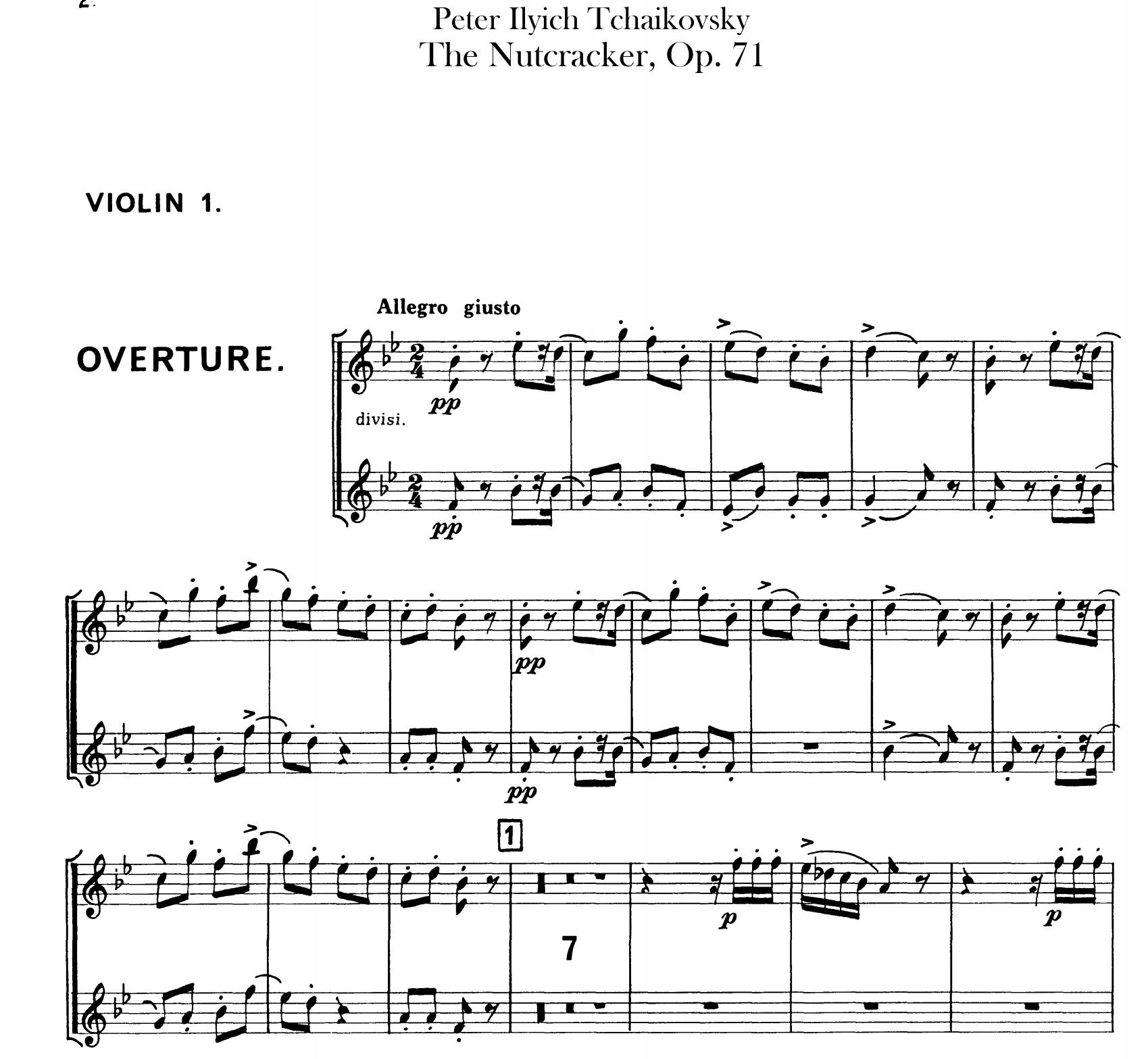
“The Nutcracker” is traditionally performed during the holiday season, making it a cherished part of many people’s Christmas celebrations. The ballet’s festive and magical atmosphere has made it a family favorite for generations.”The Nutcracker” is known for its iconic pieces, including the “Dance of the Sugar Plum Fairy,” the “Waltz of the Flowers,” the “Russian Dance (Trepak),” and the “March,” among others. Each of these pieces has its own unique character and musical theme. Complete Act I and II sheet music for violin.

Advanced violinists can aim to tackle the entire suite or perform challenging solo arrangements of specific movements. Tchaikovsky’s intricate ornamentations and rapid passages demand a high level of technical prowess, including advanced bowing techniques, shifting, and nuanced vibrato.
PREVIEW

Free Violin Sheet Music

Sarasate’s Zigeunerweisen, Gypsy Airs Op 20 , is a tempestuous masterpiece, a whirlwind of virtuosic violin writing often associated with the fiery passion and flamboyant flair of Gypsy music. But what if this passionate dance took to the stage not with a full orchestra, but with the intimate voice of a solo violin? Playing Zigeunerweisen on violin is more than …

While Eine kleine Nachtmusik, K.525, typically shines as a string ensemble piece, its spirit translates surprisingly well to solo violin. Imagine the familiar melodies, originally woven through shimmering violins, violas, and cellos, now gracefully dancing on a single string. The opening Allegro might take on a playful intimacy, the serenade-like Romanze feel like a whispered secret, and the Menuetto exude …

Clara Schumann composed her Piano Concerto in A minor, Op. 7, in 1835 when she was just 15 years old. This concerto is one of her early compositions and demonstrates her prodigious talent as both a pianist and a composer. Intermediate and early advanced violinists may find certain sections of the concerto approachable, but capturing the full essence of Clara …

“Dido and Aeneas” is one of Henry Purcell’s most celebrated and enduring works. Composed around 1688, this opera is a landmark in English Baroque music. “Dido and Aeneas” is a tragic opera in three acts, with a libretto by Nahum Tate. While the exact date of composition is uncertain, it is believed to have been written around 1688. The opera …

Tchaikovsky‘s String Quartet No. 1 in D major, Op. 11, is a cornerstone of chamber music repertoire, and for violinists, wielding the melody within its movements is a privilege like no other. Composed in 1871, the quartet bursts with Tchaikovsky’s signature passion, lyricism, and emotional depth, offering a violinist a canvas to paint a tapestry of sound. Tchaikovsky’s gift for …

Symphony No. 83 in G minor, “The Hen”, like many of Haydn’s works, was composed during his time in London in 1785. It is renowned for its inventive use of musical elements, including a unique second movement that imitates the clucking of a hen, hence the nickname. This symphony showcases Haydn’s wit and creativity, making it a notable piece in …

Claude Debussy’s Violin Sonata in G minor, composed in 1916-1917, is a significant work in the violin and piano chamber music repertoire. It is one of Debussy’s late compositions and reflects his mature compositional style, characterized by its impressionistic harmonies and textures.

The melody for “Twinkle, Twinkle, Little Star” is also the same as that of the French nursery rhyme “Ah! vous dirai-je, maman” and Wolfgang Amadeus Mozart famously used this melody for his variations for piano, K. 265/300e. The simple and repetitive nature of the rhyme makes it a favorite for young children and is often one of the first songs …

Bizet’s Carmen, a fiery operatic tale of passion and defiance, explodes onto the stage with its larger-than-life characters and powerful melodies. But imagine stripping away the orchestral pomp and placing this emotional rollercoaster on the delicate shoulders of a single violin. With the orchestra silenced, the violin becomes the sole storyteller, weaving Carmen’s seductive Habanera with slithering grace and potent …

“Träumerei” is part of Schumann’s collection of piano pieces titled “Kinderszenen” or “Scenes from Childhood.” The title translates to “Dreaming” in English, reflecting the piece’s introspective and nostalgic nature. The melody unfolds with gentle phrasing and a sense of wistfulness, making it a favorite among musicians and audiences alike. Transcribing piano compositions for the violin requires careful consideration of the …

Mahler’s “Kindertotenlieder” (Songs on the Death of Children) is known for its exquisite and deeply emotional music, characterized by lush orchestration and profound vocal lines. The cycle is often performed by a mezzo-soprano or baritone, and it’s a deeply moving experience for both performers and listeners. Nun will die Sonn’ so hell aufgeh’n (Now the sun wants to rise as …

Brahms’ Hungarian Dance No. 5 in F sharp minor, WoO 1 No. 5, is a captivating melody, infused with the fiery spirit of Hungarian music. Traditionally heard in its orchestral or piano settings, this passionate dance takes on a new life when interpreted on the solo violin. Stripped of its orchestral grandeur, the violin becomes the sole vessel for Brahms’ …

Composed in 1829 as part of Rossini’s opera “William Tell,” the overture is divided into four distinct sections: the pastoral introduction featuring the famous solo for English horn, the stormy Allegro section, the calm and lyrical Andante, and the finale, which is marked by its galloping pace and heroic themes. Adapting this symphonic work for the violin requires not only …

Ludwig van Beethoven’s Symphony No. 9 in D minor, Op. 125, is one of the most celebrated and iconic works in the classical music repertoire. This symphony is often referred to as the “Choral Symphony” because it includes vocal soloists and a choir in its final movement. Beethoven composed it between 1817 and 1824, and it was first performed on …

Rachmaninoff’s Piano Concerto No. 2 in C minor, Op. 18, is one of his most famous and beloved compositions. It was composed between 1900 and 1901 and is considered a masterpiece of the Romantic era in classical music. The first movement is marked by its lyrical and passionate melodies. It begins with a hauntingly beautiful piano solo before the orchestra …