
Gounod – L’Angelus

Home » Piano Sheet Music » Gounod – L’Angelus

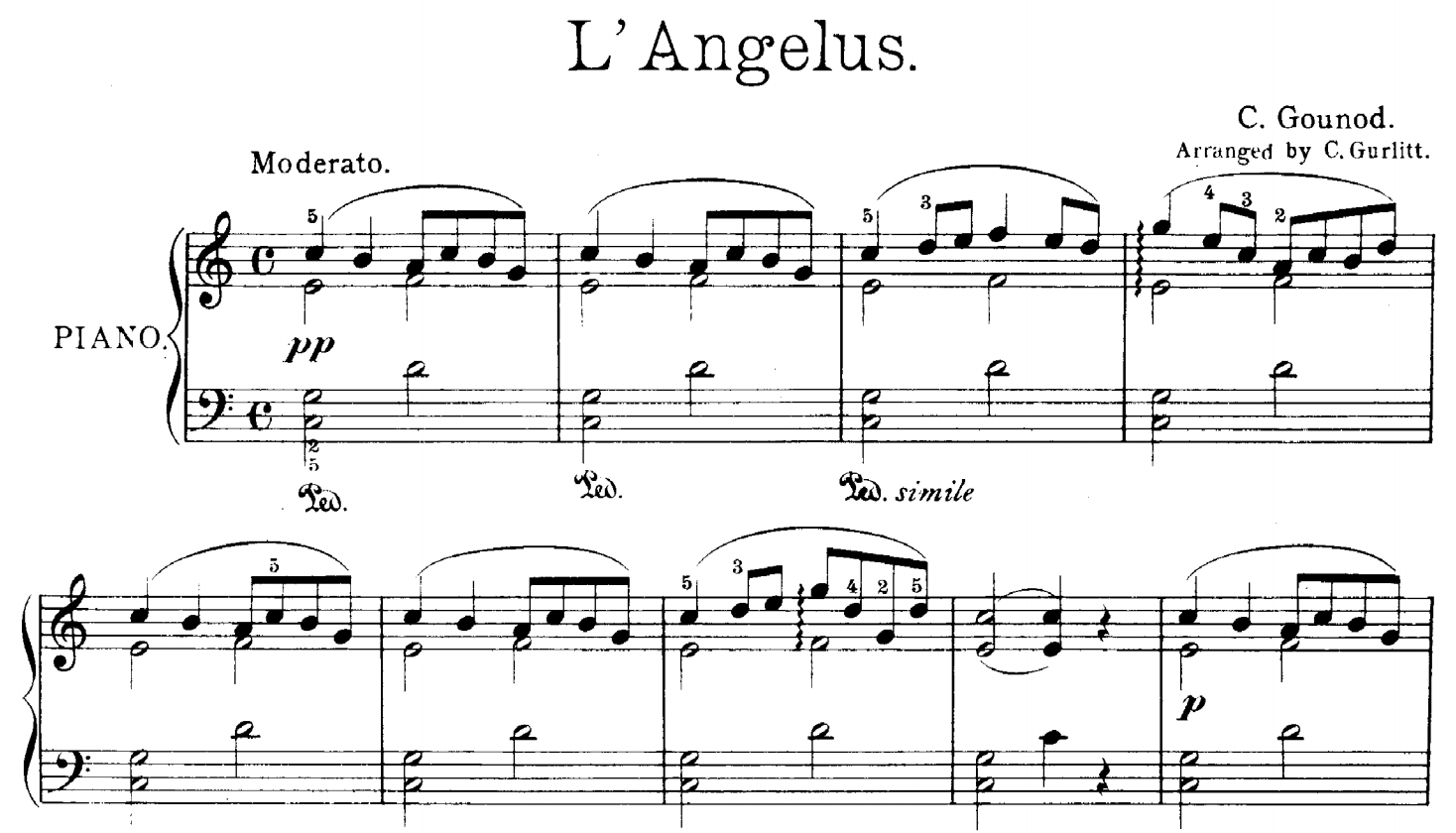
Gounod’s “L’Angelus” captures the solemnity and reverence of the Angelus prayer through its expressive melodies and harmonies. The title is French for “The Angelus,” and the music aims to convey the spirit of this prayerful moment.

“L’Angelus” is a vocal work that draws inspiration from the traditional Catholic devotion known as the Angelus, commemorating the Annunciation. The piece is typically scored for voice and piano, creating a contemplative and devotional atmosphere.

“L’Angelus” is best suited for pianists at the late beginner to early intermediate level. Players should be comfortable with basic hand coordination, reading musical notation, and have a reasonable grasp of fundamental piano techniques. While the piece does not require advanced virtuosity, it does call for a sensitive touch and an ability to convey the emotional depth embedded in the composition.
PREVIEW

Christmas Sheet Music

“Hark! The Herald Angels Sing” is a song that celebrates the joyous news of the birth of Jesus and is a staple of Christmas carol singing. The combination of Charles Wesley’s poetic lyrics and Felix Mendelssohn’s uplifting melody has made it a timeless favorite during the holiday season.

Peter J. Wilhousky wrote the lyrics and music for “Carol of the Russian Children” in 1936. He is the same composer who adapted the Ukrainian folk chant “Shchedryk” (sometimes spelled “Shchedrik”) to create the English version of “Carol of the Bells.” The lyrics of “Carol of the Russian Children” celebrate the beauty of the Russian landscape, particularly the valleys and …

“O Come, O Come, Emmanuel” is a well-known Christmas carol with its origins in medieval Latin hymns. It is a hymn of anticipation, longing for the coming of the Messiah. The lyrics are based on a set of seven Advent antiphons, each addressing a different name or attribute of Christ and used in the seven days leading up to Christmas. …

“O Sanctissima,” also known as “O du fröhliche,” is a hymn and carol dedicated to the Virgin Mary. The text of the hymn is attributed to the German poet and priest Fr. Caspar Stollhofen, who lived in the 17th century. The music is often associated with the Sicilian folk tune “O sanctissima,” and it has been used in various musical …

“A Great and Mighty Wonder” is a hymn with lyrics written by St. Germanus, Bishop of Constantinople, in the 7th century. The hymn reflects on the miraculous nature of the Incarnation, celebrating the birth of Jesus Christ. The text has been translated into English by various authors, and the melody is often associated with the German hymn “Es ist ein …

“Silent Night,” the beloved Christmas carol composed by Franz Xaver Gruber in 1818, is cherished for its gentle melody and timeless sense of peace. Playing this carol on the cello allows musicians to evoke its deep warmth and calm beauty. “Silent Night” is an excellent piece for beginner cellists due to its slow tempo, simple melody, and opportunities to develop …

“Ding Dong! Merrily on High” is a popular Christmas carol with French origins. The lyrics were written by English composer George Ratcliffe Woodward, and the melody is based on a 16th-century French dance tune. The title of the carol is derived from the sound of bells, which is often associated with the Christmas season.

The melody used in “Joy to the World” is actually from Handel’s Messiah, but the lyrics were written by Watts to celebrate the second coming of Jesus Christ, rather than his birth. The song has since become associated with Christmas and is commonly sung during the holiday season.

Herbert Sharpe (1876–1955) was a British composer and organist known for his contributions to choral and organ music. He held various positions as a church organist and choir director in England during his lifetime. Joyous Bells is one of his sacred works. One of the remarkable aspects of “Joyous Bells” is its versatility, making it accessible to pianists of various …

“What Child Is This?” is a Christmas carol with lyrics written by William Chatterton Dix in 1865. The lyrics are set to the tune of the traditional English folk song “Greensleeves.” The carol focuses on the birth of Jesus Christ and reflects on the significance of His arrival. To play “What Child Is This” on the piano, a pianist should …

Franz Liszt, the Hungarian composer and virtuoso pianist of the Romantic era, left an indelible mark on the world of classical music with his innovative compositions. One such gem that often goes overlooked in his extensive repertoire is “In Hungarian Style,” a delightful piece from his collection “The Christmas Tree.” This composition, rich in Hungarian folk influences, is a perfect …

“God Rest Ye Merry, Gentlemen” is one of the most well-known traditional English Christmas carols. It dates back to the 16th century and has a timeless, solemn melody that lends itself well to a variety of arrangements, including for the cello. This piece can benefit from dynamic contrast, especially to convey the solemn and majestic feel of the carol. Use …

“What Child Is This?” is a traditional Christmas carol set to the tune of “Greensleeves.” Since the piece has a flowing, lyrical quality, aim for smooth, connected bow strokes. Use a full bow for longer notes and maintain even pressure. If you’re comfortable with vibrato, use it to add warmth and expression to longer notes. However, don’t overdo it; subtlety …

“Deck the Halls” is a well-known traditional Christmas carol with Welsh origins, dating back to the 16th century. Its lively and festive melody is perfect for the holiday season. The carol is in a major key and follows a cheerful, upbeat rhythm, making it popular for group performances. Use smooth legato bowing for the longer phrases and short, crisp staccato …

Also known as “See Amid the Winter’s Snow” is a traditional Christmas carol with lyrics written by Edward Caswall and music composed by Sir John Goss. It was first published in 1854. This carol is known for its serene and reflective lyrics that tell the story of the birth of Jesus Christ and the adoration of the shepherds and angels. …