
The Coventry Carol

Home » Cello Sheet Music » The Coventry Carol

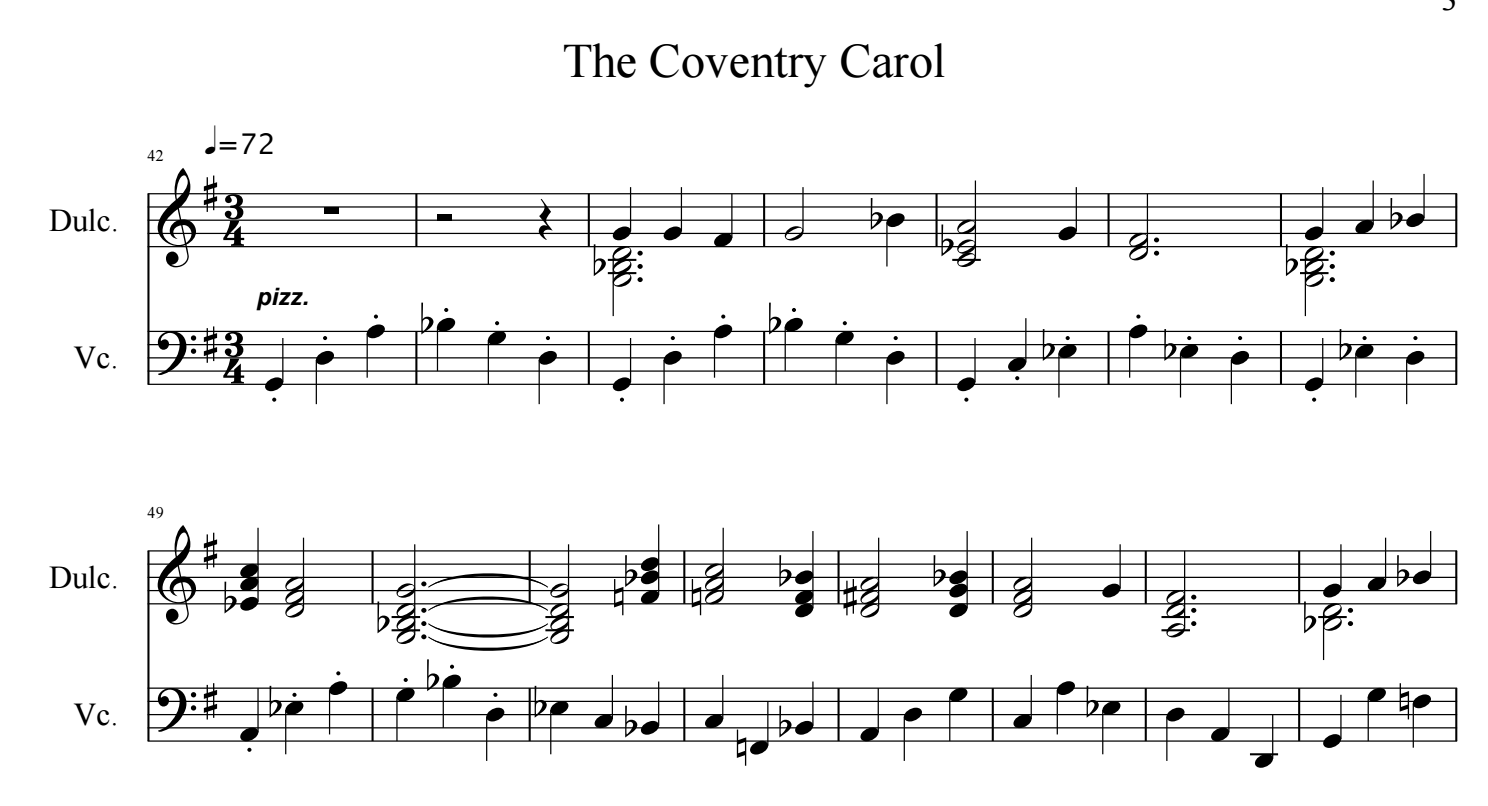
The Coventry Carol is a traditional English Christmas carol dating back to the 16th century. It was originally part of a mystery play called The Pageant of the Shearmen and Tailors, which depicted the biblical story of the Massacre of the Innocents, where King Herod ordered the killing of male infants. The carol is a haunting lullaby sung by mothers of the doomed children, making it one of the more somber and poignant Christmas tunes.

The carol has a mournful, lullaby-like character. Focus on bringing out the emotional depth of the piece with smooth, legato bowing and expressive dynamics. Avoid abrupt accents and keep a soft, flowing quality. Since this is a haunting and sorrowful piece, use vibrato delicately. A gentle, slow vibrato can enhance the lamenting feel but avoid overusing it as it may overpower the solemnity of the melody.
PREVIEW

Christmas Sheet Music

“Here We Come A-Wassailing” is a traditional English Christmas carol that is often sung during the holiday season. It’s a cheerful and festive song that expresses well-wishes and good cheer as people go door to door, singing and celebrating the Christmas spirit.

“All Praise to Jesus’ Hallowed Name” is a Christian hymn with lyrics written by Thomas Kelly in the early 19th century. The hymn is often set to the melody “Dix,” composed by Conrad Kocher. The text of the hymn focuses on praising the name of Jesus and acknowledging His role as Savior and Lord. When playing “All Praise to Jesus’ …

Handel’s Hallelujah Chorus, a masterpiece from his oratorio “Messiah,” is a celebrated piece that has resonated through the ages. While originally composed for a full orchestra and choir, the transcendent beauty of the piece can be captured on a single instrument, such as the violin. Playing Handel’s Hallelujah on the violin requires a certain level of skill and technique, making …

“Away in a Manger” is a popular Christmas carol that is often sung during the holiday season. It has become a well-loved part of Christmas traditions in many English-speaking countries. The lyrics and tune of this carol have been adapted and arranged in several variations over the years. H

“Jesus Christ the Apple Tree” is a popular English hymn that dates back to the 18th century. The lyrics of this hymn are often attributed to an unknown author. It is sometimes referred to as “The Apple-Tree Song” or simply “The Apple Tree.” The hymn uses the metaphor of an apple tree to represent Jesus Christ, drawing parallels between the …

“Quem Pastores Laudavere” is a traditional German Christmas carol that has been cherished for centuries. The title translates to “Whom the Shepherds Praised” in English. The origins of “Quem Pastores Laudavere” can be traced back to medieval Germany, likely around the 14th century. This carol has endured the test of time and has become a beloved part of the Christmas …

“Formerly” is one of the delightful pieces from Franz Liszt’s “Weihnachtsbaum” (The Christmas Tree) collection. This collection, composed in 1874, consists of 12 short piano pieces, each inspired by different aspects of the Christmas season. “Formerly” is a charming and nostalgic piece that reflects on the joys and memories of Christmases past. Liszt’s musical language beautifully captures the sentiment of …

“Hark! The Herald Angels Sing” is often performed with organ accompaniment, and it sounds particularly majestic when played on an organ due to the instrument’s rich and powerful sound. The organ arrangement of the carol can vary in complexity, with some versions featuring intricate harmonies and ornamentation. The music for the carol was composed by Felix Mendelssohn in 1840. The …

“Wachet auf, ruft uns die Stimme” BWV 645 is part of Bach’s Orgelbüchlein (Little Organ Book), which is a collection of chorale preludes for the organ. This particular chorale prelude is based on the hymn of the same name by Philipp Nicolai. The hymn itself is associated with the Advent season and is often used in church services. The piece …

“O Come, All Ye Faithful” is a popular Christmas carol with lyrics attributed to John Francis Wade, and it is often sung to the tune known as “Adeste Fideles.” The carol is also sometimes referred to by its Latin incipit, “Adeste Fideles.” The melody of “O Come, All Ye Faithful” is relatively straightforward, making it accessible to a broad range …

The exact origins of “God Rest Ye Merry, Gentlemen” are not well-documented, but it is believed to date back to the 16th century or earlier. It is one of the many traditional carols that have been passed down through generations. The phrase “God rest ye merry” is often misunderstood in modern English. In this context, “rest” means “keep” or “make,” …

“Knecht Ruprecht” is the fourth movement from Schumann’s piano suite titled “Album für die Jugend” (Album for the Young), Op. 68. Composed in 1848, this piece embodies the festive spirit of the holiday season, featuring playful and whimsical elements. The title refers to a traditional German Christmas character, Knecht Ruprecht, who accompanies St. Nicholas to reward or admonish children based …

“December: Christmas” is the twelfth and final piece in Pyotr Ilyich Tchaikovsky’s collection “The Seasons.” This piece is a musical representation of the Christmas holiday, capturing the festive and joyous atmosphere associated with this time of the year. Tchaikovsky incorporates traditional Christmas themes into the composition, creating a musical portrayal of the joy, warmth, and camaraderie associated with Christmas celebrations.

The “Coventry Carol” is one of the oldest known carols, dating back to the 16th century. It is traditionally sung as part of a mystery play called the “Pageant of the Shearmen and Tailors.” The play was performed in Coventry, England, and depicted the biblical story of the Massacre of the Innocents, which is found in the Gospel of Matthew. …

“Angels We Have Heard on High” is a traditional Christmas carol with French origins. The English lyrics were written by James Chadwick, an English Roman Catholic bishop, in the mid-19th century. The music for “Angels We Have Heard on High” is based on the traditional French melody of “Gloria in excelsis Deo,” which means “Glory to God in the Highest.” …