
Liszt – O Holy Night

Home » Piano Sheet Music » Liszt – O Holy Night

“O Heilige Nacht” is the German translation of the Christmas carol “O Holy Night,” which was composed by Adolphe Adam. This piece is part of Weihnachtsbaum which is a suite of 12 pieces written by Franz Liszt in 1873–1876.

The original version of “O Holy Night” is already a challenging piece for pianists due to its wide-ranging melodies and emotive content. Liszt’s arrangement takes it a step further, adding his own unique touch while preserving the essence of the original composition. Pianists attempting this piece should possess advanced sight-reading skills, a keen sense of musicality, and the ability to convey the profound spiritual nature of the carol.

Franz Liszt’s rendition of “O Holy Night” on the piano is a testament to his brilliance as a composer and pianist. While the original version of the carol is accessible to a broad range of skill levels, Liszt’s arrangement is a challenging masterpiece that requires the expertise of an advanced pianist. Playing this enchanting piece not only showcases technical prowess but also demands a deep connection to the emotional and spiritual essence of the music, allowing pianists to create a truly magical and memorable performance.
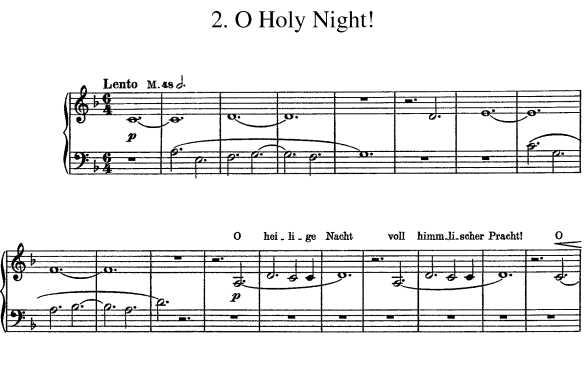
PREVIEW

Christmas Sheet Music

Herbert Sharpe (1876–1955) was a British composer and organist known for his contributions to choral and organ music. He held various positions as a church organist and choir director in England during his lifetime. Joyous Bells is one of his sacred works. One of the remarkable aspects of “Joyous Bells” is its versatility, making it accessible to pianists of various …

“It Came Upon the Midnight Clear” is a popular Christmas carol with lyrics written by Edmund Sears and music composed by Richard Storrs Willis. The carol was first published in 1850. The tune composed by Richard Storrs Willis is a beautiful and peaceful melody, often sung during the Christmas season to celebrate the birth of Jesus Christ and to convey …

Camille Saint-Saëns’ “Christmas Oratorio” (Oratorio de Noël), Op. 12, is a beautifully crafted sacred work for choir, soloists, and small orchestra. Composed in 1858, it is often performed during the Advent or Christmas season and is notable for its lyrical and serene character. The piece features 10 movements, and it is imbued with a sense of warmth and intimacy rather …

“In the Bleak Midwinter” is a Christmas carol that was written by the English poet Christina Rossetti. It was first published in 1872 as part of a collection of her poems titled “Goblin Market and Other Poems.” The poem has since been set to music by several composers, but the most famous musical setting was composed by Gustav Holst in …

“Hark! The Herald Angels Sing” is a well-known Christmas carol that has been sung and arranged for various instruments since its inception. Mendelssohn’s original music is jubilant and stately, making it a popular piece during holiday performances. The melody should be played with smooth, lyrical phrasing to reflect the carol’s uplifting and joyful nature. Emphasize dynamic contrasts. Play softly during …

“We Wish You a Merry Christmas” is a traditional English Christmas carol that dates back to the 16th century. It’s a joyful and lively song that’s popular during the holiday season. The melody is relatively simple and repetitive, making it a great choice for beginner to intermediate cellists who are looking for festive repertoire. Since this piece has a lively …

“The Holly and the Ivy” is a traditional English Christmas carol that dates back to the 18th century. It celebrates the symbolism of holly and ivy in Christian traditions, where holly represents Jesus and his suffering (the sharp leaves symbolizing the crown of thorns, and the red berries his blood), while ivy symbolizes the Virgin Mary. Since “The Holly and …

In the vast tapestry of Christmas carols, few compositions resonate as beautifully and timelessly as Herbert Hughes’ “Carol of Jesus Child.” This enchanting piece, originally written for voice and piano, captures the essence of the holiday season with its evocative melodies and tender harmonies. Today, let’s explore the charm of this carol and discuss the skill level required for pianists …

The lyrics of “Gaudete” are written in Latin and are inspired by verses from the Bible, particularly Philippians 4:4-7. The carol expresses joy and celebration at the coming of Christ and encourages believers to rejoice in the Lord. It is a lively and upbeat song that is typically sung with enthusiasm and energy.

“Silent Night” (German: “Stille Nacht, heilige Nacht”) is one of the most beloved and well-known Christmas carols worldwide. It was composed by Franz Xaver Gruber, with lyrics written by Joseph Mohr. The carol was first performed in the small Austrian village of Oberndorf on Christmas Eve in 1818. Gruber’s “Silent Night” remains a timeless gem in the world of Christmas …

“Frosty the Snowman” was written by Walter “Jack” Rollins and Steve Nelson. They composed the song in 1950. The song tells the story of Frosty, a snowman who comes to life when a magical hat is placed on his head. Frosty then leads the children in the song on various adventures before eventually melting away, promising to return again someday. …

“Amazing Grace” is a well-known Christian hymn that has become a classic in the realm of religious and folk music. The lyrics were written by John Newton, a British sailor and former slave trader, and the music is a traditional tune, possibly of Scottish origin. The hymn reflects Newton’s personal spiritual transformation and his understanding of divine grace and forgiveness.

“Deck the Halls” is a traditional Christmas carol that is typically sung during the holiday season. It’s a cheerful and festive song that encourages people to decorate their homes and celebrate the Christmas spirit.

Tchaikovsky’s “Dance of the Sugar Plum Fairy” from the timeless ballet “The Nutcracker” is a masterpiece that has captivated audiences for generations. Bringing this enchanting piece to life on the piano requires skill and finesse, making it a delightful challenge for pianists of different levels. The delicate and magical melody of the “Dance of the Sugar Plum Fairy” is characterized …

“In Dulci Jubilo” arranged for the Organ. The original text is attributed to Heinrich Seuse, a German mystic, and poet who lived in the 14th century. The song celebrates the joy and happiness of the Christmas season, and it has been performed and recorded by many artists and choirs over the centuries.