
It Came Upon the Midnight Clear

Home » Violin Sheet Music » It Came Upon the Midnight Clear

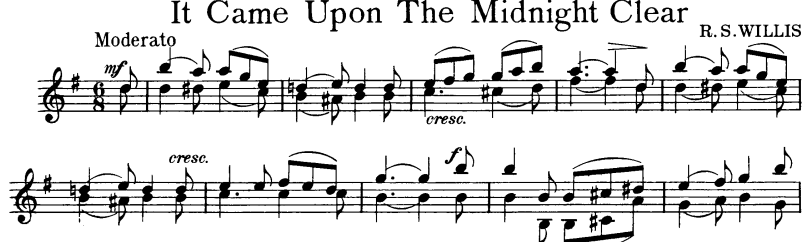
“It Came Upon the Midnight Clear” is a popular Christmas carol with lyrics written by Edmund Sears and music composed by Richard Storrs Willis. The carol was first published in 1850. The tune composed by Richard Storrs Willis is a beautiful and peaceful melody, often sung during the Christmas season to celebrate the birth of Jesus Christ and to convey a message of peace and goodwill to all. It has become a beloved part of the holiday repertoire and is performed in various arrangements by choirs, musicians, and singers around the world.

“It Came Upon the Midnight Clear” is well-suited for intermediate to advanced violinists. While the melody is relatively straightforward, the piece demands a refined sense of bow control, intonation, and musical sensitivity. Intermediate players will find the main theme accessible, but advanced musicians can explore the nuances within the composition, infusing it with their own artistic interpretations.
PREVIEW

Christmas Sheet Music

The Arabian Dance, also known as the Coffee Dance, is part of the second act of “The Nutcracker.” Tchaikovsky masterfully incorporates Middle Eastern influences, using rich and evocative melodies to transport listeners to a world of mystery and enchantment. The piano arrangement retains the exotic charm, allowing pianists to express the nuances of the original orchestral score. Pyotr Ilyich Tchaikovsky’s …

“Ave Maria” composed by Charles Gounod is one of the most well-known settings of this prayer. Gounod’s “Ave Maria” is based on Johann Sebastian Bach’s “Prelude in C Major,” specifically from the first prelude in his collection titled “The Well-Tempered Clavier,” BWV 846. Gounod added a vocal melody and adapted the music to fit the traditional Latin text of the …

“It Came Upon a Midnight Clear” is a Christmas carol that was written by American pastor and poet Edmund Hamilton Sears in 1849. The carol is set to music composed by Richard Storrs Willis, and it was first published in the “Christian Register” in Boston in December 1850. The lyrics of the carol reflect themes of peace and the message …

The Sussex Carol, also known as “On Christmas Night All Christians Sing,” is a traditional English Christmas carol. It is believed to have originated in the Sussex region of England, hence the name. The Sussex Carol is a popular traditional Christmas song, and it has been recorded and performed by various artists and choirs over the years. It captures the …

“O Nata Lux de Lumine” or “O Light Born of Light” is a hymn often associated with the Christian liturgy, particularly the office of Compline. It is commonly used during the Advent season.

Franz Liszt, the Hungarian composer and virtuoso pianist of the Romantic era, left an indelible mark on the world of classical music with his innovative compositions. One such gem that often goes overlooked in his extensive repertoire is “In Hungarian Style,” a delightful piece from his collection “The Christmas Tree.” This composition, rich in Hungarian folk influences, is a perfect …

“German Dance, K.605 No.3” or “Sleigh Ride” or in German “Die Schlittenfahrt” from the set of Three German Dances, K.605 is a lively and festive composition that captures the joyful spirit of a sleigh ride. Arranged for violin.

Bach’s Christmas Oratorio is a monumental work composed for the Christmas season, celebrating the birth of Christ through vibrant choruses, arias, and recitatives. It is written for a full choir, soloists, and orchestra, with text from the Gospels of Luke and Matthew, and draws on both sacred and secular themes. The six parts of the oratorio each have their own …

Franz Liszt’s “Carillon” is a delightful and evocative piano composition. Liszt, a prominent figure in the Romantic era of classical music, composed this piece as part of his larger work titled “Années de pèlerinage” (Years of Pilgrimage). “Années de pèlerinage” is a collection of three suites for solo piano, and “Carillon” is part of the first suite, “Suisse” (Switzerland). “Carillon” …

“Christmas Is Coming” is a traditional Christmas song that is often associated with the holiday season. It is not a well-known or widely recognized Christmas song with a distinct origin. It may be a lesser-known or regional carol, and there isn’t significant historical or cultural information available about it. However it is commonly sung as part of the Christmas carol …

“The Birthday of a King” is a Christmas song written by William H. Neidlinger, with lyrics by William H. Neidlinger and E. R. Munro. It was first published in 1890 and has since become a traditional Christmas carol. The song celebrates the birth of Jesus Christ and the joyous occasion of His arrival. “The Birthday of a King” was originally …

“Bring a Torch, Jeanette, Isabella” is a traditional French Christmas carol, known as “Un flambeau, Jeanette, Isabelle” in French. It dates back to the 16th century and is still popular during the Christmas season today. It is generally considered a relatively easy Christmas carol to play on the piano, making it a suitable choice for pianists of various skill levels. …

The Russian Trepak, also known as the “Russian Dance,” is a lively and energetic piece from Tchaikovsky’s Nutcracker Suite. It captures the spirit of Russian folk dance, complete with its lively tempo and infectious melodies. The music is characterized by its brisk pace, intricate rhythms, and triumphant flair, making it a favorite among both performers and listeners. While Tchaikovsky originally …

“Die musikalische Schlittenfahrt,” which translates to “The Musical Sleigh Ride” in English, is a delightful and festive composition by the German composer Leopold Mozart. Leopold Mozart, father of the renowned Wolfgang Amadeus Mozart, was a composer, conductor, and violinist during the 18th century. Leopold Mozart’s “Die musikalische Schlittenfahrt” is a musical depiction of a sleigh ride, capturing the joy and …

“Angels We Have Heard on High” is a traditional Christmas carol, originating from France. The song is best known for its “Gloria in excelsis Deo” refrain, which reflects the biblical story of angels proclaiming the birth of Jesus to shepherds. The melody, known as “Gloria”, is believed to have been written in the 18th century, while the English lyrics were …