
Liszt – In Hungarian Style

Home » Piano Sheet Music » Liszt – In Hungarian Style

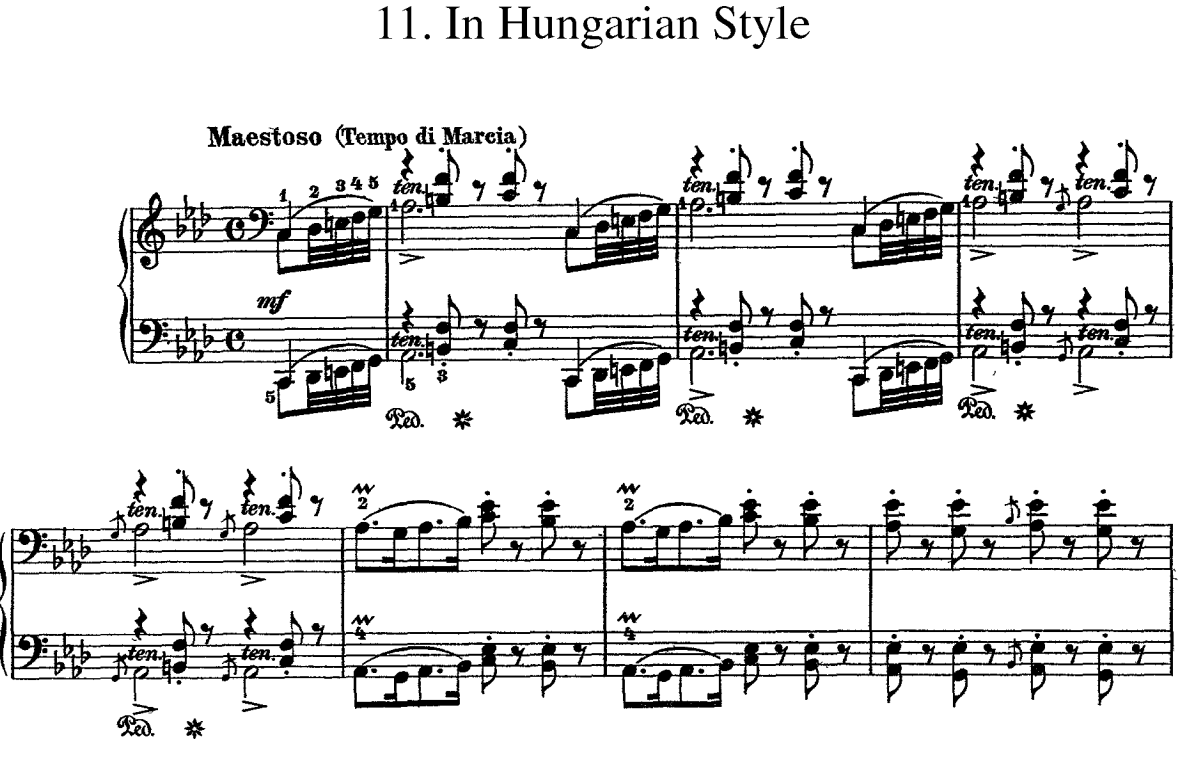
Franz Liszt, the Hungarian composer and virtuoso pianist of the Romantic era, left an indelible mark on the world of classical music with his innovative compositions. One such gem that often goes overlooked in his extensive repertoire is “In Hungarian Style,” a delightful piece from his collection “The Christmas Tree.” This composition, rich in Hungarian folk influences, is a perfect addition to your festive piano repertoire.

To embark on this musical journey, a pianist should possess an intermediate to advanced skill level. The piece demands technical proficiency, particularly in executing rapid passages and maintaining precise fingerwork. The dynamic contrasts, expressive nuances, and dramatic phrasing call for a pianist with a keen sense of musicality.
PREVIEW

Christmas Sheet Music

Composed as part of Handel’s renowned oratorio “Messiah,” this chorus erupts with triumphant joy, announcing the birth of Jesus Christ. The soaring soprano lines and rich choral harmonies paint a vivid picture of heavenly hosts proclaiming the good news. Handel’s “For unto us a child is born” is a timeless masterpiece, a cornerstone of the Christmas season and a powerful …

The “Coventry Carol” is a Christmas carol that dates back to the 16th century. It is part of a larger work known as the “Coventry Mystery Plays,” which were a series of dramatic presentations or pageants performed in Coventry, England, during the late Middle Ages. The carol is specifically associated with the “Pageant of the Shearmen and Tailors,” one of …

Bartók’s Romanian Christmas Songs is a delightful collection comprising six pieces, each a musical gem reflecting the festive traditions of Romania. The composer’s keen interest in folk music is evident in the use of modal scales, rhythmic intricacies, and the incorporation of rustic dance elements. From the lively and celebratory “Dance of the Bagpipes” to the contemplative and haunting “Pillow …

“Christmas Postlude,” is a musical composition often played on the organ in churches during the Christmas season. The title “Sit Laus Plena Sit Sonora” is Latin and can be translated as “Let there be full praise, let there be sound.” This suggests that the composition is intended to be a celebratory and joyful piece of music appropriate for the Christmas …

The piece is part of Berlioz’s larger work, the oratorio “L’Enfance du Christ” (The Childhood of Christ). “Sérénade agreste à la Madone” is the final movement of Part II of the oratorio. It depicts the shepherds bidding farewell to the Holy Family as they flee to Egypt. Adapting orchestral compositions for the piano is no easy task, and yet, the …

The lyrics of “Gaudete” are written in Latin and are inspired by verses from the Bible, particularly Philippians 4:4-7. The carol expresses joy and celebration at the coming of Christ and encourages believers to rejoice in the Lord. It is a lively and upbeat song that is typically sung with enthusiasm and energy.

In the vast tapestry of Christmas carols, few compositions resonate as beautifully and timelessly as Herbert Hughes’ “Carol of Jesus Child.” This enchanting piece, originally written for voice and piano, captures the essence of the holiday season with its evocative melodies and tender harmonies. Today, let’s explore the charm of this carol and discuss the skill level required for pianists …

“What Child Is This?” is a popular Christmas carol that is often sung during the holiday season. The lyrics are set to the tune of the English folk song “Greensleeves.” The carol is known for its serene and reflective tone, and it focuses on the nativity story of the birth of Jesus Christ. While “What Child Is This” may seem …

“Fum, Fum, Fum” is a traditional Christmas carol that originated in Catalonia, a region in northeastern Spain. The lyrics of the carol are simple and joyful. The word “fum” means “smoke” in Catalan, and the repeated “fum, fum, fum” in the song is often interpreted as an onomatopoeic representation of a drum or a strumming sound. The carol typically celebrates …

“O Sanctissima,” also known as “O du fröhliche,” is a hymn and carol dedicated to the Virgin Mary. The text of the hymn is attributed to the German poet and priest Fr. Caspar Stollhofen, who lived in the 17th century. The music is often associated with the Sicilian folk tune “O sanctissima,” and it has been used in various musical …

The Waltz of the Flowers is a dazzling segment from the second act of “The Nutcracker,” where the Sugar Plum Fairy welcomes the arrival of the beautiful flowers. Tchaikovsky’s genius is evident in the intricate melodies, lush harmonies, and graceful waltz rhythm that characterize this piece. Adapting it for the piano allows musicians to explore the rich tapestry of Tchaikovsky’s …

“Christ Was Born on Christmas Day” is a traditional Christmas carol that celebrates the birth of Jesus Christ. The lyrics emphasize the joy and significance of this momentous event in Christian theology. The carol is often sung during the Christmas season in various Christian denominations and has been performed and recorded by numerous artists. The carol typically reflects on the …

“Silver Bells” is a classic Christmas song written by Jay Livingston and Ray Evans. It was first performed by Bob Hope and Marilyn Maxwell in the 1951 film “The Lemon Drop Kid.” The song is known for its cheerful and festive lyrics, which evoke the joyful atmosphere of the holiday season in a bustling city. The original version of “Silver …

“Deck the Halls” is a traditional Christmas carol that is typically sung during the holiday season. It’s a cheerful and festive song that encourages people to decorate their homes and celebrate the Christmas spirit.

“Christmas in Sicily” is one of the masterpieces of Italian-American composer Pietro Alessandro Yon. Yon was a renowned organist and composer known for his contributions to sacred and holiday music.