
Carol of the Russian Children

Home » Piano Sheet Music » Carol of the Russian Children

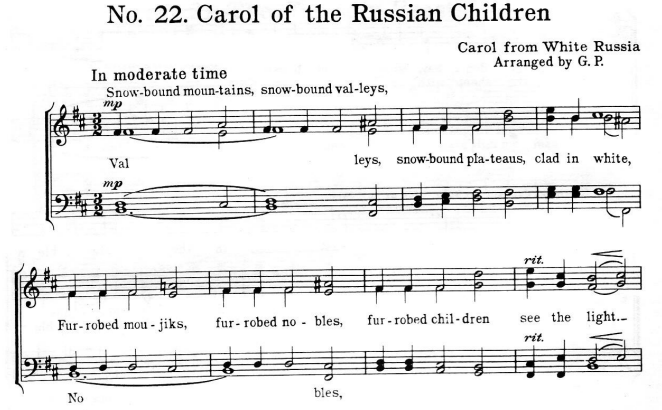
Peter J. Wilhousky wrote the lyrics and music for “Carol of the Russian Children” in 1936. He is the same composer who adapted the Ukrainian folk chant “Shchedryk” (sometimes spelled “Shchedrik”) to create the English version of “Carol of the Bells.” The lyrics of “Carol of the Russian Children” celebrate the beauty of the Russian landscape, particularly the valleys and snow-covered plains. The song captures a sense of wonder and nostalgia for the winter season in Russia.

“Carol of the Russian Children” is moderately challenging, requiring a pianist with an intermediate to advanced skill level. The piece demands a solid command of piano technique, including proficiency in hand coordination, dynamics, and expression. The intricate melodic lines and harmonic variations within the composition demand a nuanced touch and a keen understanding of musical phrasing.

Pianists aiming to tackle this piece should have a good grasp of both hands working independently, as there are moments of intricate interplay between the treble and bass clefs. Additionally, a nuanced sense of timing and a keen ear for subtle nuances in tempo are crucial for capturing the lively and spirited character of the composition.
PREVIEW

Christmas Sheet Music

The full title of Cantata BWV 191 “Gloria in excelsis Deo” is often attributed to Bach. However, there is some debate among scholars about its authorship, and some suggest that it may have been composed by someone else in the Bach family or a student of Bach. This piece is a setting of the Gloria text, a part of the …

“Christmas Postlude,” is a musical composition often played on the organ in churches during the Christmas season. The title “Sit Laus Plena Sit Sonora” is Latin and can be translated as “Let there be full praise, let there be sound.” This suggests that the composition is intended to be a celebratory and joyful piece of music appropriate for the Christmas …

Camille Saint-Saëns’ “Oratorio de Noël,” also known as his Christmas Oratorio, Op. 12, is a splendid and spiritually evocative composition. Written in 1858, this oratorio reflects Saint-Saëns’ mastery in blending sacred and festive elements. The piano rendition of Saint-Saëns’ Christmas Oratorio Op. 12 demands a pianist with an intermediate to advanced skill level. The piece presents challenges in terms of …

“Jingle Bells” is one of the most well-known and beloved Christmas songs worldwide. It was composed by James Lord Pierpont and was published under the title “One Horse Open Sleigh” in 1857. “Jingle Bells” is a jolly and upbeat song that captures the spirit of the holiday season. Its simple yet catchy melody makes it a perfect choice for pianists …

“Ave Maria”- D.839 Op.52 No.6 by Franz Schubert is a timeless and beautiful composition. Composed in 1825 as part of his work titled “Ellens dritter Gesang” (Ellen’s Third Song), it has since become known simply as “Ave Maria.” The lyrics are based on a German translation of Sir Walter Scott’s poem “The Lady of the Lake.” One of the joys …

“O Nata Lux de Lumine” or “O Light Born of Light” is a hymn often associated with the Christian liturgy, particularly the office of Compline. It is commonly used during the Advent season.

“Noel Nouvelet” is a traditional French Christmas carol that has been cherished for its beautiful melody and joyful lyrics. “Noel Nouvelet,” often simply referred to as “Noel,” dates back to the 15th century and is believed to have originated in the region of France. The carol is a celebration of the birth of Jesus Christ and has become a popular …

Adventlied, Op. 71 is a sacred choral work for mixed voices and orchestra by Robert Schumann, composed in 1848. The text is a poem by Friedrich Rückert, “Dein König kommt in niedern Hüllen” (“Your King comes in humble guise”). The work is a festive and triumphant celebration of the coming of Christ, with a strong emphasis on hope and renewal. …

“Angels from the Realms of Glory” is a Christmas carol with lyrics written by Scottish poet James Montgomery and music composed by Henry Thomas Smart. Smart was an English organist, composer, and conductor known for his hymn tunes. The carol was first published in 1816 in Montgomery’s newspaper, the Sheffield Iris, under the title “Nativity.” The lyrics of the carol …

“Deck the Halls” is a traditional Christmas carol that is typically sung during the holiday season. It’s a cheerful and festive song that encourages people to decorate their homes and celebrate the Christmas spirit.

The piece is part of Berlioz’s larger work, the oratorio “L’Enfance du Christ” (The Childhood of Christ). “Sérénade agreste à la Madone” is the final movement of Part II of the oratorio. It depicts the shepherds bidding farewell to the Holy Family as they flee to Egypt. Adapting orchestral compositions for the piano is no easy task, and yet, the …

The Waltz of the Flowers is a dazzling segment from the second act of “The Nutcracker,” where the Sugar Plum Fairy welcomes the arrival of the beautiful flowers. Tchaikovsky’s genius is evident in the intricate melodies, lush harmonies, and graceful waltz rhythm that characterize this piece. Adapting it for the piano allows musicians to explore the rich tapestry of Tchaikovsky’s …

The “Méditation” from Charles Gounod’s adaptation of J.S. Bach’s Prelude No. 1 in C major, BWV 846, commonly known as “Ave Maria,” is a well-known and beloved musical piece. Gounod composed this setting in the mid-19th century, creating a beautiful fusion of Bach’s Prelude with his own melodic lines and harmonies. The “Ave Maria” by Gounod is often used in …

“Frosty the Snowman” was written by Walter “Jack” Rollins and Steve Nelson. They composed the song in 1950. The song tells the story of Frosty, a snowman who comes to life when a magical hat is placed on his head. Frosty then leads the children in the song on various adventures before eventually melting away, promising to return again someday. …

“All Praise to Jesus’ Hallowed Name” is a Christian hymn with lyrics written by Thomas Kelly in the early 19th century. The hymn is often set to the melody “Dix,” composed by Conrad Kocher. The text of the hymn focuses on praising the name of Jesus and acknowledging His role as Savior and Lord. When playing “All Praise to Jesus’ …