
All Praise to Jesus Hallowed Name

Home » Piano Sheet Music » All Praise to Jesus Hallowed Name

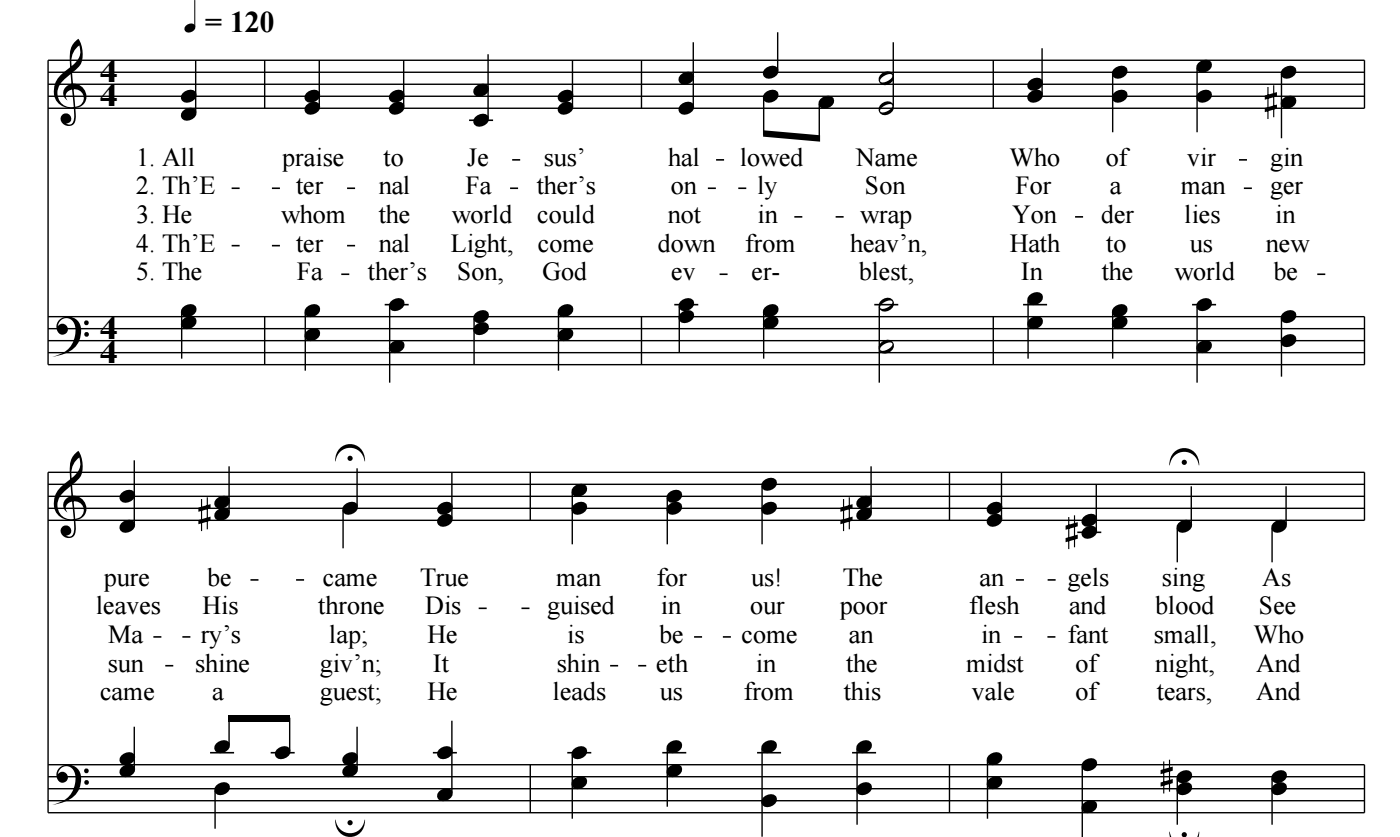
“All Praise to Jesus’ Hallowed Name” is a Christian hymn with lyrics written by Thomas Kelly in the early 19th century. The hymn is often set to the melody “Dix,” composed by Conrad Kocher. The text of the hymn focuses on praising the name of Jesus and acknowledging His role as Savior and Lord. When playing “All Praise to Jesus’ Hallowed Name” on the piano, consider maintaining a steady tempo that allows for a reverent and worshipful atmosphere.

The skill level required to play “All Praise to Jesus’ Hallowed Name” on the piano is generally intermediate. The arrangement encompasses a range of techniques, including arpeggios, hand coordination, and dynamic control. A pianist with a solid foundation in basic piano skills, including knowledge of key signatures and an understanding of chord progressions, would find this piece accessible.
PREVIEW

Christmas Sheet Music

“German Dance, K.605 No.3” or “Sleigh Ride” or in German “Die Schlittenfahrt” from the set of Three German Dances, K.605 is a lively and festive composition that captures the joyful spirit of a sleigh ride. Arranged for violin.

“Jingle Bells” is one of the most famous and widely recognized Christmas songs in the world. Written by James Lord Pierpont in 1857, it was originally intended to be a Thanksgiving song, but its catchy melody and festive lyrics made it a favorite during the Christmas season. Playing “Jingle Bells” on the cello can be fun and a great way …

“O Holy Night” (French: “Cantique de Noël”) is a Christmas carol that was written in French by poet Placide Cappeau and set to music by composer Adolphe Adam. Cappeau wrote the lyrics in 1843, and Adam composed the music later the same year. The carol was first performed in Roquemaure, France, during a midnight Mass on Christmas Eve in 1847. …

“O Christmas Tree,” also known as “O Tannenbaum,” is a traditional German Christmas carol. The melody for this song has been used for various purposes over the years, including other Christmas songs. The song is typically performed in a reflective and reverent manner, paying homage to the tradition of decorating Christmas trees. Whether you’re a beginner pianist embarking on your …

Composed by George Frideric Handel, “Joy To The World” was initially not intended to be a Christmas carol. The melody we associate with the song today was adapted by Lowell Mason in the 19th century from Handel’s work. The result is a piece that radiates exuberance and has become a staple in holiday celebrations around the world. For those just …

Franz Liszt, the Hungarian composer and virtuoso pianist of the Romantic era, left an indelible mark on the world of classical music with his innovative compositions and unparalleled piano skills. One of his lesser-known yet captivating pieces is “March of The Three Magi” (S. 388), a musical gem that takes the listener on a majestic journey. Playing this piece on …

“O Come, All Ye Faithful,” also known as “Adeste Fideles” in Latin, is a classic Christmas carol. The original Latin text is attributed to John Francis Wade, an 18th-century hymnist, and the English translation is often attributed to Frederick Oakeley. The melody is believed to have been written by John Reading in the 18th century. It is typically performed in …

“Jingle Bells” was written by James Lord Pierpont and published under the title “One Horse Open Sleigh” in 1857. The song’s catchy melody and upbeat lyrics have made it a holiday classic that is often associated with the joy and festivities of the Christmas season. It is a relatively simple song to play on the piano, making it a popular …

The Arabian Dance, also known as the Coffee Dance, is part of the second act of “The Nutcracker.” Tchaikovsky masterfully incorporates Middle Eastern influences, using rich and evocative melodies to transport listeners to a world of mystery and enchantment. The piano arrangement retains the exotic charm, allowing pianists to express the nuances of the original orchestral score. Pyotr Ilyich Tchaikovsky’s …

“Ding Dong! Merrily on High” is a popular Christmas carol with French origins. The lyrics were written by English composer George Ratcliffe Woodward, and the melody is based on a 16th-century French dance tune. The title of the carol is derived from the sound of bells, which is often associated with the Christmas season.

The “Christmas Eve Suite” is a collection of orchestral pieces derived from Nikolai Rimsky-Korsakov’s opera “Christmas Eve,” also known as “Noch’ pered Rozhdestvom” in Russian. The suite consists of several delightful and festive movements that capture the spirit of the holiday season.

“Formerly” is one of the delightful pieces from Franz Liszt’s “Weihnachtsbaum” (The Christmas Tree) collection. This collection, composed in 1874, consists of 12 short piano pieces, each inspired by different aspects of the Christmas season. “Formerly” is a charming and nostalgic piece that reflects on the joys and memories of Christmases past. Liszt’s musical language beautifully captures the sentiment of …

The Russian Trepak, also known as the “Russian Dance,” is a lively and energetic piece from Tchaikovsky’s Nutcracker Suite. It captures the spirit of Russian folk dance, complete with its lively tempo and infectious melodies. The music is characterized by its brisk pace, intricate rhythms, and triumphant flair, making it a favorite among both performers and listeners. While Tchaikovsky originally …

“Weihnachtslied,” which translates to “Christmas Song” in English, is a charming piano piece that reflects Schumann’s mastery in conveying emotion through music. Composed in 1848, it is a part of his larger collection, “Album für die Jugend” (Album for the Young), which aims to provide musical education and enjoyment for young pianists. This piece is characterized by its melodic simplicity …

“Angels We Have Heard on High” is a traditional Christmas carol with French origins. The English lyrics were written by James Chadwick, an English Roman Catholic bishop, in the mid-19th century. The music for “Angels We Have Heard on High” is based on the traditional French melody of “Gloria in excelsis Deo,” which means “Glory to God in the Highest.” …