
Schumann – Adventlied Op.71

Home » Violin Sheet Music » Schumann – Adventlied Op.71

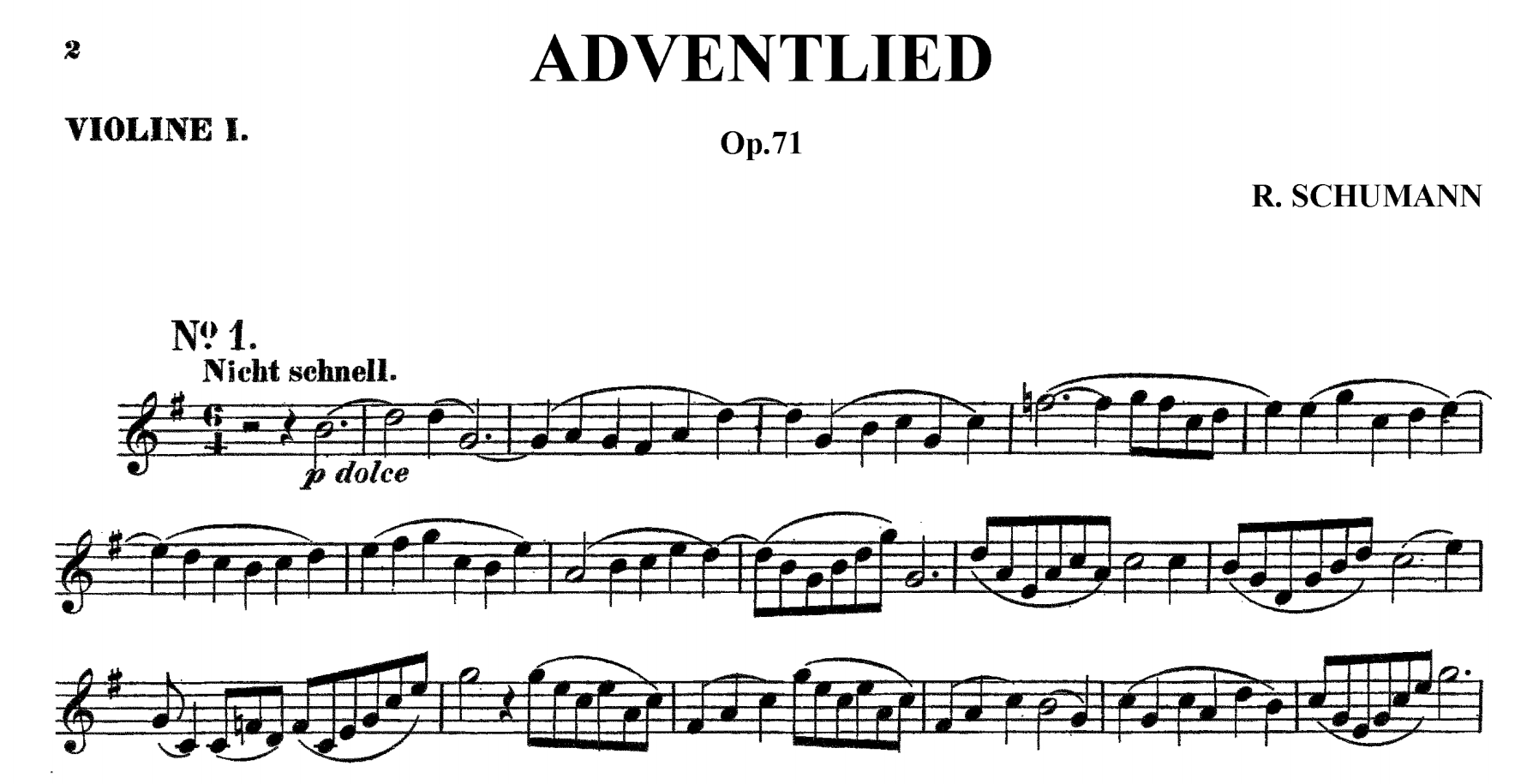
Adventlied, Op. 71 is a sacred choral work for mixed voices and orchestra by Robert Schumann, composed in 1848. The text is a poem by Friedrich Rückert, “Dein König kommt in niedern Hüllen” (“Your King comes in humble guise”). The work is a festive and triumphant celebration of the coming of Christ, with a strong emphasis on hope and renewal.

Adventlied, Op. 71 was originally intended for a performance at the dedication of a new church in Düsseldorf, Germany. The text of the poem is based on a passage from the Gospel of Luke. The work is in three sections, each of which begins with a solo quartet. The final section of the work is a triumphant allegro, which ends with a powerful Amen.

Schumann’s Adventlied is best suited for intermediate to advanced violinists. The piece demands a solid foundation in technical skills, including proficiency in shifting, vibrato, and bow control. The expressive nature of the composition requires a nuanced understanding of phrasing and an ability to convey a range of emotions through the violin.
PREVIEW

Christmas Sheet Music

“A Great and Mighty Wonder” is a hymn with lyrics written by St. Germanus, Bishop of Constantinople, in the 7th century. The hymn reflects on the miraculous nature of the Incarnation, celebrating the birth of Jesus Christ. The text has been translated into English by various authors, and the melody is often associated with the German hymn “Es ist ein …

Handel’s Hallelujah Chorus, a masterpiece from his oratorio “Messiah,” is a celebrated piece that has resonated through the ages. While originally composed for a full orchestra and choir, the transcendent beauty of the piece can be captured on a single instrument, such as the violin. Playing Handel’s Hallelujah on the violin requires a certain level of skill and technique, making …

The melody of “O Come, All Ye Faithful” is lyrical and flowing, which suits the cello’s natural singing tone. Focus on making each phrase sound vocal, as though you are singing through the instrument. Start gently and build towards the climactic phrase “O come, let us adore Him.” Use controlled crescendos to bring warmth and richness to the tune, especially …

The “Coventry Carol” is one of the oldest known carols, dating back to the 16th century. It is traditionally sung as part of a mystery play called the “Pageant of the Shearmen and Tailors.” The play was performed in Coventry, England, and depicted the biblical story of the Massacre of the Innocents, which is found in the Gospel of Matthew. …

“Silent Night” (German: “Stille Nacht, heilige Nacht”) is a widely cherished Christmas carol known for its simple and serene melody. It was originally written in German by Joseph Mohr, with music composed by Franz Xaver Gruber.

“Gaudete” is a sacred Christmas carol that has its origins in Latin liturgical music. The word “Gaudete” means “Rejoice” in Latin, and the carol is often associated with the Advent season, which is the period of preparation and anticipation leading up to Christmas. While “Gaudete” may seem intimidating at first glance, it is accessible to pianists with a moderate to …

The popularity of “Gesù Bambino” extends beyond its initial composition, and it has been recorded and performed by numerous artists in various arrangements. The piece has become a holiday classic, evoking the spirit of Christmas and the warmth of the Nativity story. While “Gesù Bambino” on the violin may appear deceptively simple in its melodic structure, achieving a truly captivating …

The lyrics of “Gaudete” are written in Latin and are inspired by verses from the Bible, particularly Philippians 4:4-7. The carol expresses joy and celebration at the coming of Christ and encourages believers to rejoice in the Lord. It is a lively and upbeat song that is typically sung with enthusiasm and energy.

“Ding Dong! Merrily on High” is a popular Christmas carol with French origins. The lyrics were written by English composer George Ratcliffe Woodward, and the melody is based on a 16th-century French dance tune. The title of the carol is derived from the sound of bells, which is often associated with the Christmas season.

“O Holy Night” (French: “Cantique de Noël”) is a Christmas carol that was written in French by poet Placide Cappeau and set to music by composer Adolphe Adam. Cappeau wrote the lyrics in 1843, and Adam composed the music later the same year. The carol was first performed in Roquemaure, France, during a midnight Mass on Christmas Eve in 1847.. …

“God Rest Ye Merry, Gentlemen” has been recorded and performed by numerous artists and choirs over the years and remains a popular and enduring part of the Christmas music tradition. It has also been adapted and arranged in various musical styles and continues to be a favorite during the holiday season. This one is arranged for the flute.

Bach’s Weihnachtsoratorium, or Christmas Oratorio, is a masterpiece that has stood the test of time, showcasing the genius of Johann Sebastian Bach. Originally composed for the Christmas season, the oratorio has become a beloved piece in the classical music repertoire. While it is often performed by orchestras and choirs, tackling it on the violin is a challenge that demands both …

Tchaikovsky’s “Dance of the Sugar Plum Fairy” from the timeless ballet “The Nutcracker” is a masterpiece that has captivated audiences for generations. Bringing this enchanting piece to life on the piano requires skill and finesse, making it a delightful challenge for pianists of different levels. The delicate and magical melody of the “Dance of the Sugar Plum Fairy” is characterized …

“Lighting the Candles on the Tree” captures the heartwarming and joyous moment of lighting the candles on a Christmas tree. It is a beautifully evocative piece that conveys the festive atmosphere and the magical anticipation associated with the holiday season. “Lighting the Candles on the Tree” is part of Franz Liszt’s “Weihnachtsbaum” (The Christmas Tree) collection, composed in 1874. One …

“The Shepherds at the Manger” is a beautiful and evocative piece of classical music composed by the Hungarian composer Franz Liszt. This composition is part of his larger work known as “The Christmas Tree” (Weihnachtsbaum), which consists of a set of 12 short piano pieces. Each piece in this collection is inspired by various aspects of the Christmas season. “The …