
The Coventry Carol

Home » Cello Sheet Music » The Coventry Carol

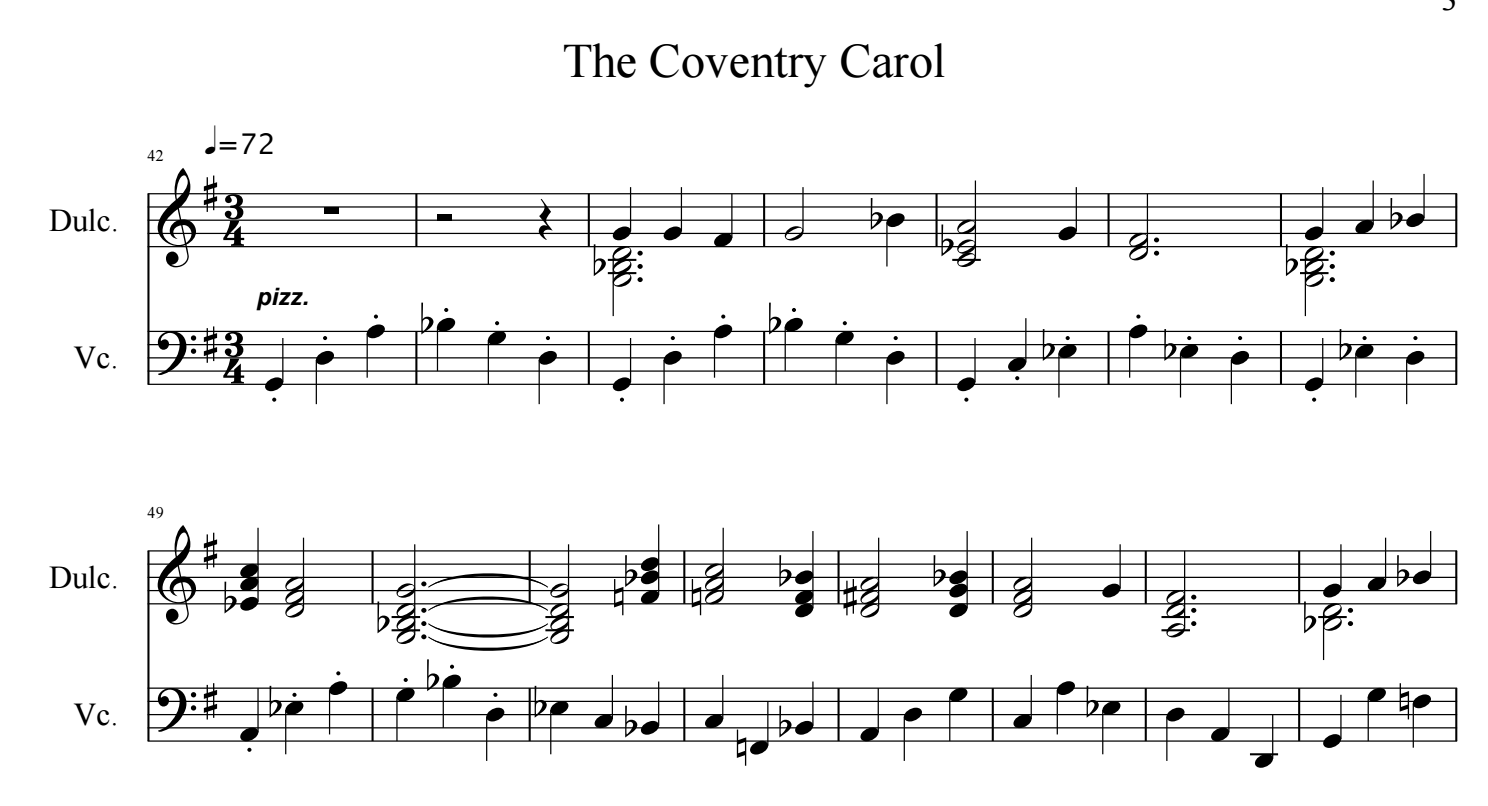
The Coventry Carol is a traditional English Christmas carol dating back to the 16th century. It was originally part of a mystery play called The Pageant of the Shearmen and Tailors, which depicted the biblical story of the Massacre of the Innocents, where King Herod ordered the killing of male infants. The carol is a haunting lullaby sung by mothers of the doomed children, making it one of the more somber and poignant Christmas tunes.

The carol has a mournful, lullaby-like character. Focus on bringing out the emotional depth of the piece with smooth, legato bowing and expressive dynamics. Avoid abrupt accents and keep a soft, flowing quality. Since this is a haunting and sorrowful piece, use vibrato delicately. A gentle, slow vibrato can enhance the lamenting feel but avoid overusing it as it may overpower the solemnity of the melody.
PREVIEW

Christmas Sheet Music

The Sussex Mummers’ Christmas Carol is a traditional English Christmas carol, often performed during the holiday season. This carol is characterized by its lively melody and festive spirit, making it a popular choice for both choral and instrumental arrangements. The carol has roots in the Sussex region of England and is associated with the local Christmas traditions and mummers’ plays, …

“Jingle Bells” is one of the most famous and widely recognized Christmas songs in the world. Written by James Lord Pierpont in 1857, it was originally intended to be a Thanksgiving song, but its catchy melody and festive lyrics made it a favorite during the Christmas season. Playing “Jingle Bells” on the cello can be fun and a great way …

“Ding Dong! Merrily on High” is a popular Christmas carol with French origins. The lyrics were written by English composer George Ratcliffe Woodward, and the melody is based on a 16th-century French dance tune. The title of the carol is derived from the sound of bells, which is often associated with the Christmas season. The organ, with its majestic pipes …

Max Reger’s Opus 17, No. 9 “Weihnachtstraum” refers to one of the pieces in his collection of solo piano works. It is a German phrase that translates to “Christmas dream” in English. It evokes a sense of the holiday season and the magical, dreamlike atmosphere that often accompanies Christmas celebrations. Reger’s “Silent Night” arrangement, also known as “Weihnachtstraum,” offers a …

Also known as “See Amid the Winter’s Snow” is a traditional Christmas carol with lyrics written by Edward Caswall and music composed by Sir John Goss. It was first published in 1854. This carol is known for its serene and reflective lyrics that tell the story of the birth of Jesus Christ and the adoration of the shepherds and angels. …

“Ave Maria” in A major is part of his larger work, the “Six Duets for Two Voices and Organ,” Op. 10. This collection includes settings of various sacred texts, and the “Ave Maria” in A major is one of the pieces within this set. These duets were composed in 1858 and showcase Saint-Saëns’s mastery of choral writing and his ability …

“We Three Kings,” also known as “Three Kings of Orient” or simply “The Quest of the Magi,” is a well-known Christmas carol that tells the story of the three Wise Men or Magi who traveled to Bethlehem to visit the newborn Jesus.

“Joy to the World” is a classic Christmas carol often arranged for a variety of instruments, including the cello. The rich and resonant tones of the cello can bring a deep, soulful quality to this joyous melody. The melody commonly associated with “Joy to the World” was arranged by Lowell Mason in 1836, an American music educator and composer. He …

“Angels We Have Heard on High” is a traditional Christmas carol with French origins. The English lyrics were written by James Chadwick, an English Roman Catholic bishop, in the mid-19th century. The music for “Angels We Have Heard on High” is based on the traditional French melody of “Gloria in excelsis Deo,” which means “Glory to God in the Highest.” …

The melody of “O Come, All Ye Faithful” is lyrical and flowing, which suits the cello’s natural singing tone. Focus on making each phrase sound vocal, as though you are singing through the instrument. Start gently and build towards the climactic phrase “O come, let us adore Him.” Use controlled crescendos to bring warmth and richness to the tune, especially …

“Amazing Grace” is a traditional hymn with uncertain authorship. It is often attributed to John Newton, a former slave trader turned Christian minister, who wrote the lyrics in the late 18th century. However, the melody used today is believed to have been added later. The melody used for “Amazing Grace” is simple yet deeply moving. It is typically sung in …

Bach’s “Gloria in excelsis Deo,” BWV 191, is a separate and shorter work compared to the larger Mass in B minor. It is a sacred choral composition, and it consists of the Gloria section of the Latin Mass.

“Silent Night” was composed by Franz Xaver Gruber, an Austrian schoolteacher, in 1818. The lyrics were written by Joseph Mohr, an Austrian priest, in the same year. The carol was first performed on Christmas Eve of 1818 at St. Nicholas Church in Oberndorf bei Salzburg, Austria.

The “Coventry Carol” is a Christmas carol that dates back to the 16th century. It is part of a larger work known as the “Coventry Mystery Plays,” which were a series of dramatic presentations or pageants performed in Coventry, England, during the late Middle Ages. The carol is specifically associated with the “Pageant of the Shearmen and Tailors,” one of …

The melody used in “Joy to the World” is actually from Handel’s Messiah, but the lyrics were written by Watts to celebrate the second coming of Jesus Christ, rather than his birth. The song has since become associated with Christmas and is commonly sung during the holiday season.