
We Wish You a Merry Christmas

Home » Cello Sheet Music » We Wish You a Merry Christmas

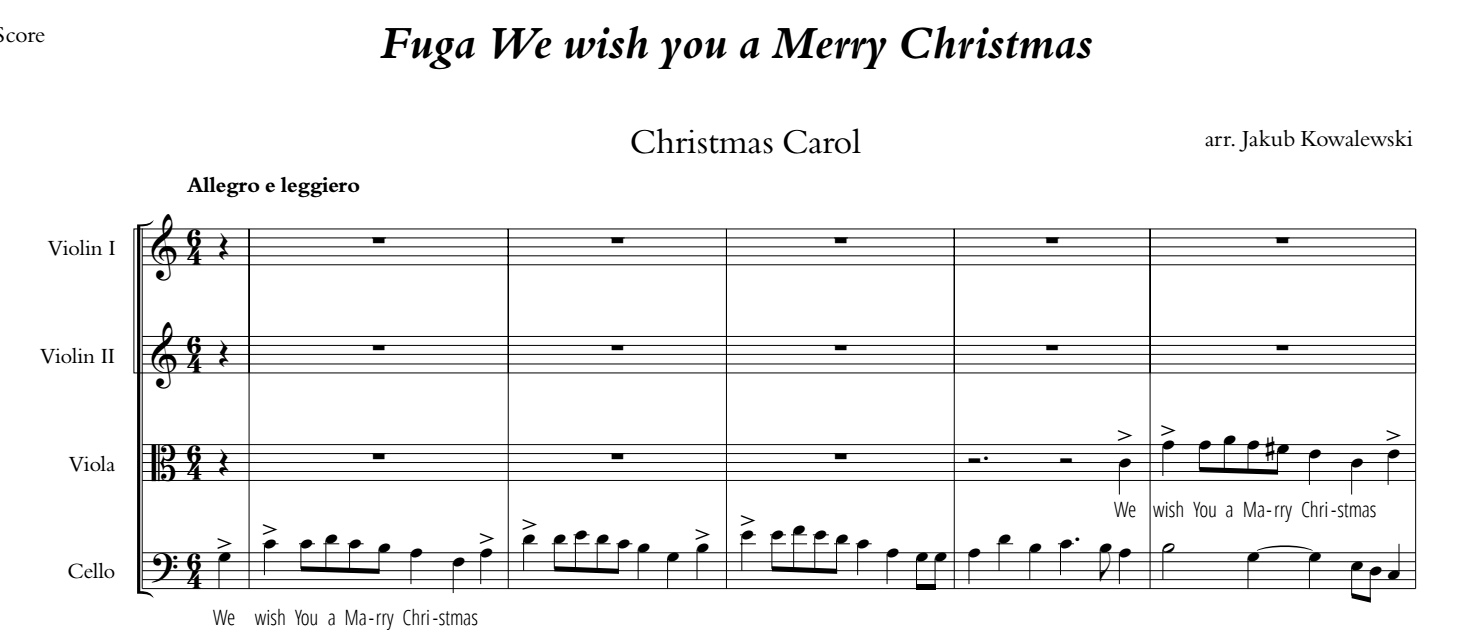
“We Wish You a Merry Christmas” is a traditional English Christmas carol that dates back to the 16th century. It’s a joyful and lively song that’s popular during the holiday season. The melody is relatively simple and repetitive, making it a great choice for beginner to intermediate cellists who are looking for festive repertoire.

Since this piece has a lively and bouncy feel, use light, detached bowing (spiccato or staccato) for the short, quick notes in the verses. Ensure smooth legato bowing on the longer notes, especially during the phrases where you sing “Good tidings we bring.”
PREVIEW

Christmas Sheet Music

“O Holy Night” (French: “Cantique de Noël”) is a Christmas carol that was written in French by poet Placide Cappeau and set to music by composer Adolphe Adam. Cappeau wrote the lyrics in 1843, and Adam composed the music later the same year. The carol was first performed in Roquemaure, France, during a midnight Mass on Christmas Eve in 1847. …

“God Rest Ye Merry, Gentlemen” is a traditional English Christmas carol. It is one of the oldest Christmas carols, dating back to the 16th century or possibly even earlier. The carol’s title can be a bit confusing to modern readers due to its archaic language. In this context, “God rest ye” means “God keep you” or “God make you.” So, …

The song’s lyrics convey a message of comfort and joy during the Christmas season, reminding listeners to have a cheerful and steadfast spirit. The carol often features a lively and upbeat melody and is typically sung in a celebratory manner. Arranged in organ sheet music.

“What Child Is This?” is a popular Christmas carol that is often sung during the holiday season. The lyrics are set to the tune of the English folk song “Greensleeves.” The carol is known for its serene and reflective tone, and it focuses on the nativity story of the birth of Jesus Christ. While “What Child Is This” may seem …

“Ave Maria” composed by Charles Gounod is one of the most well-known settings of this prayer. Gounod’s “Ave Maria” is based on Johann Sebastian Bach’s “Prelude in C Major,” specifically from the first prelude in his collection titled “The Well-Tempered Clavier,” BWV 846. Gounod added a vocal melody and adapted the music to fit the traditional Latin text of the …

“Gabriel’s Message” is a Christmas carol based on the biblical story of the Annunciation, where the angel Gabriel delivers the message to the Virgin Mary that she will conceive and give birth to Jesus, the Son of God. The carol is also known as “The Angel Gabriel from Heaven Came.” “Gabriel’s Message” is a piece that accommodates a range of …

“Angels We Have Heard on High” is a traditional Christmas carol, originating from France. The song is best known for its “Gloria in excelsis Deo” refrain, which reflects the biblical story of angels proclaiming the birth of Jesus to shepherds. The melody, known as “Gloria”, is believed to have been written in the 18th century, while the English lyrics were …

The Russian Trepak, also known as the “Russian Dance,” is a lively and energetic piece from Tchaikovsky’s Nutcracker Suite. It captures the spirit of Russian folk dance, complete with its lively tempo and infectious melodies. The music is characterized by its brisk pace, intricate rhythms, and triumphant flair, making it a favorite among both performers and listeners. While Tchaikovsky originally …

Camille Saint-Saëns’ “Oratorio de Noël,” also known as his Christmas Oratorio, Op. 12, is a splendid and spiritually evocative composition. Written in 1858, this oratorio reflects Saint-Saëns’ mastery in blending sacred and festive elements. The piano rendition of Saint-Saëns’ Christmas Oratorio Op. 12 demands a pianist with an intermediate to advanced skill level. The piece presents challenges in terms of …

“In the Bleak Midwinter” is a Christmas carol that reflects on the nativity of Jesus Christ and the humility of the setting in which he was born. It describes the bleak and cold midwinter, with imagery of snow and frost, and contrasts it with the warmth and wonder of the Christ child’s arrival. The lyrics evoke a sense of awe …

“In Dulci Jubilo” arranged for the Organ. The original text is attributed to Heinrich Seuse, a German mystic, and poet who lived in the 14th century. The song celebrates the joy and happiness of the Christmas season, and it has been performed and recorded by many artists and choirs over the centuries.

“Here We Come A-Wassailing” is a traditional English Christmas carol. It is also sometimes known as “Here We Come A-Caroling.” The song dates back to the 16th century, and its lyrics have evolved over time. The term “wassailing” refers to the tradition of going door-to-door to sing carols and offer good wishes to neighbors, often in exchange for food, drink, …

“The Holly and the Ivy” is a traditional English Christmas carol that dates back to the 18th century. It celebrates the symbolism of holly and ivy in Christian traditions, where holly represents Jesus and his suffering (the sharp leaves symbolizing the crown of thorns, and the red berries his blood), while ivy symbolizes the Virgin Mary. Since “The Holly and …

The lyrics of “Gaudete” are written in Latin and are inspired by verses from the Bible, particularly Philippians 4:4-7. The carol expresses joy and celebration at the coming of Christ and encourages believers to rejoice in the Lord. It is a lively and upbeat song that is typically sung with enthusiasm and energy.

Peter J. Wilhousky wrote the lyrics and music for “Carol of the Russian Children” in 1936. He is the same composer who adapted the Ukrainian folk chant “Shchedryk” (sometimes spelled “Shchedrik”) to create the English version of “Carol of the Bells.” The lyrics of “Carol of the Russian Children” celebrate the beauty of the Russian landscape, particularly the valleys and …