A Christmas Carol

Home » Piano Sheet Music » A Christmas Carol

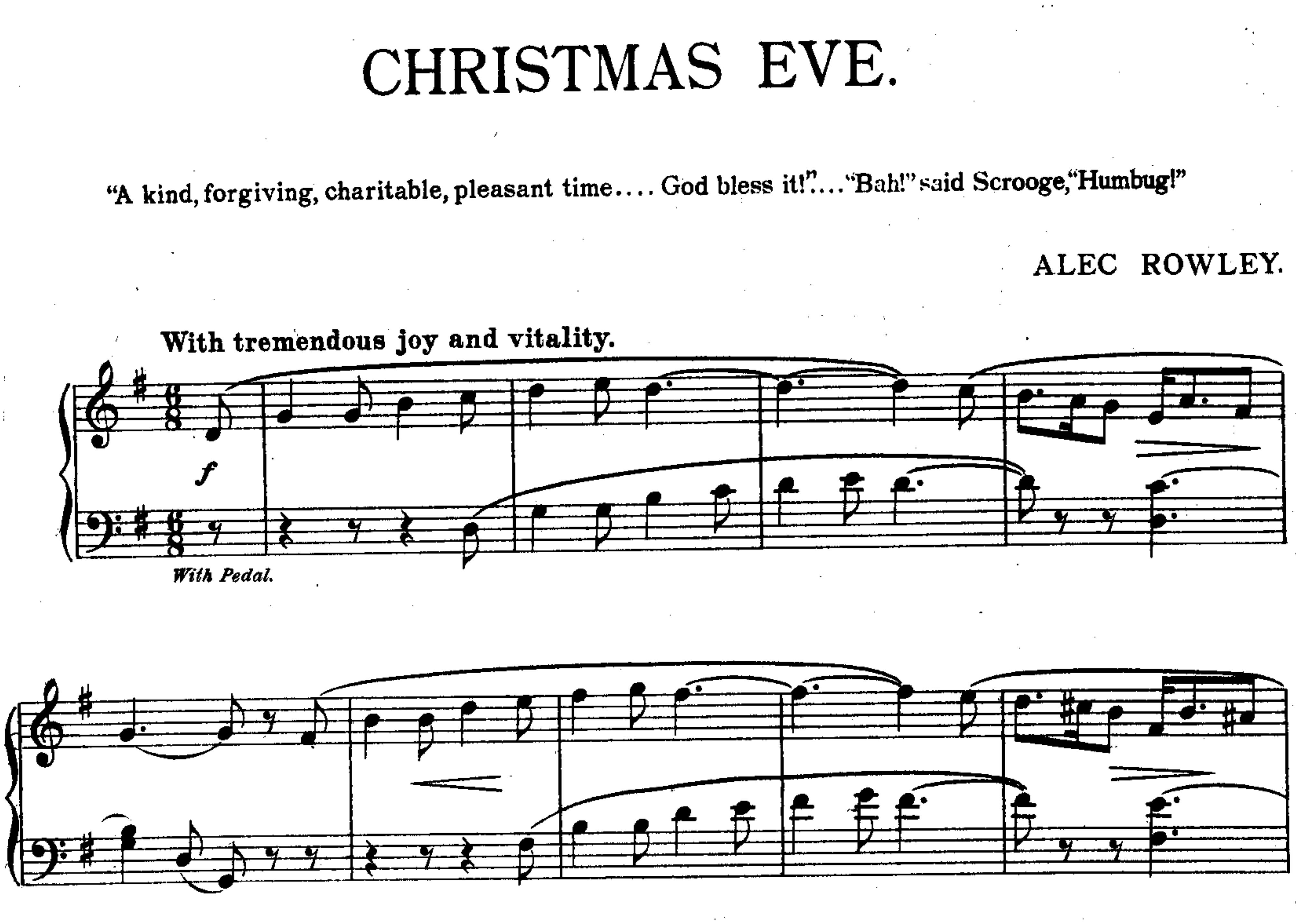
Alec Rowley (1892–1958) was a British composer and educator known for his contributions to the world of music. “A Christmas Carol” is one of his most celebrated compositions, offering pianists a musical journey through the joy and warmth of the holiday season. The piece is characterized by its nostalgic melodies and intricate harmonies, creating a vivid musical tapestry that resonates with the spirit of Christmas.

While “A Christmas Carol” is not considered an overly complex piece, it does require a certain level of proficiency to capture its expressive nuances and convey its festive atmosphere. Intermediate to advanced pianists with a solid understanding of fundamental piano techniques, such as finger independence, dynamic control, and interpretation, will find this piece well-suited to their skill level.

  1. Christmas Eve
  2. Marley’s Ghost
  3. The First of the Three Spirits
  4. Mr. Fezziwig’s Ball
  5. The Second of the Three Spirits
  6. The Awakening
  7. The Last of the Spirits
  8. Scrooge’s Redemption
  9. Christmas Day

PREVIEW

Christmas Sheet Music

The word “mirliton” refers to a toy kazoo-like instrument made from a paper tube and waxed paper, which produces a buzzing sound. The French translation aptly captures the lighthearted and playful nature of the music and choreography in this part of Tchaikovsky’s ballet classic, The Nutcracker. The music is characterized by its high-pitched, staccato notes, which mimic the sound of mirlitons.

“Silent Night” was composed by Franz Xaver Gruber, an Austrian schoolteacher, in 1818. The lyrics were written by Joseph Mohr, an Austrian priest, in the same year. The carol was first performed on Christmas Eve of 1818 at St. Nicholas Church in Oberndorf bei Salzburg, Austria.

The “Coventry Carol” is one of the oldest known carols, dating back to the 16th century. It is traditionally sung as part of a mystery play called the “Pageant of the Shearmen and Tailors.” The play was performed in Coventry, England, and depicted the biblical story of the Massacre of the Innocents, which is found in the Gospel of Matthew. …

Three of the most popular Christmas carols in the world: “The First Noel”, “Once in Royal David’s City”, “Dong Dong Merrily on High” arranged for flute duet sheet music.

“O Little Town of Bethlehem” is a well-known Christmas carol with lyrics written by Phillips Brooks and music composed by Lewis Redner. The song was first performed in 1868 and has become a classic in the Christmas music repertoire. It paints a peaceful and reverent picture of the town of Bethlehem on the night of Jesus’ birth. The original version …

“Jesus Christ the Apple Tree” is a popular English hymn that dates back to the 18th century. The lyrics of this hymn are often attributed to an unknown author. It is sometimes referred to as “The Apple-Tree Song” or simply “The Apple Tree.” The hymn uses the metaphor of an apple tree to represent Jesus Christ, drawing parallels between the …

“Santa Claus Is Comin’ to Town” is a popular Christmas song written by J. Fred Coots and Haven Gillespie. It was first introduced in 1934 when it was performed on the Eddie Cantor radio show and has since become a classic holiday tune. The song conveys the anticipation and excitement of Santa Claus’s arrival on Christmas Eve and encourages children …

“Joy to the World” is a popular Christmas carol with lyrics written by Isaac Watts and music based on a melody by Lowell Mason. It was first published in 1719 and has since become a classic holiday song. The lyrics of the song celebrate the arrival of the Savior and the joy this event brings to the world. It is …

The popularity of “Gesù Bambino” extends beyond its initial composition, and it has been recorded and performed by numerous artists in various arrangements. The piece has become a holiday classic, evoking the spirit of Christmas and the warmth of the Nativity story. While “Gesù Bambino” on the violin may appear deceptively simple in its melodic structure, achieving a truly captivating …

“Formerly” is one of the delightful pieces from Franz Liszt’s “Weihnachtsbaum” (The Christmas Tree) collection. This collection, composed in 1874, consists of 12 short piano pieces, each inspired by different aspects of the Christmas season. “Formerly” is a charming and nostalgic piece that reflects on the joys and memories of Christmases past. Liszt’s musical language beautifully captures the sentiment of …

“In Polish Style” is one of the delightful pieces from Franz Liszt’s “Weihnachtsbaum” (The Christmas Tree) collection. This collection, composed in 1874, consists of 12 short piano pieces, each inspired by different aspects of the Christmas season. Performing Liszt’s “In Polish Style” on the piano requires a blend of technical skill, musicality, and a deep understanding of the composer’s stylistic …

Pyotr Ilyich Tchaikovsky’s “Waltz of the Snowflakes” is a mesmerizing piece of classical music that captures the enchantment and beauty of winter. Originally composed for the ballet “The Nutcracker,” this waltz has become a timeless favorite, evoking images of swirling snowflakes dancing in a winter wonderland. The “Waltz of the Snowflakes” is part of the second act of “The Nutcracker” …

The Christmas Oratorio (Weihnachtsoratorium), BWV 248, is a magnificent choral work composed by Johann Sebastian Bach. Completed in 1734, it is a set of six cantatas intended for performance during the Christmas season. Each cantata corresponds to a specific feast day within the Christmas period. Here’s an overview of the structure and themes of Bach’s Christmas Oratorio.

Tchaikovsky’s “Dance of the Sugar Plum Fairy” from the timeless ballet “The Nutcracker” is a masterpiece that has captivated audiences for generations. Bringing this enchanting piece to life on the piano requires skill and finesse, making it a delightful challenge for pianists of different levels. The delicate and magical melody of the “Dance of the Sugar Plum Fairy” is characterized …

“Christmas Postlude,” is a musical composition often played on the organ in churches during the Christmas season. The title “Sit Laus Plena Sit Sonora” is Latin and can be translated as “Let there be full praise, let there be sound.” This suggests that the composition is intended to be a celebratory and joyful piece of music appropriate for the Christmas …