
Pietro Yon – Gesu Bambino

Home » Piano Sheet Music » Pietro Yon – Gesu Bambino

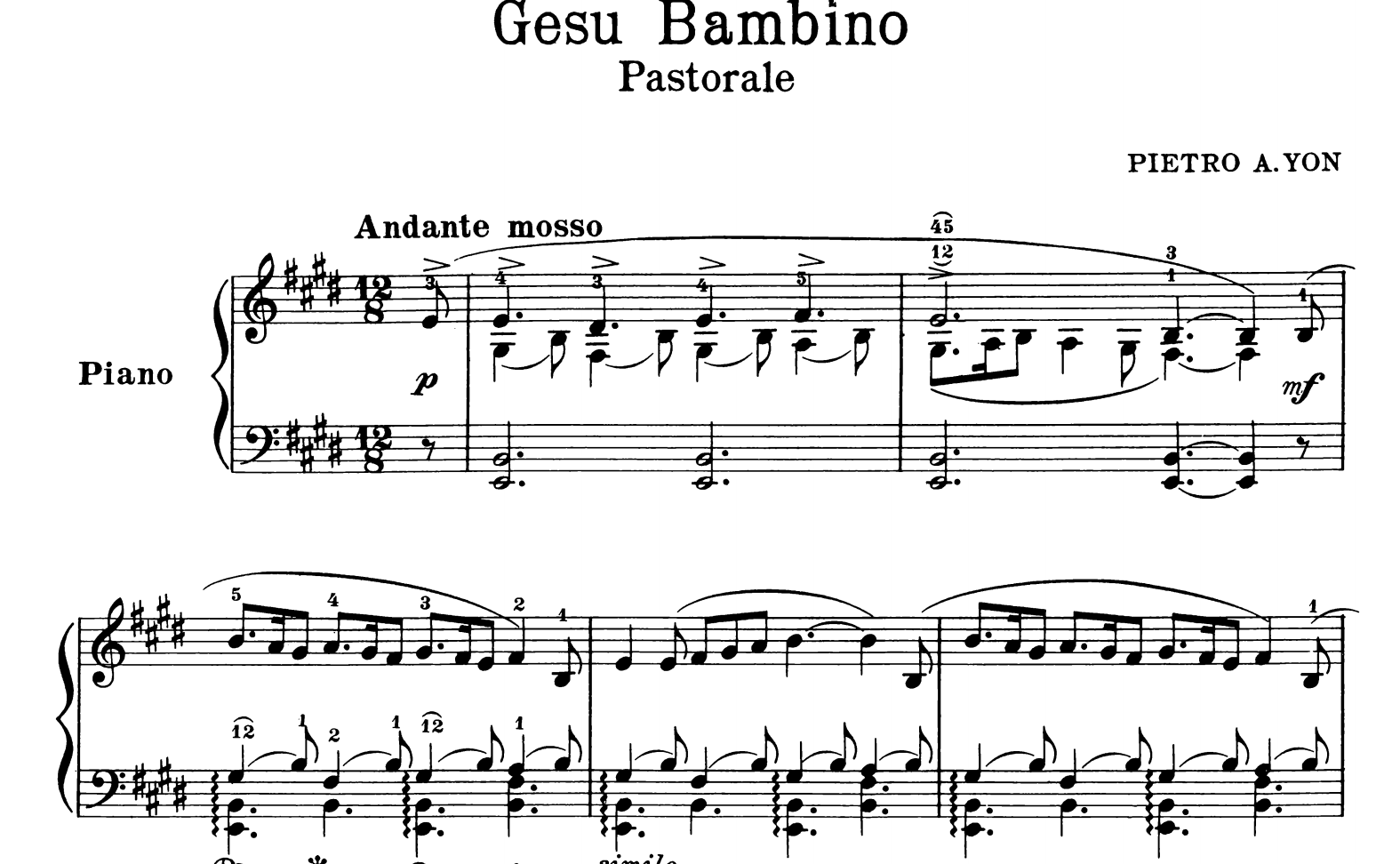
“Gesù Bambino” is a beautiful Christmas carol composed by Pietro Yon in 1917. The title translates from Italian to “Baby Jesus” in English. This piece is particularly well-known for its lyrical and expressive qualities, making it a cherished addition to the repertoire of Christmas music.

The piece requires a pianist to convey a sense of innocence, tenderness, and celebration. While the composition itself is not overly complex, it does demand a degree of technical proficiency, especially in achieving a balanced and expressive interpretation. Pianists should pay attention to dynamics, phrasing, and nuanced expression to bring out the emotive qualities embedded in the music.

Intermediate to advanced pianists will find “Gesù Bambino” to be a rewarding challenge. The piece includes arpeggiated passages, delicate ornamentation, and moments of dynamic contrast, all of which contribute to its charm. A solid understanding of finger control, pedaling, and a nuanced touch will allow the performer to fully capture the spirit of the composition.
PREVIEW

Christmas Sheet Music

The Chorus of Shepherds is part of Reinecke’s larger body of work, which often drew inspiration from nature and storytelling. In this particular piece, Reinecke invites pianists to paint a musical picture of shepherds gathering in the countryside, their simple melodies echoing through the air. The composition is characterized by its light-hearted and joyful atmosphere, with cascading arpeggios and graceful …

Daquin’s compositions are known for their expressive and emotive qualities. In the “Livre de Noëls,” he effectively captures the joy and spirit of the Christmas season through his inventive use of musical devices. Daquin’s “Livre de Noëls” is considered an important contribution to the French Baroque keyboard repertoire. It provides valuable insights into the musical tastes and practices of the …

“Cathedral Windows” Op. 106, composed in 1914, showcases Karg-Elert’s innovative approach to harmonies, textures, and registrations. “Cathedral Windows” is a set of six pieces, each named after a specific stained glass window in a cathedral. Karg-Elert employs rich harmonies, intricate counterpoint, and expressive melodic lines to evoke the majestic and contemplative atmosphere of these imagined windows. The movements are titled: …

“The Holly and the Ivy” is a traditional English Christmas carol that dates back to the 18th century. It celebrates the symbolism of holly and ivy in Christian traditions, where holly represents Jesus and his suffering (the sharp leaves symbolizing the crown of thorns, and the red berries his blood), while ivy symbolizes the Virgin Mary. Since “The Holly and …

The Waltz of the Flowers is a dazzling segment from the second act of “The Nutcracker,” where the Sugar Plum Fairy welcomes the arrival of the beautiful flowers. Tchaikovsky’s genius is evident in the intricate melodies, lush harmonies, and graceful waltz rhythm that characterize this piece. Adapting it for the piano allows musicians to explore the rich tapestry of Tchaikovsky’s …

“The Holly and the Ivy” is a traditional English Christmas carol that dates back to the 18th century, although some sources suggest that it may have even earlier origins. The song is a celebration of the holly and the ivy, two evergreen plants that are often associated with the Christmas season. “The Holly and the Ivy” is a classic Christmas …

“God Rest Ye Merry, Gentlemen” has been recorded and performed by numerous artists and choirs over the years and remains a popular and enduring part of the Christmas music tradition. It has also been adapted and arranged in various musical styles and continues to be a favorite during the holiday season. This one is arranged for the flute.

“The Twelve Days of Christmas” is a traditional English Christmas carol that dates back to the 18th century. The song is cumulative in nature, with each verse adding a new gift to the list. It is believed to have originated in France before coming to England and has become one of the most well-known and enduring Christmas songs. The song …

“I Heard the Bells on Christmas Day” is a Christmas carol with lyrics written by the American poet Henry Wadsworth Longfellow. The poem was initially composed on December 25, 1863, during the American Civil War. Longfellow had experienced personal tragedy, with his son Charles severely wounded in the war, and he was deeply affected by the state of the nation. …

“Silent Night” (German: “Stille Nacht, heilige Nacht”) is one of the most beloved and well-known Christmas carols worldwide. It was composed by Franz Xaver Gruber, with lyrics written by Joseph Mohr. The carol was first performed in the small Austrian village of Oberndorf on Christmas Eve in 1818. Gruber’s “Silent Night” remains a timeless gem in the world of Christmas …

“Christmas in Sicily” is one of the masterpieces of Italian-American composer Pietro Alessandro Yon. Yon was a renowned organist and composer known for his contributions to sacred and holiday music.

“Hark! The Herald Angels Sing” is a well-known Christmas carol that has been sung and arranged for various instruments since its inception. Mendelssohn’s original music is jubilant and stately, making it a popular piece during holiday performances. The melody should be played with smooth, lyrical phrasing to reflect the carol’s uplifting and joyful nature. Emphasize dynamic contrasts. Play softly during …

The lyrics of “Gaudete” are written in Latin and are inspired by verses from the Bible, particularly Philippians 4:4-7. The carol expresses joy and celebration at the coming of Christ and encourages believers to rejoice in the Lord. It is a lively and upbeat song that is typically sung with enthusiasm and energy.

“Deck the Halls” is a Welsh carol that dates back to the 16th century. The melody is believed to have originated from a traditional Welsh New Year’s Eve carol called “Nos Galan.” The song is known for its cheerful lyrics that celebrate the holiday season and the spirit of Christmas. The refrain “Fa-la-la-la-la, la-la-la-la” is a distinctive and memorable part …

Johannes Brahms’s Eleven Chorale Preludes, Op. 122, stand as one of the final contributions to the composer’s extensive body of work. Composed in the last years of his life (1896), these chorale preludes exhibit a deep introspection and spiritual depth, reflecting Brahms’s mature style. Here is a list of the eleven chorale preludes included in Op. 122: Each of these …