
It Came Upon the Midnight Clear

Home » Violin Sheet Music » It Came Upon the Midnight Clear

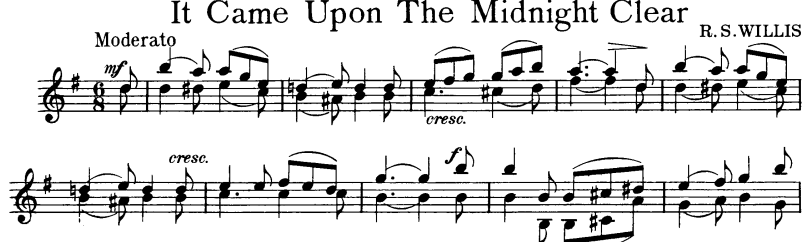
“It Came Upon the Midnight Clear” is a popular Christmas carol with lyrics written by Edmund Sears and music composed by Richard Storrs Willis. The carol was first published in 1850. The tune composed by Richard Storrs Willis is a beautiful and peaceful melody, often sung during the Christmas season to celebrate the birth of Jesus Christ and to convey a message of peace and goodwill to all. It has become a beloved part of the holiday repertoire and is performed in various arrangements by choirs, musicians, and singers around the world.

“It Came Upon the Midnight Clear” is well-suited for intermediate to advanced violinists. While the melody is relatively straightforward, the piece demands a refined sense of bow control, intonation, and musical sensitivity. Intermediate players will find the main theme accessible, but advanced musicians can explore the nuances within the composition, infusing it with their own artistic interpretations.
PREVIEW

Christmas Sheet Music

Alec Rowley (1892–1958) was a British composer and educator known for his contributions to the world of music. “A Christmas Carol” is one of his most celebrated compositions, offering pianists a musical journey through the joy and warmth of the holiday season. The piece is characterized by its nostalgic melodies and intricate harmonies, creating a vivid musical tapestry that resonates …

“God Rest Ye Merry, Gentlemen” is a traditional English Christmas carol. It is one of the oldest Christmas carols, dating back to the 16th century or possibly even earlier. The carol’s title can be a bit confusing to modern readers due to its archaic language. In this context, “God rest ye” means “God keep you” or “God make you.” So, …

“Ave Maria” composed by Charles Gounod is one of the most well-known settings of this prayer. Gounod’s “Ave Maria” is based on Johann Sebastian Bach’s “Prelude in C Major,” specifically from the first prelude in his collection titled “The Well-Tempered Clavier,” BWV 846. Gounod added a vocal melody and adapted the music to fit the traditional Latin text of the …

Tchaikovsky’s “Dance of the Sugar Plum Fairy” from the timeless ballet “The Nutcracker” is a masterpiece that has captivated audiences for generations. Bringing this enchanting piece to life on the piano requires skill and finesse, making it a delightful challenge for pianists of different levels. The delicate and magical melody of the “Dance of the Sugar Plum Fairy” is characterized …

“Here We Come A-Wassailing” is a traditional English Christmas carol that is often sung during the holiday season. It’s a cheerful and festive song that expresses well-wishes and good cheer as people go door to door, singing and celebrating the Christmas spirit.

“Hark! The Herald Angels Sing” is often performed with organ accompaniment, and it sounds particularly majestic when played on an organ due to the instrument’s rich and powerful sound. The organ arrangement of the carol can vary in complexity, with some versions featuring intricate harmonies and ornamentation. The music for the carol was composed by Felix Mendelssohn in 1840. The …

“All My Heart This Night Rejoices” is a traditional German Christmas carol that originated in the 17th century. The lyrics were written by Paul Gerhardt, and the melody is attributed to Johann Georg Ebeling. The hymn beautifully captures the joy and wonder of the Christmas season, expressing gratitude for the birth of Jesus Christ. The hymn’s expressive nature invites pianists …

“Hark! The Herald Angels Sing” is a popular Christmas carol with lyrics written by Charles Wesley in 1739. The music for the carol was composed by Felix Mendelssohn in 1840. The carol is traditionally sung to celebrate the birth of Jesus Christ and is a staple in Christmas celebrations and church services. The carol goes on to tell the story …

“God Rest Ye Merry, Gentlemen” has been recorded and performed by numerous artists and choirs over the years and remains a popular and enduring part of the Christmas music tradition. It has also been adapted and arranged in various musical styles and continues to be a favorite during the holiday season. This one is arranged for the flute.

“Joy to the World” is a classic Christmas carol often arranged for a variety of instruments, including the cello. The rich and resonant tones of the cello can bring a deep, soulful quality to this joyous melody. The melody commonly associated with “Joy to the World” was arranged by Lowell Mason in 1836, an American music educator and composer. He …

The Sussex Carol, also known as “On Christmas Night All Christians Sing,” is a traditional English Christmas carol. It is believed to have originated in the Sussex region of England, hence the name. The Sussex Carol is a popular traditional Christmas song, and it has been recorded and performed by various artists and choirs over the years. It captures the …

“Deck the Halls” is a Welsh carol that dates back to the 16th century. The melody is believed to have originated from a traditional Welsh New Year’s Eve carol called “Nos Galan.” The song is known for its cheerful lyrics that celebrate the holiday season and the spirit of Christmas. The refrain “Fa-la-la-la-la, la-la-la-la” is a distinctive and memorable part …

“O Holy Night” (French: “Cantique de Noël”) is a Christmas carol that was written in French by poet Placide Cappeau and set to music by composer Adolphe Adam. Cappeau wrote the lyrics in 1843, and Adam composed the music later the same year. The carol was first performed in Roquemaure, France, during a midnight Mass on Christmas Eve in 1847.. …

“O Holy Night” (French: “Cantique de Noël”) is a Christmas carol that was written in French by poet Placide Cappeau and set to music by composer Adolphe Adam. Cappeau wrote the lyrics in 1843, and Adam composed the music later the same year. The carol was first performed in Roquemaure, France, during a midnight Mass on Christmas Eve in 1847.. …

Max Reger’s Opus 17, No. 9 “Weihnachtstraum” refers to one of the pieces in his collection of solo piano works. It is a German phrase that translates to “Christmas dream” in English. It evokes a sense of the holiday season and the magical, dreamlike atmosphere that often accompanies Christmas celebrations. Reger’s “Silent Night” arrangement, also known as “Weihnachtstraum,” offers a …