
Reinecke – Chorus of Shepherds

Home » Piano Sheet Music » Reinecke – Chorus of Shepherds

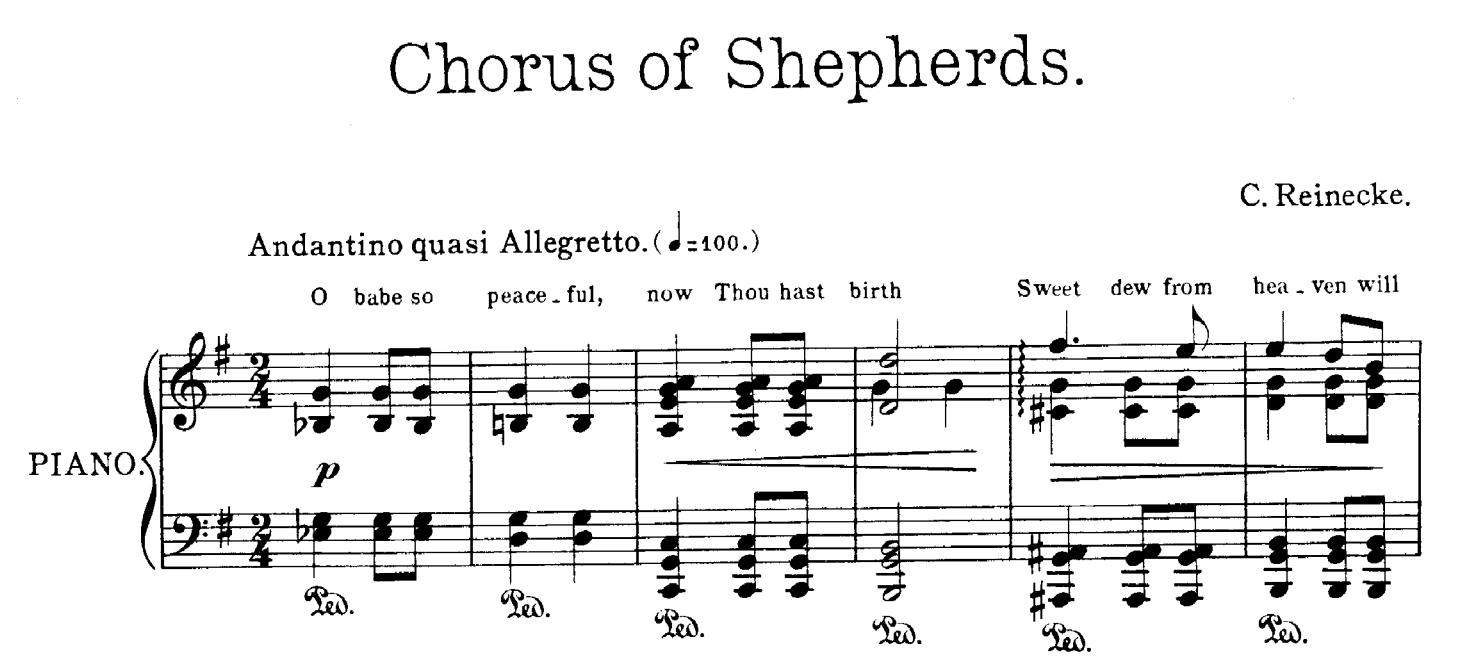
The Chorus of Shepherds is part of Reinecke’s larger body of work, which often drew inspiration from nature and storytelling. In this particular piece, Reinecke invites pianists to paint a musical picture of shepherds gathering in the countryside, their simple melodies echoing through the air. The composition is characterized by its light-hearted and joyful atmosphere, with cascading arpeggios and graceful runs that mimic the movement of sheep in a meadow.

Reinecke’s Chorus of Shepherds is well-suited for pianists at an intermediate level. Players should possess a good command of hand coordination, familiarity with various articulations, and a moderate level of finger dexterity. The piece serves as an excellent stepping stone for those looking to expand their repertoire beyond beginner-level pieces and explore the diverse world of 19th-century Romantic piano music.
PREVIEW

Christmas Sheet Music

“Hark! The Herald Angels Sing” is a song that celebrates the joyous news of the birth of Jesus and is a staple of Christmas carol singing. The combination of Charles Wesley’s poetic lyrics and Felix Mendelssohn’s uplifting melody has made it a timeless favorite during the holiday season.

The English lyrics for “Carol of the Bells” were written by Peter J. Wilhousky in 1936. Wilhousky’s version of the song tells the story of the bells announcing the arrival of Christmas. The melody for “Carol of the Bells” is derived from a Ukrainian folk chant called “Shchedryk” (sometimes spelled “Shchedrik”), which was composed by Mykola Leontovych in 1916. The …

“Good King Wenceslas” is a Christmas carol that tells the story of a generous and kind-hearted Bohemian king who braved harsh winter weather to provide charity to a poor peasant. The lyrics, penned by John Mason Neale in the 19th century, are set to the melody of a 13th-century spring carol called “Tempus adest floridum.” The combination of the heartwarming …

“Cathedral Windows” Op. 106, composed in 1914, showcases Karg-Elert’s innovative approach to harmonies, textures, and registrations. “Cathedral Windows” is a set of six pieces, each named after a specific stained glass window in a cathedral. Karg-Elert employs rich harmonies, intricate counterpoint, and expressive melodic lines to evoke the majestic and contemplative atmosphere of these imagined windows. The movements are titled: …

Composed in 1741, Handel’s Messiah was initially written for a choir and orchestra. The work is divided into three parts, each telling a different aspect of the story of Christ, from the prophecy of the Messiah’s coming to the ultimate redemption. The piece is known for its intricate choral passages, powerful melodies, and emotional depth. George Frideric Handel’s Messiah stands …

“Carol of the Bells” is a popular Christmas carol with a distinctive and recognizable melody. The music for this carol was composed by Mykola Leontovych, a Ukrainian composer, in 1914. The original composition is titled “Shchedryk,” which means “The Generous One” in Ukrainian and refers to a traditional Ukrainian folk chant that welcomed the New Year.

“Nun komm, der Heiden Heiland, BWV 659” is a chorale prelude composed by Johann Sebastian Bach. It is part of his larger collection of organ works, particularly those that involve chorale settings. The title translates to “Now come, Savior of the Gentiles” in English. This chorale prelude is based on the hymn “Nun komm, der Heiden Heiland,” which is attributed …

“O Come, All Ye Faithful,” also known as “Adeste Fideles” in Latin, is a classic Christmas carol. The original Latin text is attributed to John Francis Wade, an 18th-century hymnist, and the English translation is often attributed to Frederick Oakeley. The melody is believed to have been written by John Reading in the 18th century. It is typically performed in …

“God Rest Ye Merry, Gentlemen” is a traditional English Christmas carol. It is one of the oldest Christmas carols, dating back to the 16th century or possibly even earlier. The carol’s title can be a bit confusing to modern readers due to its archaic language. In this context, “God rest ye” means “God keep you” or “God make you.” So, …

“A Christmas Greeting” Op. 52 is a short and delightful composition that captures the spirit of the season. Elgar, known for his orchestral works and the famous “Pomp and Circumstance” marches, demonstrates his versatility in this enchanting piece. The composition exudes warmth and joy, making it a perfect choice for violinists aiming to spread holiday cheer through their music. While …

“Ding Dong Merrily on High” is a traditional Christmas carol with a lively, joyful tune. The melody dates back to the 16th century, composed by French composer Jehan Tabourot, and the lyrics were later added in the 19th century by English composer George Ratcliffe Woodward. The carol is known for its uplifting melody and distinctive “Gloria” refrain. “Ding Dong Merrily …

“Ding Dong! Merrily on High” is a popular Christmas carol with French origins. The lyrics were written by English composer George Ratcliffe Woodward, and the melody is based on a 16th-century French dance tune. The title of the carol is derived from the sound of bells, which is often associated with the Christmas season.

Pyotr Ilyich Tchaikovsky’s timeless ballet, “The Nutcracker,” is a masterpiece that has captivated audiences for generations. Among its enchanting compositions is the charming “Dance of the Mirlitons,” a delightful piece that translates beautifully onto the piano. The Dance of the Mirlitons, also known as the Reed Flutes, is a whimsical and lively dance that occurs in Act II of The …

The piece is part of Berlioz’s larger work, the oratorio “L’Enfance du Christ” (The Childhood of Christ). “Sérénade agreste à la Madone” is the final movement of Part II of the oratorio. It depicts the shepherds bidding farewell to the Holy Family as they flee to Egypt. Adapting orchestral compositions for the piano is no easy task, and yet, the …

“O Holy Night” (French: “Cantique de Noël”) is a Christmas carol that was written in French by poet Placide Cappeau and set to music by composer Adolphe Adam. Cappeau wrote the lyrics in 1843, and Adam composed the music later the same year. The carol was first performed in Roquemaure, France, during a midnight Mass on Christmas Eve in 1847.. …