
Corelli – Christmas Concerto

Home » Violin Sheet Music » Corelli – Christmas Concerto

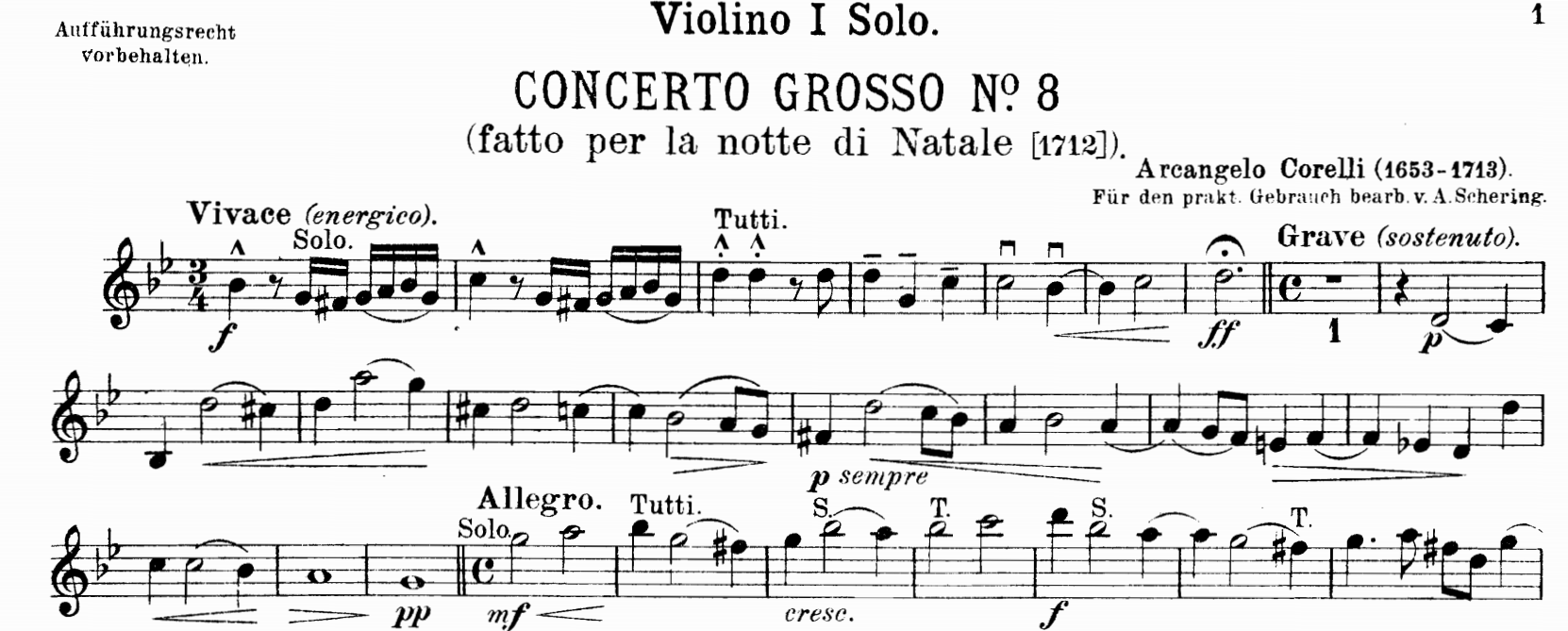
This masterpiece, also known as “Concerto Grosso in G minor, Op. 6, No. 8,” holds a special place in the repertoire of Baroque music. Composed by Arcangelo Corelli around 1690, this concerto is part of his renowned set of twelve concerti grossi. Corelli’s Christmas Concerto has remained a popular choice for holiday performances, admired for its exuberance and the timeless beauty of its melodies.

While Corelli’s Christmas Concerto is a challenging piece, it is not exclusively reserved for virtuosos. A proficient intermediate to advanced violinist can undertake the task of mastering this concerto with dedication and guidance.
PREVIEW

Christmas Sheet Music

“Amazing Grace” is a well-known Christian hymn with a history that dates back to the 18th century. The lyrics were written by the English poet and clergyman John Newton, and the music is often attributed to an anonymous composer. The hymn has become a staple in Christian worship and is widely recognized and appreciated for its profound and uplifting message.

“Gentle Mary Laid Her Child” is a traditional Christmas carol that reflects on the peaceful and tender scene of Mary laying the infant Jesus in a manger. The lyrics often evoke a sense of serenity and devotion, capturing the essence of the Nativity. The carol’s portrayal of the intimate moments surrounding the birth of Jesus makes it a fitting addition …

“It Came Upon a Midnight Clear” is a Christmas carol that was written by American pastor and poet Edmund Hamilton Sears in 1849. The carol is set to music composed by Richard Storrs Willis, and it was first published in the “Christian Register” in Boston in December 1850. The lyrics of the carol reflect themes of peace and the message …

The Chorus of Shepherds is part of Reinecke’s larger body of work, which often drew inspiration from nature and storytelling. In this particular piece, Reinecke invites pianists to paint a musical picture of shepherds gathering in the countryside, their simple melodies echoing through the air. The composition is characterized by its light-hearted and joyful atmosphere, with cascading arpeggios and graceful …

The word “mirliton” refers to a toy kazoo-like instrument made from a paper tube and waxed paper, which produces a buzzing sound. The French translation aptly captures the lighthearted and playful nature of the music and choreography in this part of Tchaikovsky’s ballet classic, The Nutcracker. The music is characterized by its high-pitched, staccato notes, which mimic the sound of mirlitons.

Also known as “See Amid the Winter’s Snow” is a traditional Christmas carol with lyrics written by Edward Caswall and music composed by Sir John Goss. It was first published in 1854. This carol is known for its serene and reflective lyrics that tell the story of the birth of Jesus Christ and the adoration of the shepherds and angels. …

“Amazing Grace” is a well-known Christian hymn that has become a classic in the realm of religious and folk music. The lyrics were written by John Newton, a British sailor and former slave trader, and the music is a traditional tune, possibly of Scottish origin. The hymn reflects Newton’s personal spiritual transformation and his understanding of divine grace and forgiveness.

“God Rest Ye Merry, Gentlemen” is a traditional English Christmas carol. It is one of the oldest Christmas carols, dating back to the 16th century or possibly even earlier. The carol’s title can be a bit confusing to modern readers due to its archaic language. In this context, “God rest ye” means “God keep you” or “God make you.” So, …

Three of the most popular Christmas carols in the world: “The First Noel”, “Once in Royal David’s City”, “Dong Dong Merrily on High” arranged for flute duet sheet music.

“O Little Town of Bethlehem” is a well-known Christmas carol with lyrics written by Phillips Brooks and music composed by Lewis Redner. The song was first performed in 1868 and has become a classic in the Christmas music repertoire. It paints a peaceful and reverent picture of the town of Bethlehem on the night of Jesus’ birth. The original version …

“What Child Is This?” is a Christmas carol with lyrics written by William Chatterton Dix in 1865. The lyrics are set to the tune of the traditional English folk song “Greensleeves.” The carol focuses on the birth of Jesus Christ and reflects on the significance of His arrival. To play “What Child Is This” on the piano, a pianist should …

“Three Christmas Songs” from “My First Songs” by Carl Reinecke. 1- Christmas Hymn, 2- Christmas Tree, 3- Cradle Song of the Infant Jesus Reinecke’s Three Christmas Songs are well-suited for intermediate to advanced pianists. While the technical demands are not overly challenging, a pianist with a solid foundation in technique and expressive playing will be better equipped to convey the …

“Christmas Postlude,” is a musical composition often played on the organ in churches during the Christmas season. The title “Sit Laus Plena Sit Sonora” is Latin and can be translated as “Let there be full praise, let there be sound.” This suggests that the composition is intended to be a celebratory and joyful piece of music appropriate for the Christmas …

Camille Saint-Saëns’ “Oratorio de Noël,” also known as his Christmas Oratorio, Op. 12, is a splendid and spiritually evocative composition. Written in 1858, this oratorio reflects Saint-Saëns’ mastery in blending sacred and festive elements. The piano rendition of Saint-Saëns’ Christmas Oratorio Op. 12 demands a pianist with an intermediate to advanced skill level. The piece presents challenges in terms of …

“Angels We Have Heard on High” is a traditional Christmas carol with French origins. The English lyrics were written by James Chadwick, an English Roman Catholic bishop, in the mid-19th century. The music for “Angels We Have Heard on High” is based on the traditional French melody of “Gloria in excelsis Deo,” which means “Glory to God in the Highest.” …