
Rise Up Shepherds and Follow

Home » Piano Sheet Music » Rise Up Shepherds and Follow

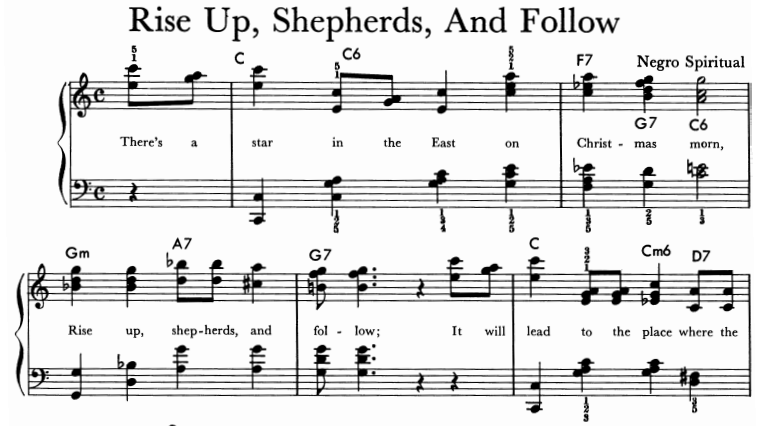
The authorship of “Rise Up, Shepherds, and Follow” is not definitively attributed to a single individual, as it is a traditional African-American spiritual that has been passed down through generations. The song tells the story of the shepherds’ journey to witness the birth of Jesus and encourages others to follow in their footsteps.

While the technical demands of “Rise Up Shepherds and Follow” are moderate, the song’s charm lies in its ability to connect with listeners on an emotional level. The pianist is tasked with conveying the warmth and sincerity inherent in the carol, requiring a delicate touch and a keen sense of musical phrasing. Intermediate-level pianists should find the piece approachable, while advanced players can elevate the performance through nuanced dynamics and expressive subtleties.
PREVIEW

Christmas Sheet Music

This piece is a setting of the Gloria text, a part of the Ordinary of the Roman Catholic Mass. It is a relatively concise work compared to some of Bach’s other choral compositions. The text “Gloria in excelsis Deo” is Latin for “Glory to God in the highest,” and it is a hymn of praise to the Holy Trinity. Arranged …

The English lyrics for “Carol of the Bells” were written by Peter J. Wilhousky in 1936. Wilhousky’s version of the song tells the story of the bells announcing the arrival of Christmas. The melody for “Carol of the Bells” is derived from a Ukrainian folk chant called “Shchedryk” (sometimes spelled “Shchedrik”), which was composed by Mykola Leontovych in 1916. The …

The song’s lyrics convey a message of comfort and joy during the Christmas season, reminding listeners to have a cheerful and steadfast spirit. The carol often features a lively and upbeat melody and is typically sung in a celebratory manner. Arranged in organ sheet music.

“Ave Maria” composed by Charles Gounod is one of the most well-known settings of this prayer. Gounod’s “Ave Maria” is based on Johann Sebastian Bach’s “Prelude in C Major,” specifically from the first prelude in his collection titled “The Well-Tempered Clavier,” BWV 846. Gounod added a vocal melody and adapted the music to fit the traditional Latin text of the …

The popularity of “Gesù Bambino” extends beyond its initial composition, and it has been recorded and performed by numerous artists in various arrangements. The piece has become a holiday classic, evoking the spirit of Christmas and the warmth of the Nativity story. While “Gesù Bambino” on the violin may appear deceptively simple in its melodic structure, achieving a truly captivating …

“O Nata Lux de Lumine” or “O Light Born of Light” is a hymn often associated with the Christian liturgy, particularly the office of Compline. It is commonly used during the Advent season.

Bach’s Christmas Oratorio is a monumental work composed for the Christmas season, celebrating the birth of Christ through vibrant choruses, arias, and recitatives. It is written for a full choir, soloists, and orchestra, with text from the Gospels of Luke and Matthew, and draws on both sacred and secular themes. The six parts of the oratorio each have their own …

“Deck the Halls” is a traditional Christmas carol that is typically sung during the holiday season. It’s a cheerful and festive song that encourages people to decorate their homes and celebrate the Christmas spirit.

“Weihnachtslied,” which translates to “Christmas Song” in English, is a charming piano piece that reflects Schumann’s mastery in conveying emotion through music. Composed in 1848, it is a part of his larger collection, “Album für die Jugend” (Album for the Young), which aims to provide musical education and enjoyment for young pianists. This piece is characterized by its melodic simplicity …

“O Come, All Ye Faithful,” also known as “Adeste Fideles” in Latin, is a classic Christmas carol. The original Latin text is attributed to John Francis Wade, an 18th-century hymnist, and the English translation is often attributed to Frederick Oakeley. The melody is believed to have been written by John Reading in the 18th century. It is typically performed in …

“Christ Was Born on Christmas Day” is a traditional Christmas carol that celebrates the birth of Jesus Christ. The lyrics emphasize the joy and significance of this momentous event in Christian theology. The carol is often sung during the Christmas season in various Christian denominations and has been performed and recorded by numerous artists. The carol typically reflects on the …

“Santa Claus Is Comin’ to Town” is a popular Christmas song written by J. Fred Coots and Haven Gillespie. It was first introduced in 1934 when it was performed on the Eddie Cantor radio show and has since become a classic holiday tune. The song conveys the anticipation and excitement of Santa Claus’s arrival on Christmas Eve and encourages children …

Bartók’s Romanian Christmas Songs is a delightful collection comprising six pieces, each a musical gem reflecting the festive traditions of Romania. The composer’s keen interest in folk music is evident in the use of modal scales, rhythmic intricacies, and the incorporation of rustic dance elements. From the lively and celebratory “Dance of the Bagpipes” to the contemplative and haunting “Pillow …

“Song of the Bagpipers” in Neapolitan is known as “Canzone dei Zampognari.” This traditional Neapolitan Christmas song is often associated with the image of bagpipers playing festive music during the holiday season in Southern Italy. Due to the technical demands and nuanced expression required, “Song of the Bagpipers” is best suited for intermediate to advanced pianists. A solid understanding of …

“Hark! The Herald Angels Sing” is a popular Christmas carol with lyrics written by Charles Wesley in 1739. The music for the carol was composed by Felix Mendelssohn in 1840. The carol is traditionally sung to celebrate the birth of Jesus Christ and is a staple in Christmas celebrations and church services. The carol goes on to tell the story …