
Holst – In The Bleak Midwinter

Home » Organ Sheet Music » Holst – In The Bleak Midwinter

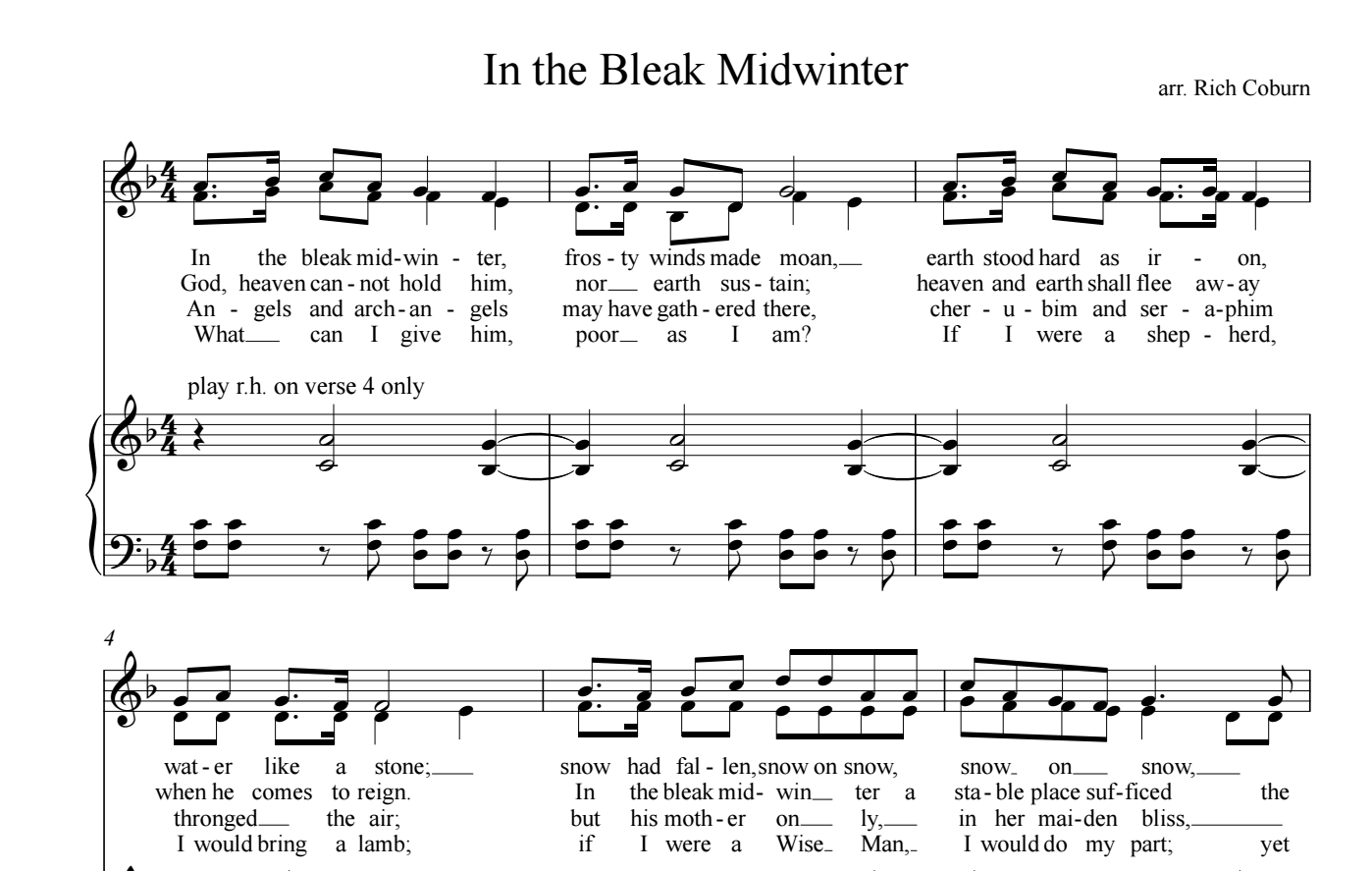
“In the Bleak Midwinter” is a Christmas carol that reflects on the nativity of Jesus Christ and the humility of the setting in which he was born. It describes the bleak and cold midwinter, with imagery of snow and frost, and contrasts it with the warmth and wonder of the Christ child’s arrival. The lyrics evoke a sense of awe and reverence for the birth of Jesus and the significance of that moment in history.
PREVIEW

Christmas Sheet Music

“In the Bleak Midwinter” is a Christmas carol that was written by the English poet Christina Rossetti. It was first published in 1872 as part of a collection of her poems titled “Goblin Market and Other Poems.” The poem has since been set to music by several composers, but the most famous musical setting was composed by Gustav Holst in …

Claude Debussy, a prominent figure in Impressionist music, is celebrated for his innovative compositions that break away from traditional harmonic structures and embrace atmospheric and evocative tonalities. One such enchanting piece is “Noël des Enfants Qui N’ont Plus de Maison” (Christmas Carol for Children Without a Home), a piano work that captures the essence of the holiday season with a …

“Away in a Manger” is a popular Christmas carol that is often sung during the holiday season. It has become a well-loved part of Christmas traditions in many English-speaking countries. The lyrics and tune of this carol have been adapted and arranged in several variations over the years. H

“Here We Come A-Wassailing” is a traditional English Christmas carol. It is also sometimes known as “Here We Come A-Caroling.” The song dates back to the 16th century, and its lyrics have evolved over time. The term “wassailing” refers to the tradition of going door-to-door to sing carols and offer good wishes to neighbors, often in exchange for food, drink, …

“Twas in the Moon of Wintertime,” also known as “Huron Carol,” is a traditional Christmas hymn that originated from the Huron people of Canada. The lyrics were written by Jean de Brébeuf, a Jesuit missionary, in the Huron-Wendat language. The melody is believed to be a French folk tune. The song beautifully depicts the Nativity story with a unique cultural …

“December: Christmas” is the twelfth and final piece in Pyotr Ilyich Tchaikovsky’s collection “The Seasons.” This piece is a musical representation of the Christmas holiday, capturing the festive and joyous atmosphere associated with this time of the year. Tchaikovsky incorporates traditional Christmas themes into the composition, creating a musical portrayal of the joy, warmth, and camaraderie associated with Christmas celebrations.

“Nun komm, der Heiden Heiland, BWV 659” is a chorale prelude composed by Johann Sebastian Bach. It is part of his larger collection of organ works, particularly those that involve chorale settings. The title translates to “Now come, Savior of the Gentiles” in English. The skill level required to play “Nun Komm der Heiden Heiland” on the piano can be …

“We Wish You a Merry Christmas” is a jubilant carol that dates back to the 16th century in England. Its catchy melody and uplifting lyrics make it a favorite during the festive season. The song is characterized by a straightforward yet spirited tune that lends itself beautifully to piano renditions. The original version of “We Wish You a Merry Christmas” …

“I Know That My Redeemer Liveth” is one of the most popular and recognizable movements from Handel’s Messiah. The aria opens with a powerful ascending melody sung by the soprano, conveying a sense of faith and hope. The music shifts between moments of quiet introspection and triumphant pronouncements, reflecting the text’s emotional journey. For pianists aspiring to master “I Know …

“Hark! The Herald Angels Sing” is a song that celebrates the joyous news of the birth of Jesus and is a staple of Christmas carol singing. The combination of Charles Wesley’s poetic lyrics and Felix Mendelssohn’s uplifting melody has made it a timeless favorite during the holiday season.

“Hark! The Herald Angels Sing” is a well-known Christmas carol that has been sung and arranged for various instruments since its inception. Mendelssohn’s original music is jubilant and stately, making it a popular piece during holiday performances. The melody should be played with smooth, lyrical phrasing to reflect the carol’s uplifting and joyful nature. Emphasize dynamic contrasts. Play softly during …

The Arabian Dance, also known as the Coffee Dance, is part of the second act of “The Nutcracker.” Tchaikovsky masterfully incorporates Middle Eastern influences, using rich and evocative melodies to transport listeners to a world of mystery and enchantment. The piano arrangement retains the exotic charm, allowing pianists to express the nuances of the original orchestral score. Pyotr Ilyich Tchaikovsky’s …

“Hark! The Herald Angels Sing” is a popular Christmas carol with lyrics written by Charles Wesley in 1739. The music for the carol was composed by Felix Mendelssohn in 1840. The carol is traditionally sung to celebrate the birth of Jesus Christ and is a staple in Christmas celebrations and church services. The carol goes on to tell the story …

Adventlied, Op. 71 is a setting of a poem by Friedrich Rückert that speaks of the anticipation of the coming of Christ. The text is full of longing and hope, and Schumann’s music captures this mood perfectly. The work is written in a grand and festive style, with soaring melodies and rich harmonies. It is a popular choice for choral …

Pyotr Ilyich Tchaikovsky’s timeless ballet, “The Nutcracker,” is a masterpiece that has captivated audiences for generations. Among its enchanting compositions is the charming “Dance of the Mirlitons,” a delightful piece that translates beautifully onto the piano. The Dance of the Mirlitons, also known as the Reed Flutes, is a whimsical and lively dance that occurs in Act II of The …