
Liszt – Slumber Song

Home » Piano Sheet Music » Liszt – Slumber Song

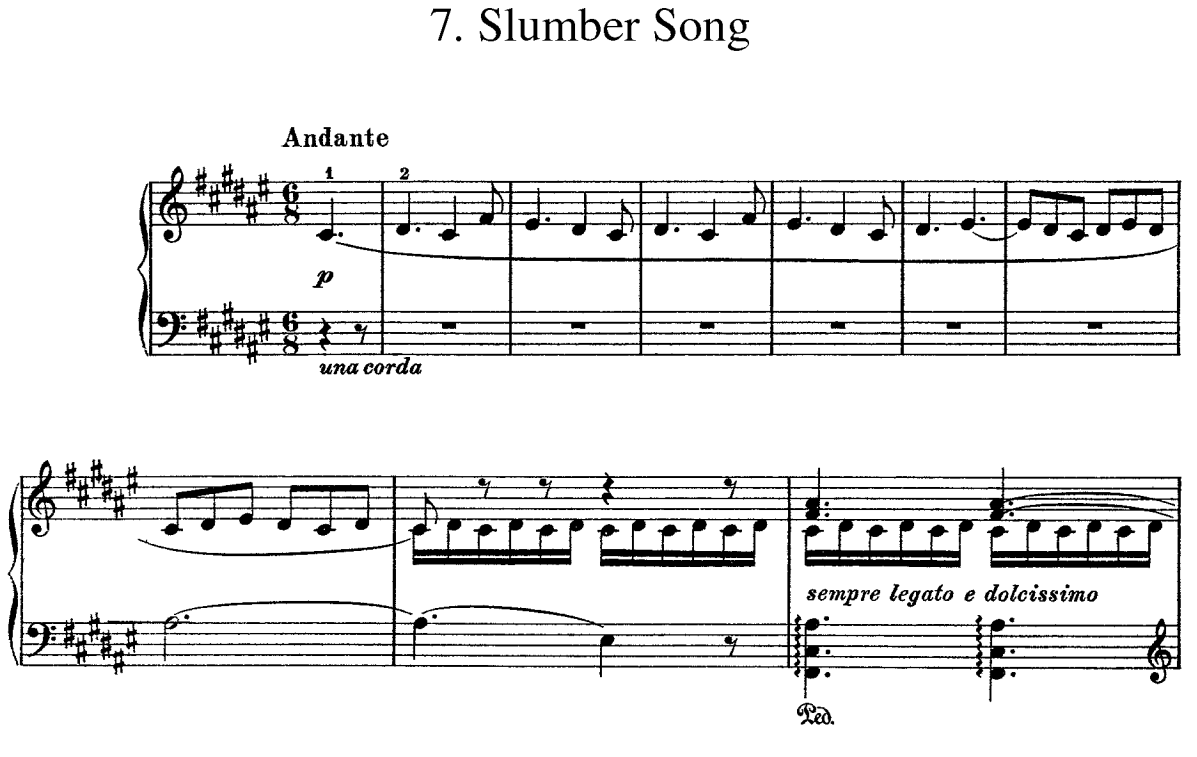
Liszt’s “Slumber Song” is a lovely and tranquil piano composition that showcases the composer’s ability to create delicate and melodic pieces. Although Liszt is often associated with virtuosic and dramatic works, “Slumber Song” is a departure from his more grandiose style, offering a gentle and soothing musical experience.

This composition is part of Liszt’s collection titled “Weihnachtsbaum” (The Christmas Tree), which features 12 short piano pieces, each inspired by various aspects of the Christmas season. “Slumber Song” is evocative of the peaceful moments associated with the holiday season.

In terms of difficulty, “Slumber Song” is well-suited for intermediate to advanced pianists. The piece’s moderate tempo and melodic lines allow intermediate players to delve into Liszt’s world while providing advanced pianists with the opportunity to showcase their interpretive skills. The key lies in capturing the subtleties of the piece, paying attention to phrasing, dynamics, and the delicate balance between the left and right hands.
PREVIEW

Christmas Sheet Music

“O Come, All Ye Faithful” is typically sung in churches and at Christmas gatherings as a way to celebrate the birth of Jesus and express devotion to Him. It has been covered by numerous artists and is a cherished part of the Christmas musical tradition. Arranged for the Flute.

“Hark! The Herald Angels Sing” is often performed with organ accompaniment, and it sounds particularly majestic when played on an organ due to the instrument’s rich and powerful sound. The organ arrangement of the carol can vary in complexity, with some versions featuring intricate harmonies and ornamentation. The music for the carol was composed by Felix Mendelssohn in 1840. The …

“Amazing Grace” is a well-known Christian hymn that has become a classic in the realm of religious and folk music. The lyrics were written by John Newton, a British sailor and former slave trader, and the music is a traditional tune, possibly of Scottish origin. The hymn reflects Newton’s personal spiritual transformation and his understanding of divine grace and forgiveness.

“Ave Maria”- D.839 Op.52 No.6 by Franz Schubert is a timeless and beautiful composition. Composed in 1825 as part of his work titled “Ellens dritter Gesang” (Ellen’s Third Song), it has since become known simply as “Ave Maria.” The lyrics are based on a German translation of Sir Walter Scott’s poem “The Lady of the Lake.” One of the joys …

“Hark! The Herald Angels Sing” is a song that celebrates the joyous news of the birth of Jesus and is a staple of Christmas carol singing. The combination of Charles Wesley’s poetic lyrics and Felix Mendelssohn’s uplifting melody has made it a timeless favorite during the holiday season.

“Silent Night” was composed by Franz Xaver Gruber, an Austrian schoolteacher, in 1818. The lyrics were written by Joseph Mohr, an Austrian priest, in the same year. The carol was first performed on Christmas Eve of 1818 at St. Nicholas Church in Oberndorf bei Salzburg, Austria.

“Rockin’ Around the Christmas Tree” is a popular Christmas song written by Johnny Marks. It was first recorded by Brenda Lee in 1958 when she was just 13 years old, and it has since become a holiday classic. The song’s lively and upbeat melody, combined with its lyrics about holiday festivities and dancing, makes it a fun and festive addition …

“Silver Bells” is a classic Christmas song written by Jay Livingston and Ray Evans. It was first performed by Bob Hope and Marilyn Maxwell in the 1951 film “The Lemon Drop Kid.” The song is known for its cheerful and festive lyrics, which evoke the joyful atmosphere of the holiday season in a bustling city. The original version of “Silver …

The carol “The First Nowell” is a beautiful and reverent song that reflects the wonder and adoration surrounding the birth of Jesus. It is often sung in church services and during Christmas celebrations, and its timeless message of the nativity story continues to resonate with people during the holiday season. “The First Noel” offers a delightful journey for violinists of …

“Good King Wenceslas” is a Christmas carol that tells the story of a generous and kind-hearted Bohemian king who braved harsh winter weather to provide charity to a poor peasant. The lyrics, penned by John Mason Neale in the 19th century, are set to the melody of a 13th-century spring carol called “Tempus adest floridum.” The combination of the heartwarming …

“Carol of the Bells” is a popular Christmas carol with a distinctive and recognizable melody. The music for this carol was composed by Mykola Leontovych, a Ukrainian composer, in 1914. The original composition is titled “Shchedryk,” which means “The Generous One” in Ukrainian and refers to a traditional Ukrainian folk chant that welcomed the New Year.

“Angels We Have Heard on High” is a traditional Christmas carol with French origins. The English lyrics were written by James Chadwick, an English Roman Catholic bishop, in the mid-19th century. The music for “Angels We Have Heard on High” is based on the traditional French melody of “Gloria in excelsis Deo,” which means “Glory to God in the Highest.” …

Franz Liszt’s “Carillon” is a delightful and evocative piano composition. Liszt, a prominent figure in the Romantic era of classical music, composed this piece as part of his larger work titled “Années de pèlerinage” (Years of Pilgrimage). “Années de pèlerinage” is a collection of three suites for solo piano, and “Carillon” is part of the first suite, “Suisse” (Switzerland). “Carillon” …

“German Dance, K.605 No.3” or “Sleigh Ride” or in German “Die Schlittenfahrt” from the set of Three German Dances, K.605 is a lively and festive composition that captures the joyful spirit of a sleigh ride. Arranged for violin.

Pyotr Ilyich Tchaikovsky’s timeless ballet, “The Nutcracker,” is a masterpiece that has captivated audiences for generations. Among its enchanting compositions is the charming “Dance of the Mirlitons,” a delightful piece that translates beautifully onto the piano. The Dance of the Mirlitons, also known as the Reed Flutes, is a whimsical and lively dance that occurs in Act II of The …