
Gabriel’s Message

Home » Piano Sheet Music » Gabriel’s Message

“Gabriel’s Message” is a Christmas carol based on the biblical story of the Annunciation, where the angel Gabriel delivers the message to the Virgin Mary that she will conceive and give birth to Jesus, the Son of God. The carol is also known as “The Angel Gabriel from Heaven Came.”

“Gabriel’s Message” is a piece that accommodates a range of skill levels, making it accessible to both intermediate and advanced pianists. The composition’s moderate tempo and relatively simple harmonic structure provide an excellent opportunity for intermediate players to refine their expressive playing and dynamic control. More advanced pianists can delve deeper into the nuances of the piece, adding personal interpretations and embellishments to elevate the performance.
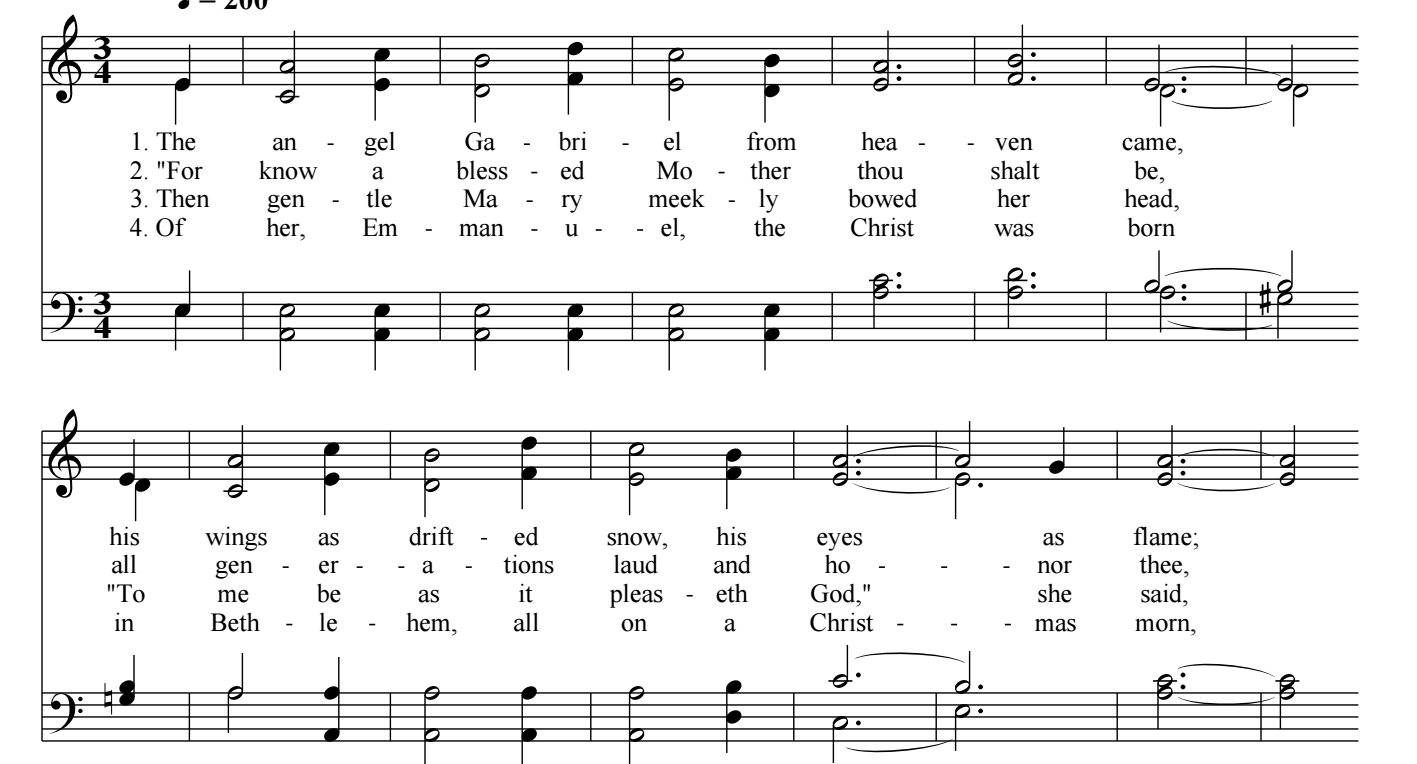
PREVIEW

Christmas Sheet Music

“O Sanctissima,” also known as “O du fröhliche,” is a hymn and carol dedicated to the Virgin Mary. The text of the hymn is attributed to the German poet and priest Fr. Caspar Stollhofen, who lived in the 17th century. The music is often associated with the Sicilian folk tune “O sanctissima,” and it has been used in various musical …

Handel’s Hallelujah Chorus, a masterpiece from his oratorio “Messiah,” is a celebrated piece that has resonated through the ages. While originally composed for a full orchestra and choir, the transcendent beauty of the piece can be captured on a single instrument, such as the violin. Playing Handel’s Hallelujah on the violin requires a certain level of skill and technique, making …

Peter J. Wilhousky wrote the lyrics and music for “Carol of the Russian Children” in 1936. He is the same composer who adapted the Ukrainian folk chant “Shchedryk” (sometimes spelled “Shchedrik”) to create the English version of “Carol of the Bells.” The lyrics of “Carol of the Russian Children” celebrate the beauty of the Russian landscape, particularly the valleys and …

“From Heaven Above to Earth I Come” is a Christmas hymn with lyrics attributed to Martin Luther. Luther wrote this hymn in the early 16th century, and it has since become a cherished part of the Christmas musical tradition. The hymn narrates the story of the Nativity, with an emphasis on the humility and divine purpose of Jesus’ birth. It …

“Ave Maria” in A major is part of his larger work, the “Six Duets for Two Voices and Organ,” Op. 10. This collection includes settings of various sacred texts, and the “Ave Maria” in A major is one of the pieces within this set. These duets were composed in 1858 and showcase Saint-Saëns’s mastery of choral writing and his ability …

Good King Wenceslas is a popular Christmas carol that tells the story of the 10th-century Duke of Bohemia, Wenceslas I, who was later canonized as a saint. The carol’s lyrics were written by John Mason Neale in 1853, and the tune is based on a 13th-century spring carol, “Tempus adest floridum” (“The time is near for flowering”). The melody has …

“O Come, All Ye Faithful,” also known as “Adeste Fideles” in Latin, is a classic Christmas carol. The original Latin text is attributed to John Francis Wade, an 18th-century hymnist, and the English translation is often attributed to Frederick Oakeley. The melody is believed to have been written by John Reading in the 18th century. It is typically performed in …

“I Heard the Bells on Christmas Day” is a Christmas carol with lyrics written by the American poet Henry Wadsworth Longfellow. The poem was initially composed on December 25, 1863, during the American Civil War. Longfellow had experienced personal tragedy, with his son Charles severely wounded in the war, and he was deeply affected by the state of the nation. …

“What Child Is This?” is a Christmas carol with lyrics written by William Chatterton Dix in 1865. The lyrics are set to the tune of the traditional English folk song “Greensleeves.” The carol focuses on the birth of Jesus Christ and reflects on the significance of His arrival. To play “What Child Is This” on the piano, a pianist should …

“O Nata Lux de Lumine” or “O Light Born of Light” is a hymn often associated with the Christian liturgy, particularly the office of Compline. It is commonly used during the Advent season.

“Jesus Christ the Apple Tree” is a popular English hymn that dates back to the 18th century. The lyrics of this hymn are often attributed to an unknown author. It is sometimes referred to as “The Apple-Tree Song” or simply “The Apple Tree.” The hymn uses the metaphor of an apple tree to represent Jesus Christ, drawing parallels between the …

Adventlied, Op. 71 is a setting of a poem by Friedrich Rückert that speaks of the anticipation of the coming of Christ. The text is full of longing and hope, and Schumann’s music captures this mood perfectly. The work is written in a grand and festive style, with soaring melodies and rich harmonies. It is a popular choice for choral …

Camille Saint-Saëns’ “Christmas Oratorio” (Oratorio de Noël), Op. 12, is a beautifully crafted sacred work for choir, soloists, and small orchestra. Composed in 1858, it is often performed during the Advent or Christmas season and is notable for its lyrical and serene character. The piece features 10 movements, and it is imbued with a sense of warmth and intimacy rather …

“Christmas Chimes” (Juleklokkerne in Danish) is one of Gade’s compositions, and it’s a festive piece that captures the spirit of the holiday season. It’s often performed during Christmas concerts and celebrations. Niels Gade was a prominent Romantic composer, conductor, and violinist, known for his contributions to Danish music in the 19th century. Christmas Chimes Op.36 No.1 is well-suited for intermediate …

“Good Christian Men, Rejoice” is a traditional Christmas carol that is often sung during the holiday season. It is also sometimes known as “In Dulci Jubilo” based on its original Latin text. The carol is a celebration of the birth of Jesus Christ and calls upon Christians to rejoice and be glad.