
Pietro Yon – Gesu Bambino

Home » Piano Sheet Music » Pietro Yon – Gesu Bambino

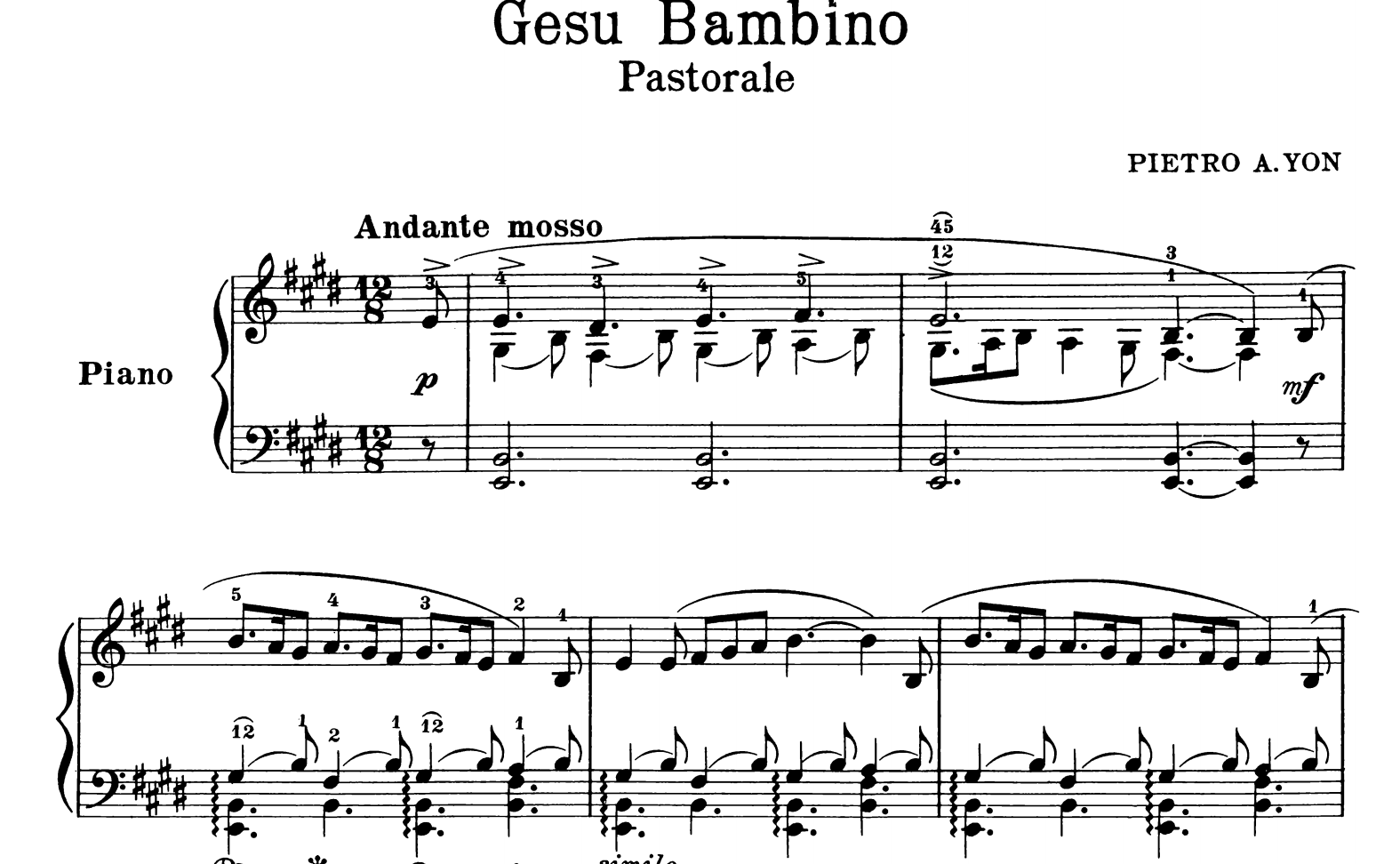
“Gesù Bambino” is a beautiful Christmas carol composed by Pietro Yon in 1917. The title translates from Italian to “Baby Jesus” in English. This piece is particularly well-known for its lyrical and expressive qualities, making it a cherished addition to the repertoire of Christmas music.

The piece requires a pianist to convey a sense of innocence, tenderness, and celebration. While the composition itself is not overly complex, it does demand a degree of technical proficiency, especially in achieving a balanced and expressive interpretation. Pianists should pay attention to dynamics, phrasing, and nuanced expression to bring out the emotive qualities embedded in the music.

Intermediate to advanced pianists will find “Gesù Bambino” to be a rewarding challenge. The piece includes arpeggiated passages, delicate ornamentation, and moments of dynamic contrast, all of which contribute to its charm. A solid understanding of finger control, pedaling, and a nuanced touch will allow the performer to fully capture the spirit of the composition.
PREVIEW

Christmas Sheet Music

“Once in Royal David’s City” is a popular Christmas carol that is often sung during the Christmas season. It was written by the English poet Cecil Frances Alexander and was first published in 1848. The hymn is typically sung to the tune “Irby,” which was composed by Henry John Gauntlett.

“Angels We Have Heard on High” is a traditional Christmas carol with French origins. The English lyrics were written by James Chadwick, an English Roman Catholic bishop, in the mid-19th century. The music for “Angels We Have Heard on High” is based on the traditional French melody of “Gloria in excelsis Deo,” which means “Glory to God in the Highest.” …

“Frosty the Snowman” was written by Walter “Jack” Rollins and Steve Nelson. They composed the song in 1950. The song tells the story of Frosty, a snowman who comes to life when a magical hat is placed on his head. Frosty then leads the children in the song on various adventures before eventually melting away, promising to return again someday. …

“I Heard the Bells on Christmas Day” is a Christmas carol with lyrics written by the American poet Henry Wadsworth Longfellow. The poem was initially composed on December 25, 1863, during the American Civil War. Longfellow had experienced personal tragedy, with his son Charles severely wounded in the war, and he was deeply affected by the state of the nation. …

“The Christmas Song” is a classic Christmas song written by Mel Tormé and Bob Wells. It was first composed in 1945 and has since become one of the most iconic and beloved Christmas songs of all time. The song is also known by its opening line, “Chestnuts roasting on an open fire.” The original version of “The Christmas Song” is …

Frank Loesser wrote “Baby, It’s Cold Outside” in 1944. The song features a playful and flirtatious duet between a man (referred to as “the Wolf” in the original sheet music) and a woman (referred to as “the Mouse”). In the song, the woman is expressing her reluctance to leave the man’s company due to the cold weather outside, while the …

“Deck the Halls” is a Welsh carol that dates back to the 16th century. The melody is believed to have originated from a traditional Welsh New Year’s Eve carol called “Nos Galan.” The song is known for its cheerful lyrics that celebrate the holiday season and the spirit of Christmas. The refrain “Fa-la-la-la-la, la-la-la-la” is a distinctive and memorable part …

Also known as “See Amid the Winter’s Snow” is often sung in church services, caroling events, and Christmas concerts. Its gentle melody and lyrics capture the reverence and wonder of the Christmas story, making it a cherished carol during the holiday season.

“Silent Night,” the beloved Christmas carol composed by Franz Xaver Gruber in 1818, is cherished for its gentle melody and timeless sense of peace. Playing this carol on the cello allows musicians to evoke its deep warmth and calm beauty. “Silent Night” is an excellent piece for beginner cellists due to its slow tempo, simple melody, and opportunities to develop …

This masterpiece, also known as “Concerto Grosso in G minor, Op. 6, No. 8,” holds a special place in the repertoire of Baroque music. Composed by Arcangelo Corelli around 1690, this concerto is part of his renowned set of twelve concerti grossi. Corelli’s Christmas Concerto has remained a popular choice for holiday performances, admired for its exuberance and the timeless …

“Now Praise We Christ, the Holy One” is a hymn that carries a deep sense of reverence and praise for Jesus Christ. As a traditional Christian hymn, it is often sung in worship services and celebrations of the Christian faith. Written during the Baroque era, “Now Praise We Christ, the Holy One” is a chorale prelude, a form of composition …

The composition is scored for voice and piano or organ, and it often features a solo vocalist accompanied by the rich harmonies of the keyboard instrument. The lyrics, written by Frederick H. Martens, narrate the story of the Nativity, celebrating the birth of Jesus Christ. The music, with its serene and tender melodies, captures the joy and reverence associated with …

“Shepherds, Shake Off Your Drowsy Sleep” is a traditional Christmas carol. The song’s lyrics encourage shepherds to wake up and go to Bethlehem to witness the birth of Jesus. The carol reflects the Biblical account of the shepherds who were visited by angels and instructed to go and see the newborn Christ. Due to the technical demands and the need …

“Ave Maria”- D.839 Op.52 No.6 by Franz Schubert is a timeless and beautiful composition. Composed in 1825 as part of his work titled “Ellens dritter Gesang” (Ellen’s Third Song), it has since become known simply as “Ave Maria.” The lyrics are based on a German translation of Sir Walter Scott’s poem “The Lady of the Lake.” While “Ave Maria” is …

“O Sanctissima,” also known as “O du fröhliche,” is a hymn and carol dedicated to the Virgin Mary. The text of the hymn is attributed to the German poet and priest Fr. Caspar Stollhofen, who lived in the 17th century. The music is often associated with the Sicilian folk tune “O sanctissima,” and it has been used in various musical …