
O Come All Ye Faithful

Home » Cello Sheet Music » O Come All Ye Faithful

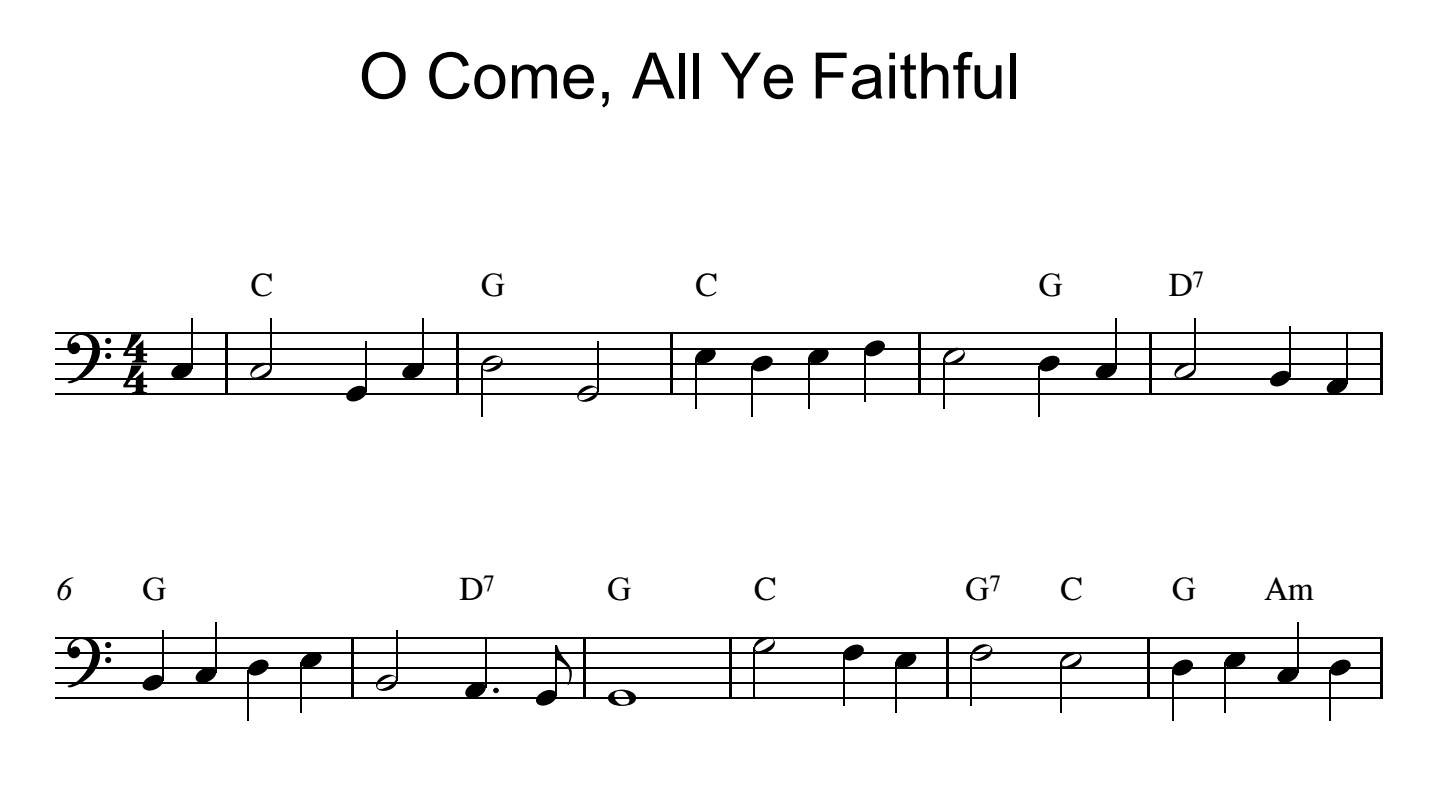
The melody of “O Come, All Ye Faithful” is lyrical and flowing, which suits the cello’s natural singing tone. Focus on making each phrase sound vocal, as though you are singing through the instrument.

Start gently and build towards the climactic phrase “O come, let us adore Him.” Use controlled crescendos to bring warmth and richness to the tune, especially in celebratory moments. For the more upbeat passages, you can slightly accent the first beat of each measure to give the piece a majestic feel, reflecting the celebratory nature of the hymn.

By focusing on expressive playing, dynamic contrast, and smooth bowing, you can bring out the beautiful, reverent character of “O Come, All Ye Faithful” on the cello. This carol’s simple yet powerful melody offers the perfect opportunity to showcase the warmth and depth of the cello’s sound during the holiday season.
PREVIEW

Christmas Sheet Music

Carl Thiel (1902–1982) was a German composer and arranger known for his contributions to piano music. Thiel’s arrangements often featured a delicate balance of technical proficiency and emotional expressiveness, making them accessible to a wide range of pianists. Carl Thiel’s arrangement of “In Dulci Jubilo” for piano is a delightful and uplifting piece that brings the joy of the holiday …

“In Dulci Jubilo,” which translates to “In Sweet Rejoicing,” is a traditional German carol that dates back to the 14th century. Its jubilant melody and lively rhythm make it a perfect choice for violinists seeking to showcase their skills while spreading holiday cheer. The piece is characterized by its dance-like quality, combining elements of medieval and Renaissance music with a …

The traditional Christmas carol “Far, Far Away on Judea’s Plains” is often attributed to John Menzies Macfarlane, a Scottish-born Canadian composer and music educator. He lived during the 19th and 20th centuries and is known for his contributions to choral and vocal music. “Far, Far Away on Judea’s Plains” is a hymn that reflects on the nativity story and is …

This composition, like the others in the Weihnachtsbaum collection, is characterized by its evocative melody and the use of harmonies that create a sense of tranquility and nostalgia. Liszt’s mastery of the piano is evident in the delicate and expressive way he presents this piece. One of the primary challenges of performing “Evening Bells” lies in capturing the delicate balance …

Franz Liszt’s “An Old Christmas Carol” is a charming and evocative piano composition. It is a part of Liszt’s larger work, “Weihnachtsbaum” (The Christmas Tree), which is a collection of 12 short piano pieces, each inspired by various aspects of the Christmas season. The composition itself is characterized by its melodic richness and harmonic depth. Liszt weaves a familiar Christmas …

“Angels from the Realms of Glory” is a traditional Christmas carol that is often sung during the holiday season. The lyrics were written by James Montgomery in 1816, and the music is usually set to the tune “Regent Square,” composed by Henry Thomas Smart in 1867.

Also known as “See Amid the Winter’s Snow” is a traditional Christmas carol with lyrics written by Edward Caswall and music composed by Sir John Goss. It was first published in 1854. This carol is known for its serene and reflective lyrics that tell the story of the birth of Jesus Christ and the adoration of the shepherds and angels. …

“O Come, All Ye Faithful” is a popular Christmas carol with lyrics attributed to John Francis Wade, and it is often sung to the tune known as “Adeste Fideles.” The carol is also sometimes referred to by its Latin incipit, “Adeste Fideles.” The melody of “O Come, All Ye Faithful” is relatively straightforward, making it accessible to a broad range …

Bartók’s Romanian Christmas Songs is a delightful collection comprising six pieces, each a musical gem reflecting the festive traditions of Romania. The composer’s keen interest in folk music is evident in the use of modal scales, rhythmic intricacies, and the incorporation of rustic dance elements. From the lively and celebratory “Dance of the Bagpipes” to the contemplative and haunting “Pillow …

“Frosty the Snowman” was written by Walter “Jack” Rollins and Steve Nelson. They composed the song in 1950. The song tells the story of Frosty, a snowman who comes to life when a magical hat is placed on his head. Frosty then leads the children in the song on various adventures before eventually melting away, promising to return again someday. …

Good King Wenceslas is a popular Christmas carol that tells the story of the 10th-century Duke of Bohemia, Wenceslas I, who was later canonized as a saint. The carol’s lyrics were written by John Mason Neale in 1853, and the tune is based on a 13th-century spring carol, “Tempus adest floridum” (“The time is near for flowering”). The melody has …

The Arabian Dance, also known as the Coffee Dance, is part of the second act of “The Nutcracker.” Tchaikovsky masterfully incorporates Middle Eastern influences, using rich and evocative melodies to transport listeners to a world of mystery and enchantment. The piano arrangement retains the exotic charm, allowing pianists to express the nuances of the original orchestral score. Pyotr Ilyich Tchaikovsky’s …

This masterpiece, also known as “Concerto Grosso in G minor, Op. 6, No. 8,” holds a special place in the repertoire of Baroque music. Composed by Arcangelo Corelli around 1690, this concerto is part of his renowned set of twelve concerti grossi. Corelli’s Christmas Concerto has remained a popular choice for holiday performances, admired for its exuberance and the timeless …

The piece is part of Berlioz’s larger work, the oratorio “L’Enfance du Christ” (The Childhood of Christ). “Sérénade agreste à la Madone” is the final movement of Part II of the oratorio. It depicts the shepherds bidding farewell to the Holy Family as they flee to Egypt. Adapting orchestral compositions for the piano is no easy task, and yet, the …

Daquin’s compositions are known for their expressive and emotive qualities. In the “Livre de Noëls,” he effectively captures the joy and spirit of the Christmas season through his inventive use of musical devices. Daquin’s “Livre de Noëls” is considered an important contribution to the French Baroque keyboard repertoire. It provides valuable insights into the musical tastes and practices of the …