
Pachelbel – Canon in D

Home » Cello Sheet Music » Pachelbel – Canon in D

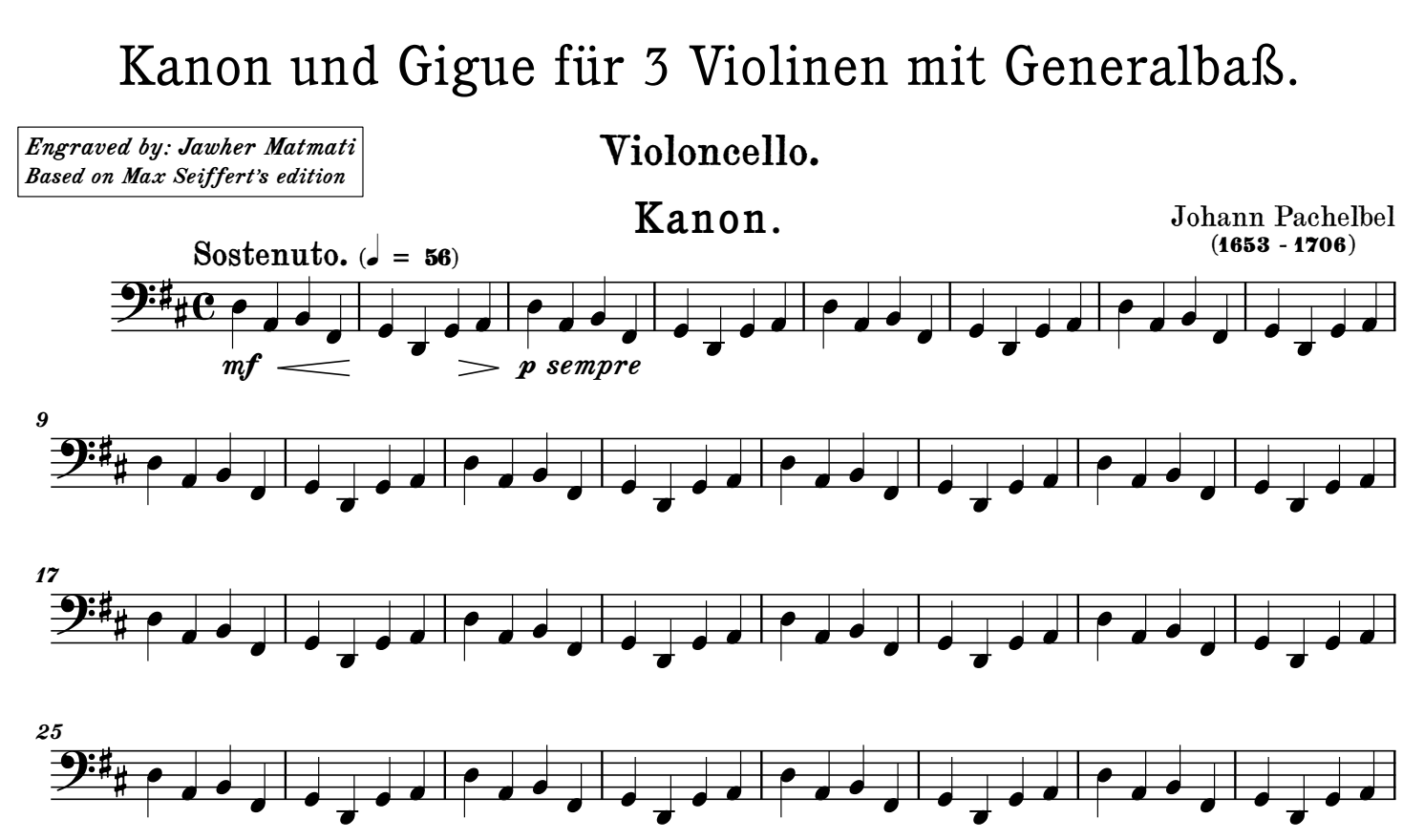
Pachelbel’s Canon in D Major is one of the most famous and recognizable pieces in Western classical music. Composed by Johann Pachelbel (1653–1706), this baroque masterpiece has become iconic, especially in weddings and other ceremonial settings.

The “Canon” in D Major is written in a form known as canon or round. This means that a musical line is introduced by one voice and then imitated in exact intervals by other voices. In this case, the canon involves three violins playing imitative counterpoint over a ground bass—a repeating bass line played by the basso continuo (often a cello or harpsichord). To play the repeating bass line beautifully, focus on smooth bowing with little interruption between the notes. The long legato lines in the ground bass should be fluid.
PREVIEW

Free Cello Sheet Music

“Away in a Manger” is a traditional Christmas carol, often associated with nativity celebrations. Its origins are somewhat disputed, with the first two verses historically attributed to Martin Luther, though this claim is debated. The melody, most commonly associated with this carol, comes in two popular versions: one by William J. Kirkpatrick (1887) and another by James R. Murray (1885). …

Good King Wenceslas is a popular Christmas carol that tells the story of the 10th-century Duke of Bohemia, Wenceslas I, who was later canonized as a saint. The carol’s lyrics were written by John Mason Neale in 1853, and the tune is based on a 13th-century spring carol, “Tempus adest floridum” (“The time is near for flowering”). The melody has …

The Sussex Mummers’ Christmas Carol is a traditional English Christmas carol, often performed during the holiday season. This carol is characterized by its lively melody and festive spirit, making it a popular choice for both choral and instrumental arrangements. The carol has roots in the Sussex region of England and is associated with the local Christmas traditions and mummers’ plays, …

Bach’s Christmas Oratorio is a monumental work composed for the Christmas season, celebrating the birth of Christ through vibrant choruses, arias, and recitatives. It is written for a full choir, soloists, and orchestra, with text from the Gospels of Luke and Matthew, and draws on both sacred and secular themes. The six parts of the oratorio each have their own …

Camille Saint-Saëns’ “Christmas Oratorio” (Oratorio de Noël), Op. 12, is a beautifully crafted sacred work for choir, soloists, and small orchestra. Composed in 1858, it is often performed during the Advent or Christmas season and is notable for its lyrical and serene character. The piece features 10 movements, and it is imbued with a sense of warmth and intimacy rather …

“Jingle Bells” is one of the most famous and widely recognized Christmas songs in the world. Written by James Lord Pierpont in 1857, it was originally intended to be a Thanksgiving song, but its catchy melody and festive lyrics made it a favorite during the Christmas season. Playing “Jingle Bells” on the cello can be fun and a great way …

Pachelbel’s Canon in D Major is one of the most famous and recognizable pieces in Western classical music. Composed by Johann Pachelbel (1653–1706), this baroque masterpiece has become iconic, especially in weddings and other ceremonial settings. The “Canon” in D Major is written in a form known as canon or round. This means that a musical line is introduced by …

“Joy to the World” is a classic Christmas carol often arranged for a variety of instruments, including the cello. The rich and resonant tones of the cello can bring a deep, soulful quality to this joyous melody. The melody commonly associated with “Joy to the World” was arranged by Lowell Mason in 1836, an American music educator and composer. He …

“Ding Dong Merrily on High” is a traditional Christmas carol with a lively, joyful tune. The melody dates back to the 16th century, composed by French composer Jehan Tabourot, and the lyrics were later added in the 19th century by English composer George Ratcliffe Woodward. The carol is known for its uplifting melody and distinctive “Gloria” refrain. “Ding Dong Merrily …

“Hark! The Herald Angels Sing” is a well-known Christmas carol that has been sung and arranged for various instruments since its inception. Mendelssohn’s original music is jubilant and stately, making it a popular piece during holiday performances. The melody should be played with smooth, lyrical phrasing to reflect the carol’s uplifting and joyful nature. Emphasize dynamic contrasts. Play softly during …

The Coventry Carol is a traditional English Christmas carol dating back to the 16th century. It was originally part of a mystery play called The Pageant of the Shearmen and Tailors, which depicted the biblical story of the Massacre of the Innocents, where King Herod ordered the killing of male infants. The carol is a haunting lullaby sung by mothers …

“Silent Night,” the beloved Christmas carol composed by Franz Xaver Gruber in 1818, is cherished for its gentle melody and timeless sense of peace. Playing this carol on the cello allows musicians to evoke its deep warmth and calm beauty. “Silent Night” is an excellent piece for beginner cellists due to its slow tempo, simple melody, and opportunities to develop …

“We Wish You a Merry Christmas” is a traditional English Christmas carol that dates back to the 16th century. It’s a joyful and lively song that’s popular during the holiday season. The melody is relatively simple and repetitive, making it a great choice for beginner to intermediate cellists who are looking for festive repertoire. Since this piece has a lively …

“The Holly and the Ivy” is a traditional English Christmas carol that dates back to the 18th century. It celebrates the symbolism of holly and ivy in Christian traditions, where holly represents Jesus and his suffering (the sharp leaves symbolizing the crown of thorns, and the red berries his blood), while ivy symbolizes the Virgin Mary. Since “The Holly and …

“Deck the Halls” is a well-known traditional Christmas carol with Welsh origins, dating back to the 16th century. Its lively and festive melody is perfect for the holiday season. The carol is in a major key and follows a cheerful, upbeat rhythm, making it popular for group performances. Use smooth legato bowing for the longer phrases and short, crisp staccato …